What Is Tokenization: How to Secure Data Without Storing It
Tokenization replaces sensitive data with useless values, ensuring that even a total system compromise yields no usable information for attackers.

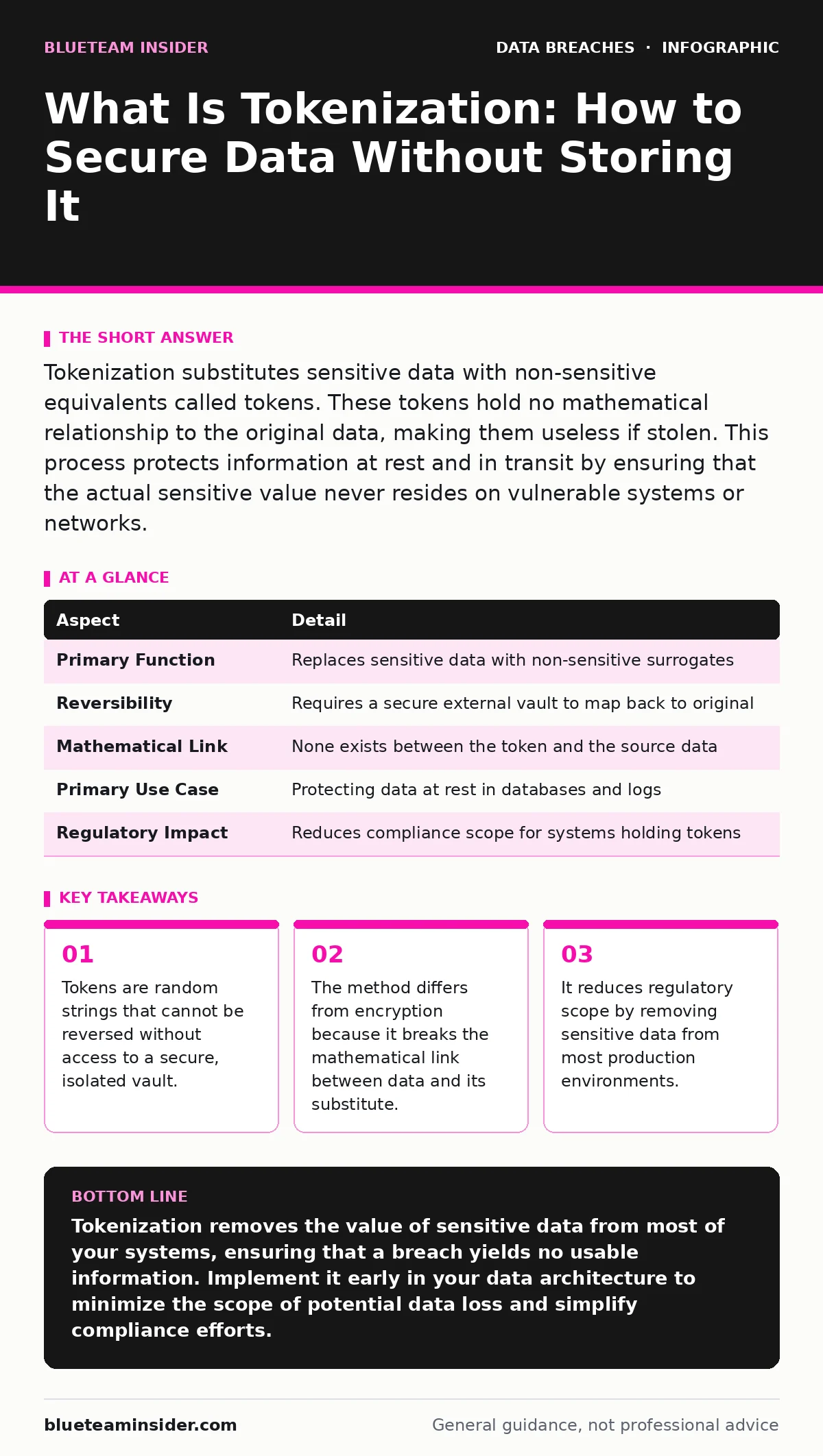
Tokenization substitutes sensitive data with non-sensitive equivalents called tokens. These tokens hold no mathematical relationship to the original data, making them useless if stolen. This process protects information at rest and in transit by ensuring that the actual sensitive value never resides on vulnerable systems or networks.
The Core Concept of Data Substitution
Imagine you hand a cashier your credit card. Instead of swiping the magnetic strip directly into a public terminal, they enter a random code into their system. That code works for the transaction, but it tells no one about your account number. If someone watches the screen, they see only a meaningless string of characters. This is the fundamental logic behind tokenization.
Tokenization is the process of replacing sensitive data with a non-sensitive equivalent, known as a token. The token serves as a placeholder that allows systems to process transactions or references without handling the actual sensitive value. Crucially, the token has no intrinsic value. It cannot be used to derive the original data through mathematical calculation or reverse engineering.
This mechanism solves a specific problem: the risk of storing sensitive data on systems that must be connected to the internet or accessed by many users. By removing the sensitive data from these environments, you eliminate the prize for attackers. If a hacker breaches a database, they find only tokens. Without the separate, secure component that maps tokens to original values, the stolen data is worthless.
| Aspect | Detail |
|---|---|
| Primary Function | Replaces sensitive data with non-sensitive surrogates |
| Reversibility | Requires a secure external vault to map back to original |
| Mathematical Link | None exists between the token and the source data |
| Primary Use Case | Protecting data at rest in databases and logs |
| Regulatory Impact | Reduces compliance scope for systems holding tokens |
How It Differs From Encryption
Many readers assume tokenization is just a form of encryption. It is not. Encryption transforms data using a mathematical algorithm and a key. Given the key, anyone can decrypt the data back to its original form. The encrypted text retains a structural relationship to the source. An encrypted credit card number might always have the same length and format as the original.
Tokenization breaks this relationship entirely. A token for a sixteen-digit card number might be a thirty-character string of random letters and numbers. It carries no format preservation unless specifically designed to do so, and even then, the value is random. There is no key to reverse the process. To get the original data back, you must query a secure token vault. This vault holds the mapping between the token and the original value.
This distinction matters for defense strategy. Encryption protects data everywhere it travels. Tokenization protects data where it sits. You often use both. You might encrypt the connection between your application and the token vault. But the data sitting in your main database is tokenized. This layered approach ensures that a breach of the database does not lead to a breach of the sensitive data. For deeper technical comparisons, see our guide on data masking.
The Architecture of a Tokenization System
A functional tokenization setup requires three distinct components. You cannot implement it with a simple software patch on a single server. The separation of duties is what provides the security benefit.
- The Tokenization Engine: This component receives the sensitive data, generates the token, and stores the mapping. It must be highly secure and isolated from the general network.
- The Token Vault: This is the secure storage for the mapping between tokens and original values. It is the only place where the sensitive data exists in plaintext. Access to this vault is strictly controlled.
- The Application Interface: This is the part of your system that interacts with users or other systems. It sends sensitive data to the engine and receives tokens. It then uses those tokens for business logic, such as looking up a customer’s purchase history.
The security of this system relies on the isolation of the vault. If an attacker breaches your application server, they obtain tokens. They cannot access the vault because it is on a separate, heavily restricted network segment. This architecture mirrors the principles found in secure user access provisioning, where permissions are granted based on need and isolated from general administrative rights.
Where Tokenization Fits in Your Defense
Tokenization is not a standalone solution. It is a specific tool for a specific job: protecting data at rest. It does not stop an attacker from entering your network. It does not prevent them from stealing files. It only ensures that the files they steal do not contain sensitive information.
You should combine tokenization with other controls. For example, if an employee leaves the company, you must revoke their access to the systems that hold the tokens. This is part of routine access reviews. If you do not manage access properly, an insider could potentially access the token vault or the logging systems that might accidentally capture sensitive data before it is tokenized.
Consider the scenario of lost and stolen devices. If a laptop contains only tokens, the physical loss of the device is less damaging. The data on the hard drive is useless without the vault. However, if that laptop also holds encryption keys or credentials to access the vault, the protection fails. Tokenization reduces the impact of hardware loss, but it does not eliminate the need for device encryption and strong authentication.
Common Misconceptions About Security
One common mistake is assuming that tokenization makes data anonymous. It does not. The token is still linked to a specific individual within the system. If you combine the token with other data, such as purchase history or location, you can still build a profile. Tokenization protects the sensitive value itself, not the privacy of the association between data points.
Another error is believing that tokenization eliminates all compliance requirements. Regulations like GDPR or PCI-DSS still apply to the token vault and the processes that handle data before and after tokenization. You must secure the pipeline. If you log the sensitive data before it enters the tokenization engine, you have created a vulnerability. The protection only works if the sensitive data never touches unsecured storage.
Some organizations try to build their own tokenization logic to save costs. This is dangerous. Custom implementations often fail to handle edge cases, such as duplicate values or format preservation requirements. They also lack the rigorous testing and isolation of commercial or standardized solutions. Relying on established standards and secure frameworks is safer than rolling your own cryptography or mapping logic.
See also: Data Exfiltration Meaning: How Attackers Steal Your Data · Data Minimization Meaning: How Less Data Stops Breaches
Practical Implementation Challenges
Implementing tokenization requires changes to your application code. Your systems must be designed to send data to the tokenization engine and receive tokens in return. This adds latency. Every transaction now involves a network call to the engine. In high-volume systems, this can become a bottleneck.
You must also manage the lifecycle of tokens. What happens if a customer cancels their card? The old token must be invalidated. The system must handle these updates seamlessly. If the mapping is not updated correctly, transactions may fail, or old data may be used incorrectly. This requires careful coordination between the business logic and the security infrastructure.
For organizations dealing with significant data exposure, consider how this fits into broader risk management. For instance, cyber insurance policies may view tokenization favorably, as it reduces the likelihood of a major data loss event. However, insurers will still require strong access controls and regular backup testing to ensure the token vault itself is resilient.
Integrating With Existing Security Controls
Tokenization works best when integrated with a broader security strategy. It complements identity theft protection services by reducing the amount of data available to steal. It supports employee data breaches policies by limiting the impact of insider threats. If an employee has access to the database, they see only tokens. They cannot exfiltrate usable customer data.
However, it does not replace the need for strong identity management. You must ensure that only authorized systems and users can request tokenization or detokenization. This ties back to identity and access management principles. Weak passwords or poor multi-factor authentication on the administration console for the token vault can undermine the entire system.
The goal is to create a environment where sensitive data is rare and heavily guarded. Tokenization pushes sensitive data out of the common areas of your IT infrastructure. It forces attackers to focus on the most secure part of your system. This makes their job harder and increases the chance of detection.
Key takeaways
- Tokens are random strings that cannot be reversed without access to a secure, isolated vault.
- The method differs from encryption because it breaks the mathematical link between data and its substitute.
- It reduces regulatory scope by removing sensitive data from most production environments.
Tokenization removes the value of sensitive data from most of your systems, ensuring that a breach yields no usable information. Implement it early in your data architecture to minimize the scope of potential data loss and simplify compliance efforts.
Frequently asked questions
Can tokenization be reversed?
Yes, but only through a secure, authorized process that queries the token vault. The token itself cannot be mathematically reversed to reveal the original data.
Is tokenization the same as anonymization?
No. Anonymization removes all identifying information permanently. Tokenization replaces data with a reversible surrogate, maintaining the ability to retrieve the original value if needed.
Does tokenization protect against SQL injection?
No. Tokenization protects the data stored in the database. SQL injection is an attack on the application logic. You must still use parameterized queries and input validation to prevent injection attacks.
What data should be tokenized?
Any data that is sensitive, regulated, or high-value, such as payment card numbers, social security numbers, or health records. Tokenize data that needs to be referenced but not always viewed in its original form.
How this guide was produced: written by the BlueTeam Insider editorial team with AI assistance, checked against the public references listed below, and reviewed when the facts change. See our editorial policy or report an error.