Stop Payment Card Theft: 5 Proven Prevention Measures
Most payment card theft succeeds because systems store full card numbers instead of using tokenization, making data masking the most effective defense against exfiltration.
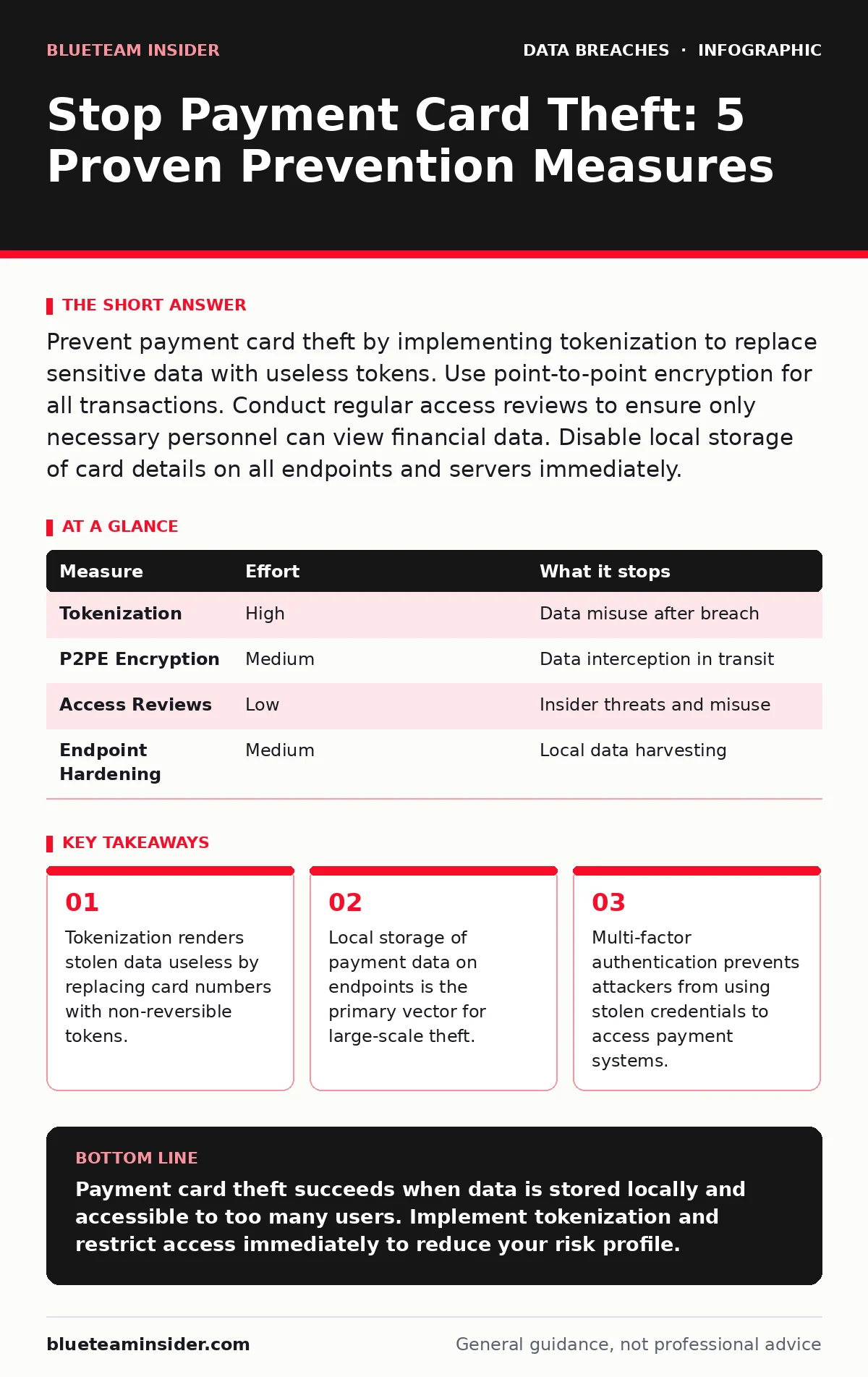
Prevent payment card theft by implementing tokenization to replace sensitive data with useless tokens. Use point-to-point encryption for all transactions. Conduct regular access reviews to ensure only necessary personnel can view financial data. Disable local storage of card details on all endpoints and servers immediately.
Why Local Storage Is the Primary Risk
Payment card theft rarely involves breaking into a secure banking mainframe. Attackers target the weakest link in the chain. That link is usually the local storage of payment data on endpoints. Imagine a retail system that caches card numbers to speed up repeat transactions. If an attacker gains access to that single point of sale terminal, they capture the raw data. The security of the central network becomes irrelevant. The data was already compromised at the edge.
You must assume every endpoint is hostile. Laptops, smartphones, and point-of-sale terminals have high turnover. They leave the organization frequently. They connect to public Wi-Fi networks. They get lost or stolen. Storing full card numbers on these devices creates a massive attack surface. The risk is not just the device itself. It is the data sitting on the disk, waiting to be harvested by malware or physical theft.
Tokenization Replaces Sensitive Data
Tokenization is the process of substituting a sensitive data element with a non-sensitive equivalent, called a token. The token retains the essential information about the data without compromising its security. Unlike encryption, which can be reversed with the right key, tokenization is one-way. The token has no mathematical relationship to the original card number. If an attacker steals the token, they cannot reverse it to find the card details.
This method protects your core systems. You process payments using tokens. The actual card data stays in a secure, compliant vault. Even if your database is breached, the attacker only gets useless tokens. This approach removes the incentive for attackers to target your internal systems. It shifts the risk to the payment processor, who has specialized security measures. You should implement tokenization for all payment interactions. It is the single most effective step you can take.
Point-to-Point Encryption Secures Transit
Data in transit is vulnerable to interception. Attackers can sit between the customer and the server, capturing data as it moves. Point-to-point encryption encrypts the data at the point of entry, such as the card reader. It remains encrypted until it reaches the secure payment processor. No intermediate system can read the data. This prevents man-in-the-middle attacks. It ensures that even if the network is compromised, the data remains unreadable.
You must use industry-standard protocols for this encryption. Weak ciphers can be broken. Ensure that your encryption keys are managed securely. Rotate them regularly. Store them in hardware security modules. Do not store keys on the same servers that process transactions. Separation of duties is critical here. If an attacker gains server access, they should not also gain access to the decryption keys. This layer of defense protects data while it moves through your infrastructure.
| Measure | Effort | What it stops |
|---|---|---|
| Tokenization | High | Data misuse after breach |
| P2PE Encryption | Medium | Data interception in transit |
| Access Reviews | Low | Insider threats and misuse |
| Endpoint Hardening | Medium | Local data harvesting |
Restrict Access to Financial Data
Not every employee needs access to payment data. Principle of least privilege means giving users only the access they need to do their jobs. Many organizations grant broad access to financial systems. This increases the risk of insider threats. It also expands the attack surface for external attackers. If they compromise a low-level account, they may still reach valuable data.
Conduct regular access reviews to identify unnecessary permissions. Check who can view, edit, or export payment records. Remove access for employees who no longer need it. Terminate access immediately upon departure. Use role-based access control to automate this process. Define clear roles for payment handling. Assign permissions based on these roles. This reduces the number of accounts that can reach sensitive data. It limits the damage if an account is compromised.
Disable Local Caching of Card Details
Many applications cache data to improve performance. This is dangerous for payment information. Caching stores data locally on the device. It often stores it in plain text. Attackers can scrape these cache files easily. They do not need to break encryption. They just need file system access. You must configure your applications to disable local caching of card details. Use secure, volatile memory instead. Clear memory after each transaction.
Imagine a mobile app that stores card numbers for quick checkout. If the phone is rooted or jailbroken, an attacker can access the app’s storage. They can extract the cached data. This is a common vector for mobile payment theft. Disable this feature in your app settings. Use secure elements on mobile devices if you must store any data. Ensure that the operating system encrypts the storage. Regularly audit your applications for this behavior.
See also: Cyber Insurance Explained: How Coverage Works and What It Misses · What Is Tokenization: How to Secure Data Without Storing It
Monitor for Anomalous Behavior
Prevention is not enough. You must detect breaches quickly. Monitor your systems for unusual activity. Look for large data exports. Watch for access from unusual locations. Set up alerts for these events. Investigate them immediately. This helps you contain a breach before it spreads. It also provides evidence for forensic analysis.
Use data loss prevention tools to monitor outbound traffic. These tools can detect sensitive data leaving the network. They can block transfers of card numbers. Configure them to alert on specific patterns. Test these rules regularly. Ensure they do not generate too many false positives. Tune them to focus on real threats. This active monitoring complements your preventive measures. It catches what slips through.
What Does Not Work Alone
Firewalls are not enough. They block unauthorized network access. They do not stop data theft from inside the network. Antivirus software is not enough. It detects known malware. It does not stop zero-day attacks or insider threats. User training is not enough. It reduces phishing success. It does not stop targeted attacks or social engineering. You need a layered approach. Combine technical controls with process improvements.
Cyber insurance is not a prevention measure. It helps with financial recovery. It does not stop the breach. Backup testing is critical for recovery. It does not prevent data theft. You must focus on reducing the value of your data to attackers. Use tokenization and encryption. Limit access. Monitor activity. These measures reduce the risk significantly.
Three Things to Do Today
You cannot implement all measures at once. Start with the highest impact actions. These three steps reduce risk immediately.
- Audit your endpoints for stored payment data. Disable local caching of card numbers.
- Review access permissions for payment systems. Remove unnecessary access.
- Enable multi-factor authentication for all accounts accessing financial data.
These actions are quick wins. They address the most common vulnerabilities. They buy you time to implement longer-term solutions. Prioritize tokenization and encryption next. These measures provide lasting protection.
Key takeaways
- Tokenization renders stolen data useless by replacing card numbers with non-reversible tokens.
- Local storage of payment data on endpoints is the primary vector for large-scale theft.
- Multi-factor authentication prevents attackers from using stolen credentials to access payment systems.
Payment card theft succeeds when data is stored locally and accessible to too many users. Implement tokenization and restrict access immediately to reduce your risk profile.
Frequently asked questions
How do I know if my payment data is already stolen?
Monitor your systems for unusual data exports and access patterns. Look for alerts from data loss prevention tools. Check for unauthorized changes to user accounts.
Is tokenization better than encryption?
Tokenization is better for data at rest. It renders stolen data useless. Encryption protects data in transit and at rest but can be reversed. Use both for complete protection.
What is the role of user access provisioning in preventing theft?
User access provisioning ensures that employees get only the access they need. It prevents privilege creep. It reduces the risk of insider threats and compromised accounts.
Can cyber insurance help if my data is stolen?
Cyber insurance helps cover the costs of a breach. It does not prevent the breach. It is a financial safety net, not a security control.
How this guide was produced: written by the BlueTeam Insider editorial team with AI assistance, checked against the public references listed below, and reviewed when the facts change. See our editorial policy or report an error.