Cyber Insurance Explained: How Coverage Works and What It Misses
Cyber insurance shifts financial risk but does not prevent attacks, leaving you exposed to operational downtime and irreversible reputational harm that policies often exclude.

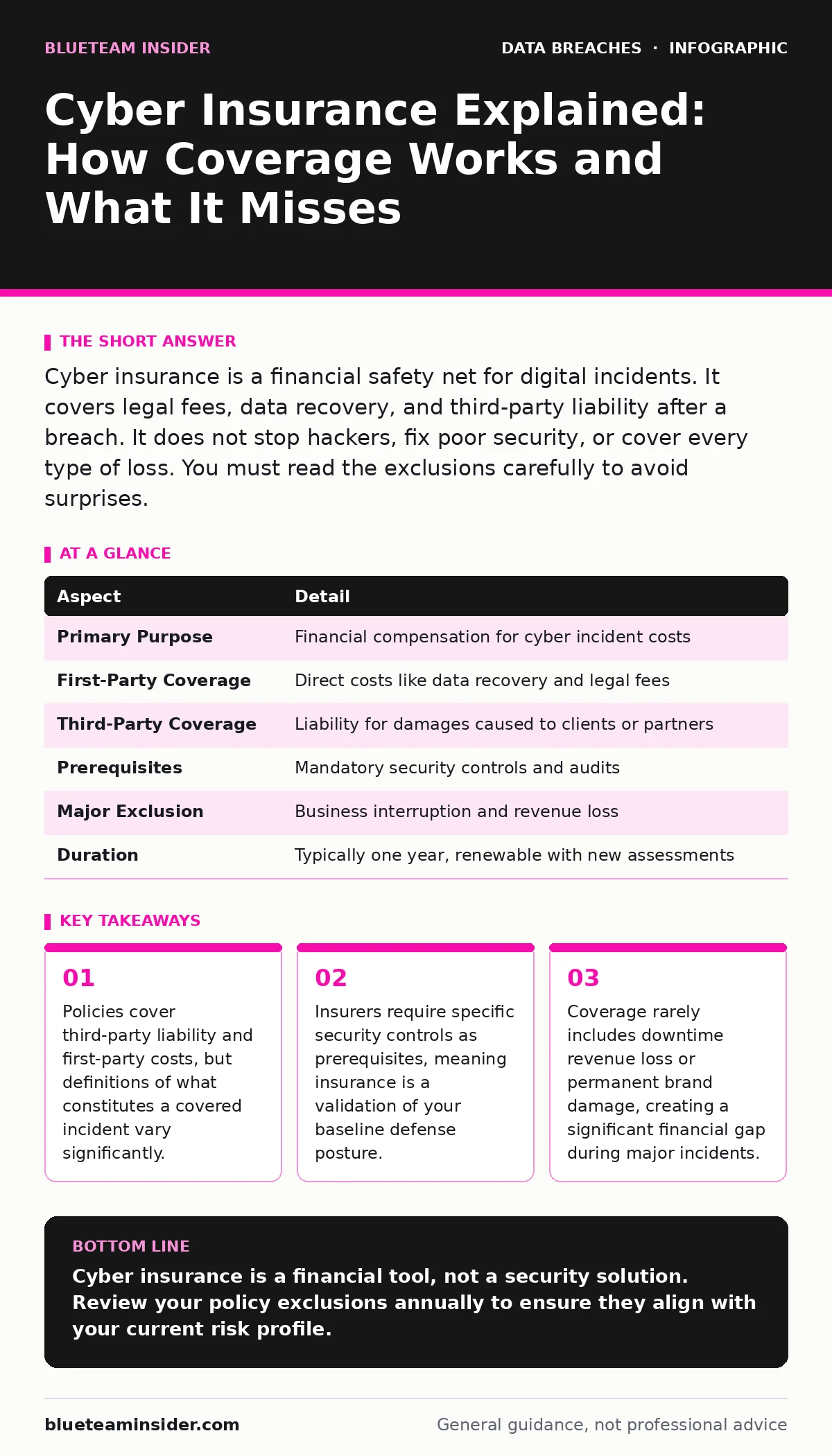
Cyber insurance is a financial safety net for digital incidents. It covers legal fees, data recovery, and third-party liability after a breach. It does not stop hackers, fix poor security, or cover every type of loss. You must read the exclusions carefully to avoid surprises.
The Insurance Analogy for Digital Risk
Imagine you insure your house against fire. The policy pays to rebuild the structure and replace belongings if flames consume them. It does not install smoke detectors, nor does it stop the fire from starting. You still lose your memories, your time, and the disruption to your daily life. Cyber insurance operates on this same principle. It provides financial compensation after a digital incident occurs. It does not prevent the incident from happening in the first place.
Many organizations mistake insurance for a security solution. This confusion is dangerous. Insurance is a transfer of financial risk, not a mitigation of technical risk. You buy it to survive the economic impact of a breach, not to avoid the breach itself. Understanding this distinction prevents you from neglecting actual security measures in favor of a false sense of safety.
| Aspect | Detail |
|---|---|
| Primary Purpose | Financial compensation for cyber incident costs |
| First-Party Coverage | Direct costs like data recovery and legal fees |
| Third-Party Coverage | Liability for damages caused to clients or partners |
| Prerequisites | Mandatory security controls and audits |
| Major Exclusion | Business interruption and revenue loss |
| Duration | Typically one year, renewable with new assessments |
Defining the Coverage Components
Cyber insurance policies generally split into two categories: first-party and third-party coverage. First-party coverage pays for losses you suffer directly. This includes costs to restore data, notify affected individuals, and hire forensic investigators to determine what happened. It also covers regulatory fines in some jurisdictions, provided local law allows insurance to cover penalties.
Third-party coverage protects you from lawsuits filed by others. If your breach exposes customer data, a client may sue for damages. This coverage handles legal defense costs and settlements. It addresses the liability you bear for failing to protect information entrusted to you. This separation matters because a single incident triggers both internal cleanup costs and external legal battles.
You must understand that "data breach" is a narrow term. Policies often use broader language like "cyber liability event." This might include ransomware demands, even if no data was stolen. It might cover denial-of-service attacks if they cause specific financial losses. Reading the precise definition of the covered peril is the most critical step in purchasing the policy.
The Hidden Cost of Prerequisites
Insurers do not sell policies to everyone. They require you to demonstrate a baseline level of security before they will write a check. This is known as underwriting. You must prove you use multi-factor authentication, maintain regular backups, and patch software vulnerabilities. If you fail to meet these requirements, the insurer may deny your claim entirely.
This creates a paradox. You need strong security to get insurance, but you also need insurance to survive the security failures that still happen. The insurer’s requirements often lag behind the latest threat tactics. A policy might require "endpoint protection" without specifying that it must be able to detect fileless malware. You might comply with the letter of the requirement while remaining vulnerable to advanced threats.
Where Insurance Fits in Defense
Insurance sits at the end of your defense chain. You first implement preventive controls like tokenization, which replaces sensitive data with non-sensitive equivalents. You use data masking to hide sensitive information in non-production environments. These measures reduce the value of data to attackers. If prevention fails, you rely on detection and response.
If an attacker bypasses your defenses, you activate your incident response plan. This is where insurance becomes relevant. The policy helps pay for the specialized experts you need to contain the threat. It covers the cost of restoring systems from clean backups, assuming you have addressed backup data exposure risks. Insurance does not pay to fix the vulnerability that allowed the entry. You must still patch the system.
Imagine you have excellent user access provisioning controls, limiting who can see what data. An employee leaves the company, and their access is not revoked promptly. This lapses into a violation of your policy terms. If that former employee’s account is compromised, the insurer may argue you failed to maintain the required access controls. The financial protection vanishes because of an administrative error.
Common Misconceptions About Coverage
People often believe cyber insurance covers business interruption losses. Most standard policies exclude revenue lost while systems are down. If a ransomware attack shuts your website for a week, the insurance pays for decryption efforts, not the sales you missed. Some policies offer limited coverage for this, but it is usually capped and difficult to claim.
Another misconception is that insurance covers reputational damage. You cannot put a price on lost trust. If customers leave because they fear their data is unsafe, insurance does not compensate you for that churn. The brand damage is permanent, while the insurance payout is finite. You must manage public relations separately, often using crisis communication firms paid out-of-pocket or through specific media liability riders.
See also: Stop Payment Card Theft: 5 Proven Prevention Measures · Shoulder Surfing Mistakes That Expose Your Credentials
The Gap Between Policy and Reality
Policies are written in legalese, not technical specifications. A clause might require "encryption of data at rest." You might encrypt your database, but leave the backup tapes unencrypted. If the tapes are stolen, the claim could be denied because the backup data was not protected. This highlights the need to review lost and stolen devices protocols alongside your cyber policy.
Insurers also exclude coverage for incidents stemming from prior known vulnerabilities. If you knew a server was unpatched and did not fix it, and that server is compromised, the insurer may claim you acted with negligence. This shifts the burden of proof to you. You must prove you acted reasonably and promptly. This is why maintaining detailed logs of security decisions is vital.
Integrating With Related Strategies
To maximize the value of cyber insurance, you must integrate it with your broader security strategy. Address credential exposure by monitoring for leaked passwords on the dark web. If credentials are leaked, attackers can use them to bypass perimeter defenses. Insurance may cover the breach, but it cannot reverse the exposure of those credentials.
Consider employee data breaches as a primary vector. Most incidents start with human error or malicious insiders. Training employees to recognize phishing attempts reduces the likelihood of an incident. Insurance does not train your staff. It only pays the bill when training fails. A layered approach that combines human awareness with technical controls reduces the frequency of claims.
Finally, do not ignore identity theft protection for your key personnel. While cyber insurance covers the organization, executives may face personal liability or identity theft. Separate protections for individuals ensure that the leadership team can focus on managing the crisis without personal financial distraction.
Key takeaways
- Policies cover third-party liability and first-party costs, but definitions of what constitutes a covered incident vary significantly.
- Insurers require specific security controls as prerequisites, meaning insurance is a validation of your baseline defense posture.
- Coverage rarely includes downtime revenue loss or permanent brand damage, creating a significant financial gap during major incidents.
Cyber insurance is a financial tool, not a security solution. Review your policy exclusions annually to ensure they align with your current risk profile.
Frequently asked questions
Does cyber insurance cover ransomware payments?
Coverage varies by policy. Some policies cover ransom payments, while others exclude them entirely. Many insurers require legal approval before paying a ransom to avoid encouraging criminal activity.
Can I get cyber insurance if I have had a previous breach?
It is more difficult and expensive. Insurers will scrutinize your history and require you to demonstrate improved security controls. Some insurers may refuse coverage for repeat offenses.
How long does it take to receive a payout?
The process involves investigation and verification. It can take weeks or months. Insurers must confirm that the incident is covered and that you have complied with all policy requirements.
Does cyber insurance cover regulatory fines?
Only if local law permits insurance to cover regulatory penalties. In some jurisdictions, paying fines with insurance is illegal. Check the specific laws in your operating regions.
How this guide was produced: written by the BlueTeam Insider editorial team with AI assistance, checked against the public references listed below, and reviewed when the facts change. See our editorial policy or report an error.