Data Minimization Meaning: How Less Data Stops Breaches
Keeping only what you need shrinks the attack surface, making breaches less damaging and compliance easier to manage.

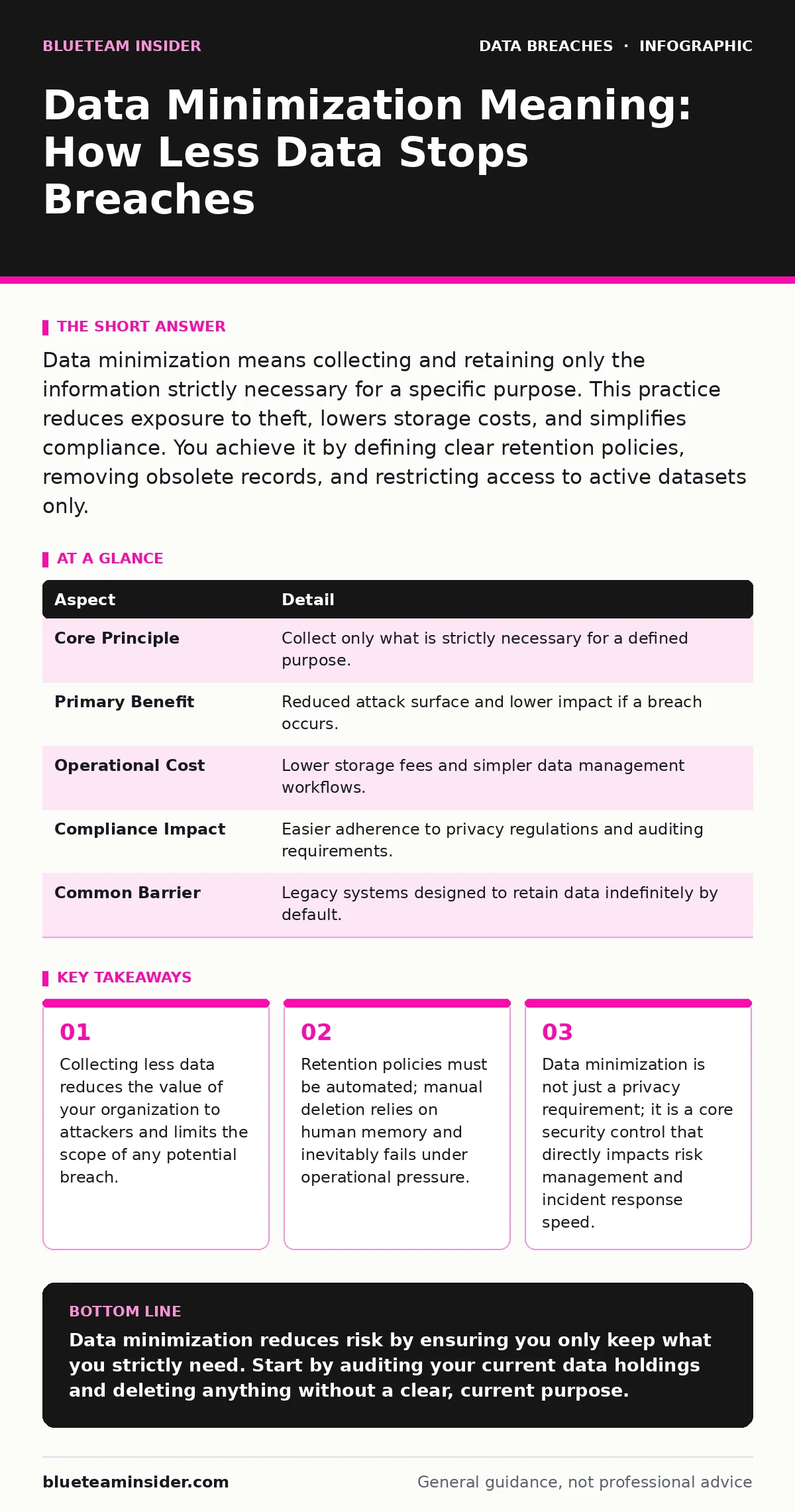
Data minimization means collecting and retaining only the information strictly necessary for a specific purpose. This practice reduces exposure to theft, lowers storage costs, and simplifies compliance. You achieve it by defining clear retention policies, removing obsolete records, and restricting access to active datasets only.
Why a Full Wallet Increases Risk
Imagine you are traveling across a border. You carry only the cash needed for the next 24 hours. If a pickpocket steals your wallet, the loss is small and manageable. Now imagine you carry your life savings, your passport, and your house keys in that same wallet. The theft becomes a catastrophe. Digital security operates on the same principle. Every piece of data you store is a key in that wallet. If you hold data you do not actively use, you are carrying unnecessary risk.
The concept of data minimization meaning is straightforward in theory but difficult in practice. It requires organizations to question every data field they collect. Most systems default to capturing everything possible. Forms include optional fields. Databases log every interaction. This default behavior creates a massive repository of information that serves no operational purpose but provides a rich target for adversaries.
| Aspect | Detail |
|---|---|
| Core Principle | Collect only what is strictly necessary for a defined purpose. |
| Primary Benefit | Reduced attack surface and lower impact if a breach occurs. |
| Operational Cost | Lower storage fees and simpler data management workflows. |
| Compliance Impact | Easier adherence to privacy regulations and auditing requirements. |
| Common Barrier | Legacy systems designed to retain data indefinitely by default. |
How Data Minimization Works in Practice
You implement this strategy by defining the lifecycle of every data element. Start with collection. Ask why you need a specific piece of information. If a user signs up for a newsletter, you need an email address. You do not need their birthdate, social security number, or home address. Removing these fields at the point of entry prevents the data from ever entering your environment.
Next, address retention. Data has a shelf life. Customer records may be needed for seven years for tax purposes. Session logs might only be useful for 30 days for debugging. Once that period expires, the data must be deleted or anonymized. This is not optional housekeeping. It is a security control. Stale data often lacks the same access controls as active data because no one monitors it. It becomes a blind spot.
Who Is Affected by This Strategy
This approach affects every organization that processes digital information. Small businesses benefit most because they lack the resources to manage large-scale breaches. Large enterprises face complex regulatory environments where minimizing data simplifies compliance. Government agencies hold sensitive citizen data that must be protected with extreme care.
Individuals are also affected. You benefit when services adopt these practices because your personal information is less likely to be exposed. However, you also face friction. Services may ask fewer questions, but they may also offer less personalized features. This trade-off is inherent in the model. You exchange convenience for security. Understanding this balance helps you make informed choices about which services you trust with your information.
What to Do About Excess Data
Start with an inventory. You cannot protect what you do not know you have. Identify every database, spreadsheet, and cloud storage bucket. Classify the data inside. Determine the purpose of each dataset. If you cannot articulate a current, valid reason for keeping the data, delete it.
Implement automated retention policies. Manual deletion is unreliable. Employees forget, priorities shift, and turnover occurs. Configure systems to automatically archive or delete data after a set period. This ensures consistency and removes human error from the process.
Review third-party vendors. You are responsible for the data you share with partners. Ensure they follow similar minimization practices. If a vendor retains your customer data longer than necessary, you remain liable for its exposure. Contractual clauses should enforce strict retention limits.
Common Misconceptions About Data Minimization
Many people believe data minimization means deleting everything possible. This is incorrect. You must keep data required for legal, operational, or safety reasons. The goal is precision, not emptiness. You keep what you need and discard the rest.
Another misconception is that this is only a privacy concern. Privacy regulations drive much of the discussion, but the security benefits are independent of law. Reducing data reduces the value of your organization to attackers. A breach that exposes only email addresses is less damaging than one that exposes financial records and health information.
Some assume that encryption replaces the need for minimization. Encryption protects data at rest and in transit, but it does not reduce the amount of data exposed. If attackers breach an encrypted system and obtain the keys, they still access all the data. Minimizing the data reduces the total volume they can access, regardless of encryption status.
See also: Identity Theft Protection: 8 Practices to Secure Your Digital Life · Access Review Mistakes That Leave Your Data Exposed
The Hidden Costs of Keeping Too Much
Storage costs are obvious, but the hidden costs are higher. Managing large datasets requires more compute power, more network bandwidth, and more administrative time. Security teams must monitor more endpoints. Incident response takes longer because analysts must sift through irrelevant data to find the breach source.
Legal exposure increases with data volume. If you hold sensitive information, you must protect it with higher standards. This means more audits, more controls, and more documentation. Each additional control adds complexity and potential points of failure. By reducing the data, you reduce the number of controls required, simplifying your security posture.
Consider the impact on cyber insurance. Insurers assess risk based on the data you hold. A company with minimal data may qualify for lower premiums or better coverage terms. A company hoarding unnecessary records faces higher deductibles and stricter underwriting. The financial incentive to minimize data is significant.
Integrating With Other Security Controls
Data minimization works best when combined with other security practices. Tokenization replaces sensitive data with non-sensitive equivalents, such as swapping credit card numbers for random tokens. This allows you to process transactions without storing the actual card details.
User access provisioning ensures that only authorized personnel can view sensitive data. Even if you minimize data, you must restrict access to what remains. Least privilege principles apply here. Employees should only see the data needed for their specific job functions.
Breach dwell time is the period between an intrusion and its detection. Minimizing data can reduce this time. With less data to monitor, security tools can focus on critical assets. Anomalies stand out more clearly against a smaller background of normal activity. This improves detection speed and limits damage.
The Long-Term View
This is not a one-time project. Data grows organically. New services are added, new regulations emerge, and business needs change. You must continuously evaluate your data practices. Build minimization into your development lifecycle. Engineers should design systems that default to deleting data rather than keeping it.
Culture matters. Employees must understand why minimizing data is important. Training should focus on the security benefits, not just compliance. When teams see how this practice protects the organization and its customers, they become advocates for it.
The goal is resilience. You cannot prevent every attack. But you can limit the damage. By holding less data, you ensure that even if a breach occurs, the impact is contained. This is the essence of modern security. It is not about building higher walls. It is about having less to lose.
Key takeaways
- Collecting less data reduces the value of your organization to attackers and limits the scope of any potential breach.
- Retention policies must be automated; manual deletion relies on human memory and inevitably fails under operational pressure.
- Data minimization is not just a privacy requirement; it is a core security control that directly impacts risk management and incident response speed.
Data minimization reduces risk by ensuring you only keep what you strictly need. Start by auditing your current data holdings and deleting anything without a clear, current purpose.
Frequently asked questions
Does data minimization violate privacy laws?
No, most privacy laws explicitly require data minimization. Keeping only necessary data helps you comply with regulations like GDPR and CCPA.
Can I minimize data if I need it for analytics?
You can use aggregated or anonymized data for analytics. This allows you to gain insights without retaining identifiable personal information.
How do I handle data that might be needed later?
Define a clear retention period based on legal and business requirements. If the need is uncertain, do not keep it. The cost of storing useless data outweighs the risk of not having it.
What is the difference between data minimization and data masking?
Minimization reduces the amount of data stored. Masking hides specific parts of the data while keeping the record intact. Both are useful, but they serve different purposes.
How this guide was produced: written by the BlueTeam Insider editorial team with AI assistance, checked against the public references listed below, and reviewed when the facts change. See our editorial policy or report an error.