Data Masking Mistakes That Expose Sensitive Information
Many organizations mask data visually but leave the underlying structure intact, allowing attackers to reconstruct original values using statistical inference.

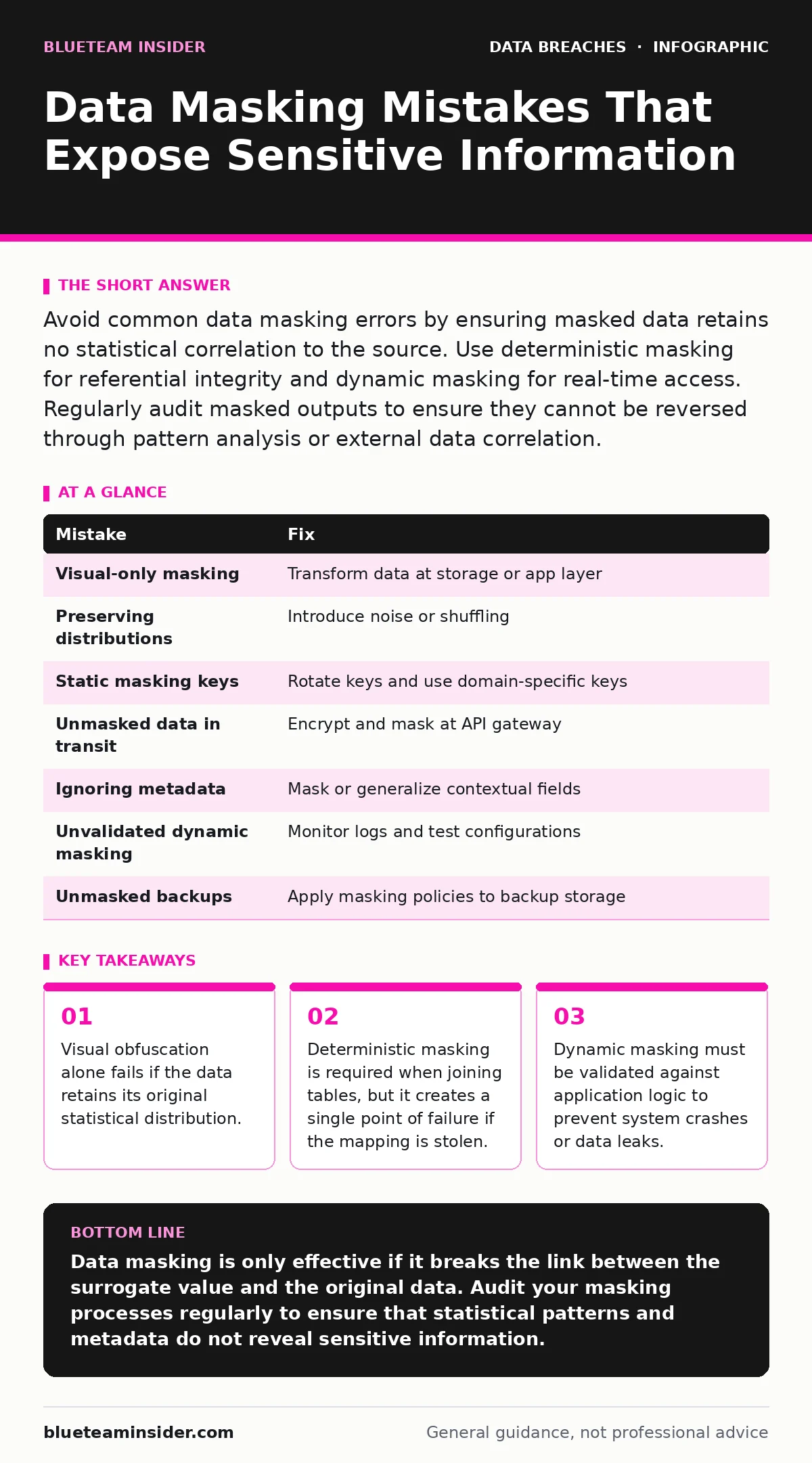
Avoid common data masking errors by ensuring masked data retains no statistical correlation to the source. Use deterministic masking for referential integrity and dynamic masking for real-time access. Regularly audit masked outputs to ensure they cannot be reversed through pattern analysis or external data correlation.
Mistake 1: Masking Only the Visual Representation
Many teams assume that replacing characters with asterisks or hashes is sufficient protection. This approach changes how the data looks but often leaves the underlying storage or database structure unchanged. Attackers who gain read access to the raw database files can bypass the visual layer entirely.
Why it hurts:
The data remains searchable and sortable in its original form within the storage layer. If an attacker extracts the raw database files, they see the unmasked values. This renders the visual mask useless against insider threats or database file theft.
The fix:
Apply transformation at the storage or application layer, not just the display layer. Use cryptographic hashing or tokenization to replace the actual value with a surrogate that cannot be reversed. Ensure the surrogate does not retain the original data type’s length or format if that information is sensitive.
Mistake 2: Preserving Statistical Distributions
When masking data for testing or development, preserving the exact statistical distribution of the source data is often considered best practice. This allows test scripts to run without breaking due to unexpected data patterns. However, this fidelity can be exploited.
Why it hurts:
If the masked data mirrors the original distribution, an attacker can use statistical inference to guess the original values. For example, if you know the salary distribution of a company, you can map masked salaries back to likely real values. This is known as a frequency attack.
The fix:
Introduce controlled noise or shuffling into the masked data. Break the direct correlation between the masked value and the original value while maintaining enough structure for software to function. This ensures that statistical analysis of the masked set yields no meaningful insights about the source.
Mistake 3: Using Static Keys for Deterministic Masking
Deterministic masking ensures that the same input always produces the same output. This is necessary for maintaining referential integrity when joining tables. However, using a single, static encryption key for all masked fields creates a systemic vulnerability.
Why it hurts:
If an attacker obtains the static key, they can decrypt every masked record in the system. This turns a single point of compromise into a total data breach. It also makes auditing difficult, as you cannot distinguish between different data sets or environments.
The fix:
Rotate masking keys regularly and use different keys for different data domains or environments. Implement key management protocols that separate the key storage from the data storage. This limits the blast radius of a key compromise and ensures that old masked data becomes unreadable when keys rotate.
Mistake 4: Failing to Mask Data in Transit
Organizations often focus heavily on masking data at rest in databases. They neglect the data moving between systems, APIs, and microservices. Data in transit is visible to network interceptors and can be captured by malicious insiders.
Why it hurts:
Even if your database is perfectly masked, the data may be sent in plaintext to a reporting service or a third-party API. This exposes the raw values to anyone monitoring the network traffic. It also violates many compliance frameworks that require protection during transmission.
The fix:
Enforce encryption for all data in transit using standard protocols. Additionally, apply masking at the API gateway level before the data leaves the secure perimeter. Ensure that microservices only receive the minimum data necessary for their function.
Mistake 5: Ignoring Contextual Metadata
Masking often focuses on the primary sensitive fields, such as names or account numbers. It ignores the surrounding metadata that can provide context. This includes timestamps, IP addresses, and user agent strings.
Why it hurts:
Metadata can be used to re-identify individuals even when their primary identifiers are masked. By correlating masked data with external data sources, an attacker can pinpoint the original source. This is particularly dangerous in small datasets where unique combinations are rare.
The fix:
Apply masking or generalization to metadata fields as well. Round timestamps to the nearest hour or day. Remove or hash IP addresses. Ensure that the combination of masked fields and metadata does not create a unique fingerprint for any individual.
See also: Cyber Insurance Explained: How Coverage Works and What It Misses · Tax Identity Theft: How to Detect, Stop and Recover
Mistake 6: Over-Reliance on Dynamic Masking Without Validation
Dynamic masking applies rules in real-time based on the user’s role. It is flexible but complex. Teams often deploy these rules without rigorous testing across all application paths.
Why it hurts:
If the dynamic masking rules are misconfigured, sensitive data may be exposed to unauthorized users. Conversely, overly aggressive masking can break application functionality, leading to workarounds that bypass security. These edge cases are often discovered only after a breach.
The fix:
Implement continuous monitoring and logging of masking events. Regularly review logs to ensure that the correct masks are being applied to the correct users. Conduct penetration testing that specifically targets the masking logic to find configuration errors.
Mistake 7: Neglecting Masking in Backup Systems
Organizations often mask data in production databases but leave backups in their original, unmasked state. Backups are frequently stored in less secure environments or accessed by fewer people, leading to complacency.
Why it hurts:
Backups are a primary target for attackers because they contain historical data that may not be as well protected. If a backup is stolen, the attacker has a complete, unmasked copy of the data. This negates all masking efforts in the live system.
The fix:
Ensure that backups inherit the same masking policies as the production data. Use automated processes to mask data before it is written to backup storage. Regularly test these backups to ensure that the masking process does not corrupt the data integrity. See our guide on backup testing for validation strategies.
| Mistake | Fix |
|---|---|
| Visual-only masking | Transform data at storage or app layer |
| Preserving distributions | Introduce noise or shuffling |
| Static masking keys | Rotate keys and use domain-specific keys |
| Unmasked data in transit | Encrypt and mask at API gateway |
| Ignoring metadata | Mask or generalize contextual fields |
| Unvalidated dynamic masking | Monitor logs and test configurations |
| Unmasked backups | Apply masking policies to backup storage |
Key takeaways
- Visual obfuscation alone fails if the data retains its original statistical distribution.
- Deterministic masking is required when joining tables, but it creates a single point of failure if the mapping is stolen.
- Dynamic masking must be validated against application logic to prevent system crashes or data leaks.
Data masking is only effective if it breaks the link between the surrogate value and the original data. Audit your masking processes regularly to ensure that statistical patterns and metadata do not reveal sensitive information.
Frequently asked questions
Does data masking prevent identity theft?
Masking reduces the value of stolen data by making it harder to link to specific individuals. It is a layer of defense that works alongside identity theft protection services.
Can masked data be used for machine learning?
Yes, if the masking process preserves the necessary statistical properties for the model. However, you must ensure that the model cannot reverse the masking to infer original values.
How does masking help with lost and stolen devices?
Masking ensures that even if a device is lost, the data stored on it is not immediately usable. It adds a layer of protection beyond device encryption.
Is masking better than encryption?
Masking and encryption serve different purposes. Masking is for usability and non-production environments, while encryption is for securing data at rest and in transit. Use both where appropriate.
How this guide was produced: written by the BlueTeam Insider editorial team with AI assistance, checked against the public references listed below, and reviewed when the facts change. See our editorial policy or report an error.