Breach Dwell Time: Reduce Exposure With 3 Proven Tactics
Most organizations detect intrusions only after attackers have moved laterally through the network, making speed the primary defense against data loss.

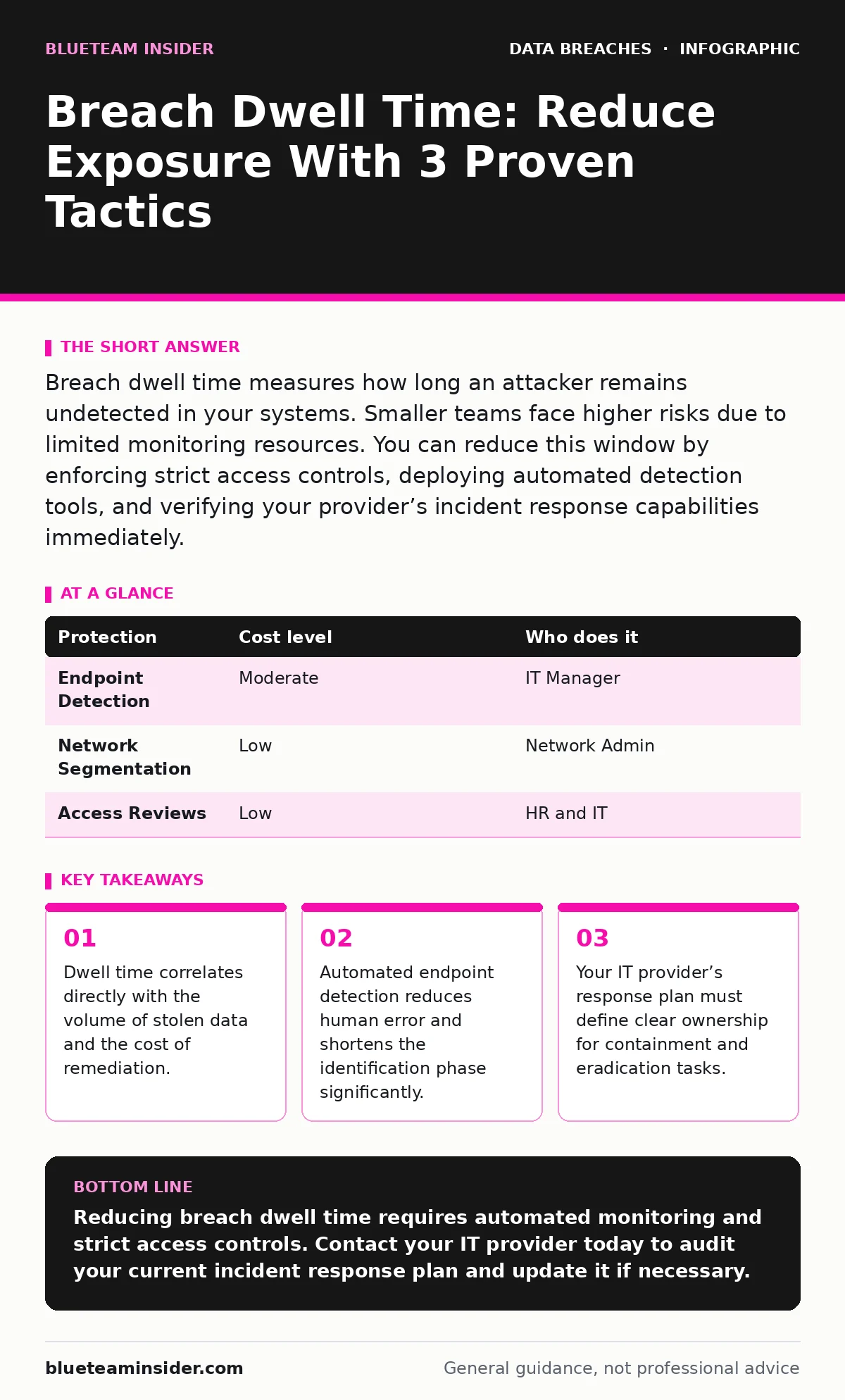
Breach dwell time measures how long an attacker remains undetected in your systems. Smaller teams face higher risks due to limited monitoring resources. You can reduce this window by enforcing strict access controls, deploying automated detection tools, and verifying your provider’s incident response capabilities immediately.
Why Dwell Time Matters for Small Teams
Breach dwell time refers to the duration between initial intrusion and final detection. This metric determines how much damage an attacker can inflict before you intervene. Small organizations often assume their size makes them less attractive targets. This assumption is incorrect. Attackers use automated tools to scan for vulnerabilities regardless of company size. They prioritize targets with weak defenses over large, hardened enterprises.
When an attacker enters your network undetected, they begin mapping your environment. They identify critical data stores, administrative accounts, and backup systems. Each hour of undetected access increases the likelihood of data exfiltration. Small teams typically lack dedicated security operations centers. This gap allows attackers to operate freely for weeks or even months. The longer they remain hidden, the more thoroughly they compromise your infrastructure.
Reducing this window requires shifting from reactive to proactive monitoring. You cannot rely on manual checks alone. Human observers miss subtle indicators of compromise. Automated systems scan logs and network traffic continuously. They flag anomalies that deviate from established baselines. This continuous surveillance is the only way to catch stealthy threats early.
The Hidden Costs of Extended Exposure
Extended dwell time creates compounding risks that extend beyond immediate data loss. Attackers use the initial access point to move laterally. They jump from one compromised device to another, seeking higher privileges. This lateral movement allows them to access systems they could not reach initially. Each hop deepens their foothold in your network.
During this phase, attackers often install persistence mechanisms. These tools ensure they can regain access even if you disconnect the initial entry point. They might modify system files, create hidden user accounts, or alter startup scripts. Removing these mechanisms requires a thorough forensic investigation. This process demands specialized skills and significant time.
Small businesses often lack the internal expertise to conduct such investigations. They must hire external incident response firms. These services are expensive and time-consuming. The financial impact includes not only remediation costs but also potential regulatory fines. Reputational damage follows when clients learn their data was exposed for an extended period. Trust takes years to rebuild and minutes to lose.
Practical Steps to Shorten Detection Windows
You can reduce breach dwell time by implementing specific technical controls. Endpoint Detection and Response (EDR) software monitors individual devices for suspicious behavior. It records process executions, file changes, and network connections. When an anomaly occurs, it alerts your team or automatically isolates the device. This prevents the threat from spreading to other systems.
Network segmentation limits the blast radius of an intrusion. You divide your network into smaller zones. Each zone enforces strict access controls between them. An attacker who compromises one segment cannot easily move to another. This containment strategy buys you time to identify and neutralize the threat. It forces attackers to work harder to reach critical assets.
Regular access reviews ensure that users and services retain only the permissions they need. Overprivileged accounts provide easy targets for attackers. When they steal credentials, they gain excessive access. By auditing permissions monthly, you remove unnecessary rights. This practice reduces the number of paths an attacker can exploit.
| Protection | Cost level | Who does it |
|---|---|---|
| Endpoint Detection | Moderate | IT Manager |
| Network Segmentation | Low | Network Admin |
| Access Reviews | Low | HR and IT |
What to Demand From Your IT Provider
Your IT provider plays a central role in monitoring and responding to threats. You must verify that their services include active detection, not just passive maintenance. Ask for a detailed breakdown of their monitoring tools. Determine if they use automated alerting or rely on manual checks. Manual checks introduce delays and human error.
Request a copy of their incident response plan. This document should outline the specific steps they take when a threat is detected. It must define roles and responsibilities clearly. You need to know who contacts you first and how quickly. Ambiguity during a crisis leads to panic and poor decisions. Clear protocols ensure a swift and coordinated response.
Verify their communication channels during an emergency. Do they have a dedicated hotline for security incidents? Can they reach you within minutes, not hours? Delayed communication extends dwell time unnecessarily. Ensure they provide regular reports on security posture. These reports should highlight detected threats and remediation actions taken.
- How do you monitor endpoints for malicious behavior?
- What is your average response time to critical alerts?
- Do you conduct regular penetration testing?
- How do you handle false positives in your alerts?
- What is your process for preserving forensic evidence?
Integrating Data Protection Strategies
Technical controls work best when combined with strong data protection practices. Data minimization reduces the amount of sensitive information you store. If you do not keep unnecessary data, attackers have less to steal. This strategy limits the impact of any breach that occurs.
Consider implementing data masking for non-production environments. This technique replaces sensitive data with fictional but realistic substitutes. Developers and testers can work with the data without accessing real credentials. This prevents accidental exposure during software development cycles.
Tokenization replaces sensitive data with unique identification symbols. These tokens have no exploitable value outside your system. If an attacker steals the tokenized data, they cannot reverse the process without access to your secure vault. This adds a layer of protection even if other defenses fail.
See also: Incident Response Plan for Ransomware Attack: Stop the Spread · Build and Validate SOC Playbooks for Incident Response
Common Mistakes That Increase Risk
Many organizations fall into the trap of over-relying on perimeter defenses. Firewalls and antivirus software are necessary but insufficient. They cannot detect threats that originate from inside the network. Insider threats and compromised credentials bypass these outer layers easily. You must assume the perimeter is breached and monitor internal activity.
Another common error is ignoring user training. Social engineering remains a primary vector for initial access. Attackers trick users into revealing credentials or downloading malware. Regular phishing simulations help identify vulnerable employees. Training must be ongoing, not a one-time event. Human error is the weakest link in any security chain.
Finally, failing to test backup systems leaves you vulnerable to ransomware. Attackers often encrypt backups to prevent recovery. You must verify that backups are immutable and offline. Regular restoration tests ensure that data can be recovered when needed. Without reliable backups, you face the choice of paying a ransom or losing everything.
Maintaining Continuous Improvement
Security is not a one-time project but a continuous process. Threats evolve rapidly, and new vulnerabilities emerge constantly. You must update your defenses regularly to stay ahead of attackers. This includes patching software, updating firewall rules, and refining detection signatures.
Review your security strategy quarterly. Assess what worked and what failed. Adjust your controls based on new findings. Engage with your IT provider to discuss emerging threats. Collaborative efforts improve overall resilience. Stagnation in security practices leads to increased risk over time.
Stay informed about industry best practices. Follow reputable security publications and forums. Share insights with your team to foster a security-aware culture. Awareness at all levels strengthens your defense posture. A vigilant organization detects threats faster and responds more effectively.
Key takeaways
- Dwell time correlates directly with the volume of stolen data and the cost of remediation.
- Automated endpoint detection reduces human error and shortens the identification phase significantly.
- Your IT provider’s response plan must define clear ownership for containment and eradication tasks.
Reducing breach dwell time requires automated monitoring and strict access controls. Contact your IT provider today to audit your current incident response plan and update it if necessary.
Frequently asked questions
How long do attackers typically stay undetected?
Attackers often remain undetected for months. Small organizations frequently discover breaches only after significant damage has occurred. Automated detection reduces this window drastically.
Can small businesses afford advanced detection tools?
Yes, many cloud-based security tools offer scalable pricing. Endpoint protection and automated logging are affordable for most small teams. The cost of a breach far exceeds these tools.
Do I need a dedicated security officer?
Not necessarily, if you outsource monitoring to a competent provider. Ensure they offer 24/7 alerting and rapid response capabilities. In-house expertise is beneficial but not always required.
How often should I review access permissions?
Review access permissions at least quarterly. More frequent reviews are advisable for high-privilege accounts. Regular audits prevent privilege creep and reduce attack surfaces.
How this guide was produced: written by the BlueTeam Insider editorial team with AI assistance, checked against the public references listed below, and reviewed when the facts change. See our editorial policy or report an error.