Social Engineering Red Flags: Why Early Detection Stops Breaches
Recognizing subtle manipulation cues reduces the window for attackers to execute complex fraud before technical controls can intervene.

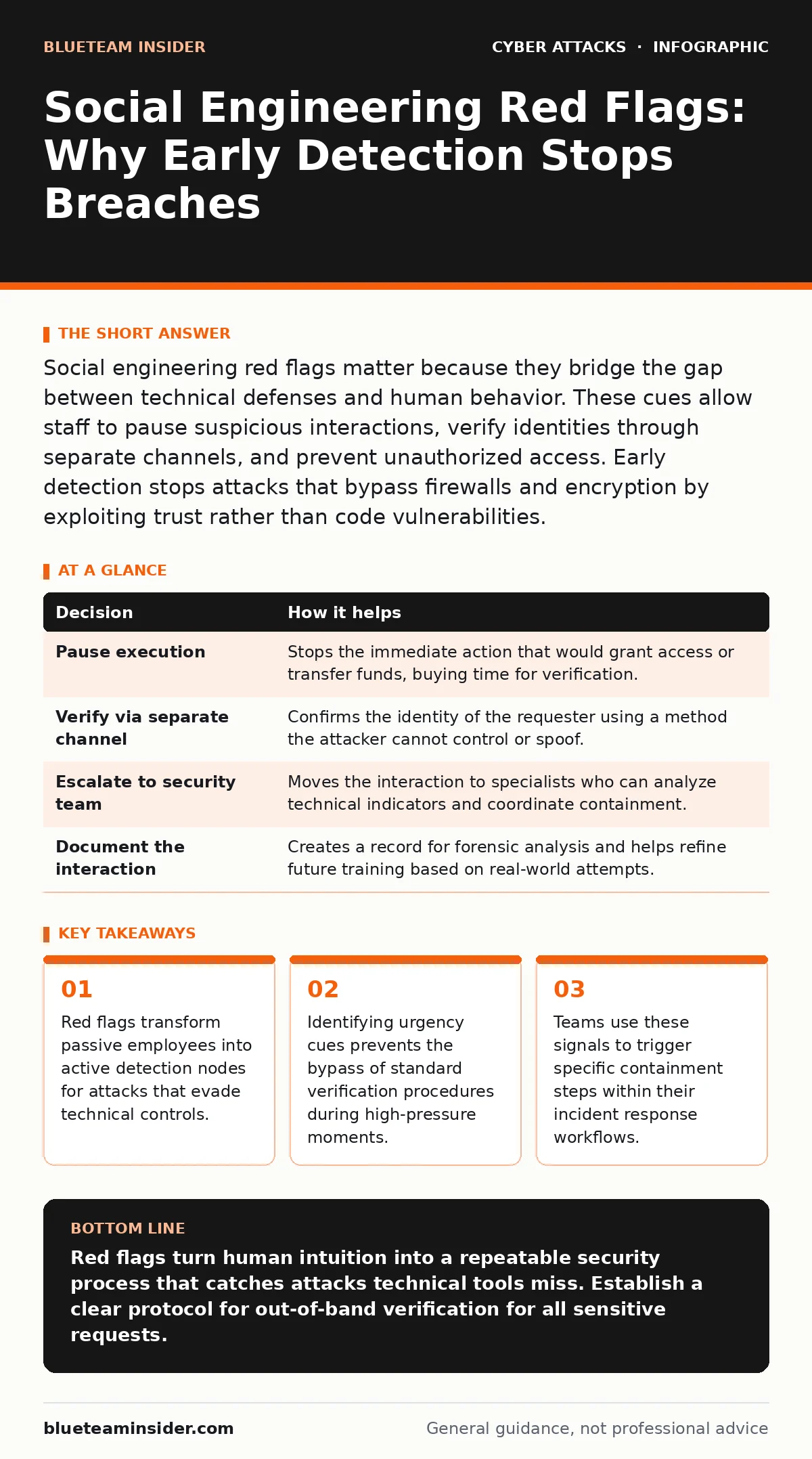
Social engineering red flags matter because they bridge the gap between technical defenses and human behavior. These cues allow staff to pause suspicious interactions, verify identities through separate channels, and prevent unauthorized access. Early detection stops attacks that bypass firewalls and encryption by exploiting trust rather than code vulnerabilities.
The Human Layer as a Detection Mechanism
Technical controls like firewalls and endpoint detection prevent known malicious code from executing. They cannot stop a user from willingly handing over credentials or authorizing a payment to an attacker. Social engineering relies on psychological manipulation rather than software exploits. Red flags are the observable signs of this manipulation.
They include unusual urgency, requests for secrecy, and deviations from standard communication patterns. Recognizing these signs allows you to interrupt the attack chain before data leaves your environment. This detection layer complements email authentication and phishing simulations by focusing on the intent behind the message rather than just its technical header.
Why Traditional Advice Fails in Practice
Standard security training often tells staff to "be vigilant" or "check the sender." This advice is too vague to be useful under pressure. Attackers craft messages that look legitimate at a glance. They use spoofed domains that differ by only one character. They mimic the tone of senior leadership. Without specific, actionable red flags, you rely on memory rather than a repeatable process.
Memory fails when stress hormones like cortisol spike during an urgent request. A structured approach to spotting manipulation cues provides a cognitive anchor. It shifts the focus from "Is this real?" to "Does this follow our established protocol?" This shift reduces the cognitive load on the employee and increases the likelihood of correct decision-making.
The Cost of Missing Subtle Cues
Imagine a team that treats every urgent email as legitimate until proven otherwise. An attacker sends a message that appears to come from the chief financial officer. The request asks for immediate wire transfer details to avoid a missed deadline. The subject line matches recent conversations. The formatting is perfect.
Without specific red flags, the employee sees only the content. They do not see the deviation from the usual approval workflow. They process the request to avoid appearing unhelpful. The loss occurs not because of a weak password, but because of a broken verification habit. This scenario highlights how social engineering exploits organizational norms and the fear of inconvenience.
How Teams Operationalize Red Flag Detection
Teams use red flags to trigger specific decision points in their security workflows. These decisions are not about guessing the attacker's identity. They are about verifying the request through an out-of-band channel. When a red flag appears, the standard operating procedure shifts from immediate compliance to verification.
This verification happens via a secondary method, such as a phone call to a known number or a secure messaging platform. The goal is to confirm the identity of the requester independently of the initial communication channel. This process integrates with broader incident response plans by providing a clear escalation path. It turns a potential breach into a reported security event.
Decision Points Informed by Red Flags
| Decision | How it helps |
|---|---|
| Pause execution | Stops the immediate action that would grant access or transfer funds, buying time for verification. |
| Verify via separate channel | Confirms the identity of the requester using a method the attacker cannot control or spoof. |
| Escalate to security team | Moves the interaction to specialists who can analyze technical indicators and coordinate containment. |
| Document the interaction | Creates a record for forensic analysis and helps refine future training based on real-world attempts. |
See also: Scareware Pop Up: How to Spot Fake Alerts and Stop the Threat · Phishing Defenses: Answers to 10 Critical Questions
The Hidden Cost of False Positives
A common concern is that strict red flag adherence will slow down business operations. Employees may fear being accused of incompetence if they question a legitimate request. This fear can lead to "alert fatigue" or compliance bypass. Teams must balance security with usability. Verification processes should be quick and standardized. For example, a simple callback to a known extension takes less than a minute.
Over time, staff become accustomed to this routine. The hidden cost of not having clear red flags is higher: a single successful attack can cost millions and damage reputation. The minor friction of verification is a necessary trade-off for security. Understanding the human factor in security helps leaders design processes that feel natural rather than obstructive.
Integrating with Technical Defenses
Red flags do not replace technical controls. They work alongside them. Email authentication protocols like DMARC help block obvious spoofing. However, attackers often use compromised legitimate accounts to bypass these checks. In these cases, the message passes all technical filters. The content and context become the only indicators. Training staff to recognize pretexting techniques ensures that even authenticated emails are scrutinized. This layer of defense is critical for protecting against vendor email compromise, where attackers mimic trusted partners. Combining technical filtering with human awareness creates a defense-in-depth strategy that is resilient to evolving attack methods.
Building a Culture of Verification
Security is not just a technical problem. It is a cultural one. Teams that encourage questioning and verification build resilience. Leaders must model this behavior by welcoming verification requests rather than punishing them. When a senior leader asks to be called back to verify a request, it signals that security is a shared responsibility. This cultural shift reduces the effectiveness of authority-based social engineering. It empowers every employee to act as a security sensor. Regular review of near-misses helps refine the list of red flags. This continuous improvement ensures that the organization stays ahead of new manipulation tactics.
Conclusion on Detection Strategies
Social engineering red flags matter because they address the weakest link in many security architectures: the human element. By defining specific cues for manipulation, you give your staff the tools to detect attacks that technical controls miss. This approach informs critical decisions like pausing execution and verifying identities. It prevents costly breaches by ensuring that urgency does not override protocol. Implementing these checks requires a shift in culture and process, but the benefit is a more resilient organization.
Key takeaways
- Red flags transform passive employees into active detection nodes for attacks that evade technical controls.
- Identifying urgency cues prevents the bypass of standard verification procedures during high-pressure moments.
- Teams use these signals to trigger specific containment steps within their incident response workflows.
Red flags turn human intuition into a repeatable security process that catches attacks technical tools miss. Establish a clear protocol for out-of-band verification for all sensitive requests.
Frequently asked questions
What is the first red flag to check in an urgent email?
Check for a deviation from standard communication channels or approval workflows. Urgent requests that bypass normal procedures are the most common indicator of social engineering.
How do you verify a request without embarrassing the sender?
Use neutral language such as "I am following up on your request as per our security policy." This frames the verification as a routine compliance step rather than a suspicion of fraud.
Can technical tools detect social engineering?
Technical tools can detect known patterns and spoofing, but they cannot judge context or intent. Human awareness remains necessary to identify subtle manipulation that passes technical filters.
What should you do if you already clicked a link?
Disconnect the device from the network immediately. Report the incident to your security team. Do not enter any credentials. Follow your organization's incident response procedures to contain potential malware.
How this guide was produced: written by the BlueTeam Insider editorial team with AI assistance, checked against the public references listed below, and reviewed when the facts change. See our editorial policy or report an error.