Vendor Email Compromise Prevention Checklist for Secure Supply Chains
Most vendor compromises bypass perimeter defenses by exploiting trusted relationships and weak identity verification rather than technical vulnerabilities.

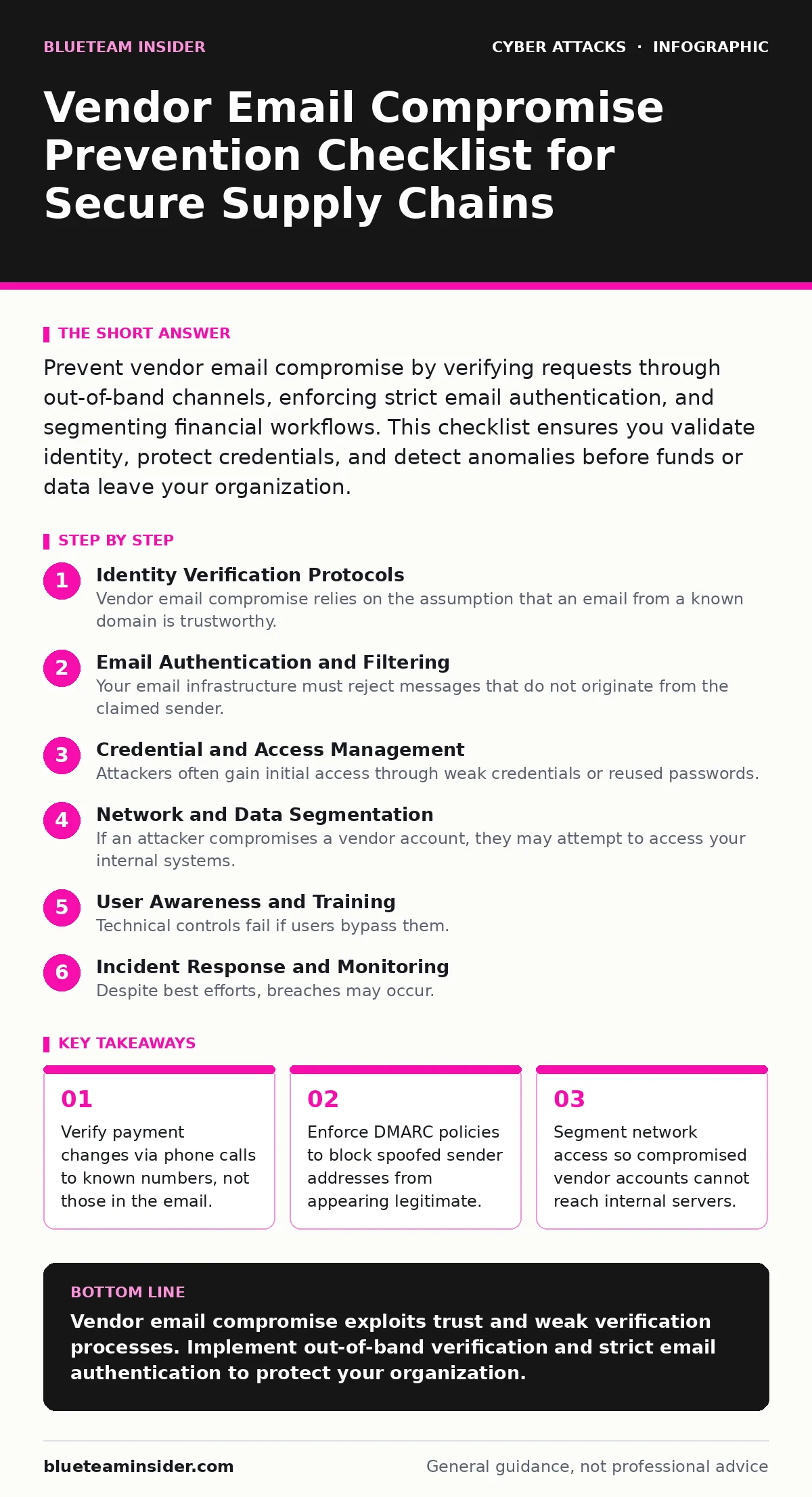
Prevent vendor email compromise by verifying requests through out-of-band channels, enforcing strict email authentication, and segmenting financial workflows. This checklist ensures you validate identity, protect credentials, and detect anomalies before funds or data leave your organization.
Identity Verification Protocols
Vendor email compromise relies on the assumption that an email from a known domain is trustworthy. Attackers often register look-alike domains or compromise legitimate accounts to send fraudulent invoices. You must treat every request for sensitive data or payment changes as suspicious until proven otherwise.
- Establish out-of-band verification procedures: Confirm payment details via a separate communication channel, such as a phone call to a known number, not one provided in the email.
- Maintain a verified contact list: Keep an internal, secure registry of authorized vendor contacts and their official email domains to cross-reference incoming requests.
- Require secondary authentication for changes: Mandate that any change to banking details or delivery addresses requires a signed form or a verified video call.
Identity verification stops the transaction before it occurs. Relying on email headers alone is insufficient because attackers can forge them or use compromised legitimate accounts.
Email Authentication and Filtering
Your email infrastructure must reject messages that do not originate from the claimed sender. Without proper authentication, attackers can easily mimic your vendors' domains. Implementing strict policies reduces the volume of deceptive emails that reach your users' inboxes.
- Enforce DMARC policies: Configure Domain-based Message Authentication, Reporting, and Conformance to reject or quarantine emails that fail authentication checks.
- Monitor SPF and DKIM records: Ensure Sender Policy Framework and DomainKeys Identified Mail are correctly configured to validate the source and integrity of incoming messages.
- Filter for look-alike domains: Use heuristic filters to block emails from domains that visually resemble your vendors' legitimate addresses but differ slightly.
Email authentication blocks the most common spoofing techniques. It does not stop attacks where the attacker has legitimately compromised the vendor's actual email account. For deeper technical details, review our guide on email authentication.
Credential and Access Management
Attackers often gain initial access through weak credentials or reused passwords. Once inside, they move laterally to find financial data or communication channels. Strong access controls limit the damage a single compromised account can cause.
- Enforce multi-factor authentication: Require MFA for all vendor portal access and internal email accounts to prevent unauthorized entry even if passwords are stolen.
- Rotate credentials regularly: Change passwords for vendor portals and shared accounts on a fixed schedule to reduce the window of opportunity for attackers.
- Apply least privilege principles: Grant vendors only the minimum access necessary to perform their duties, preventing lateral movement within your network.
Credential management reduces the risk of unauthorized access. It does not prevent social engineering attacks that trick users into voluntarily handing over credentials. See our guide on password spraying to understand how attackers test weak credentials at scale.
Network and Data Segmentation
If an attacker compromises a vendor account, they may attempt to access your internal systems. Segmentation ensures that a breach in one area does not compromise the entire organization. Isolating sensitive data limits the attacker's ability to move laterally.
- Segment vendor access networks: Place vendor connections in isolated network zones with strict firewall rules preventing access to internal resources.
- Encrypt sensitive data at rest and in transit: Ensure that financial records and intellectual property are encrypted, rendering them useless if intercepted.
- Monitor data exfiltration attempts: Use data loss prevention tools to alert on unusual outbound traffic patterns that may indicate data theft.
Network segmentation contains breaches. It adds complexity to network management and may require updates to firewall rules as vendor needs change. Learn more about architectural strategies in our guide on network segmentation.
User Awareness and Training
Technical controls fail if users bypass them. Employees must recognize the subtle signs of a compromise attempt. Training should focus on realistic scenarios rather than generic warnings.
- Conduct regular phishing simulations: Test employees' ability to spot fraudulent emails from vendors and provide immediate feedback on mistakes.
- Train on social engineering red flags: Teach users to recognize urgency, unusual requests, and mismatched sender details that indicate a potential attack.
- Establish a reporting culture: Encourage employees to report suspicious emails without fear of punishment, enabling early detection and response.
User training reduces the success rate of social engineering. It requires continuous reinforcement to remain effective against evolving tactics. Refer to our guide on social engineering red flags for detailed indicators.
Incident Response and Monitoring
Despite best efforts, breaches may occur. A prepared response plan minimizes damage and accelerates recovery. Monitoring systems for anomalies allows for early detection of compromise indicators.
- Develop incident response plans: Create specific procedures for handling vendor email compromises, including communication protocols and containment steps.
- Monitor for anomalous behavior: Use security information and event management systems to detect unusual login times, locations, or data access patterns.
- Conduct post-incident reviews: Analyze breaches to identify weaknesses in your defenses and update controls to prevent recurrence.
Incident response limits impact. It requires regular testing to ensure effectiveness under pressure. See our guide on incident response plans for framework details.
Key takeaways
- Verify payment changes via phone calls to known numbers, not those in the email.
- Enforce DMARC policies to block spoofed sender addresses from appearing legitimate.
- Segment network access so compromised vendor accounts cannot reach internal servers.
Vendor email compromise exploits trust and weak verification processes. Implement out-of-band verification and strict email authentication to protect your organization.
Frequently asked questions
How do I detect if a vendor email is spoofed?
Check the sender's actual email address for subtle misspellings and verify the message headers for authentication failures like missing DKIM or SPF records.
What is the first step if I suspect a vendor email compromise?
Immediately verify the request through a separate, trusted communication channel and quarantine the suspicious email to prevent further distribution.
Can multi-factor authentication stop vendor email compromise?
MFA prevents unauthorized access to accounts but does not stop attacks where the attacker uses a legitimately compromised account to send fraudulent emails.
How often should I update my vendor contact list?
Update your verified contact list whenever vendor personnel change or during regular quarterly reviews to ensure accuracy and reduce spoofing risks.
How this guide was produced: written by the BlueTeam Insider editorial team with AI assistance, checked against the public references listed below, and reviewed when the facts change. See our editorial policy or report an error.