Detect PyPI Package Vulnerabilities: Signals, Tools, and Blind Spots
Most PyPI supply chain attacks hide in normal dependency updates, making log anomalies and integrity checks the only reliable detection methods.
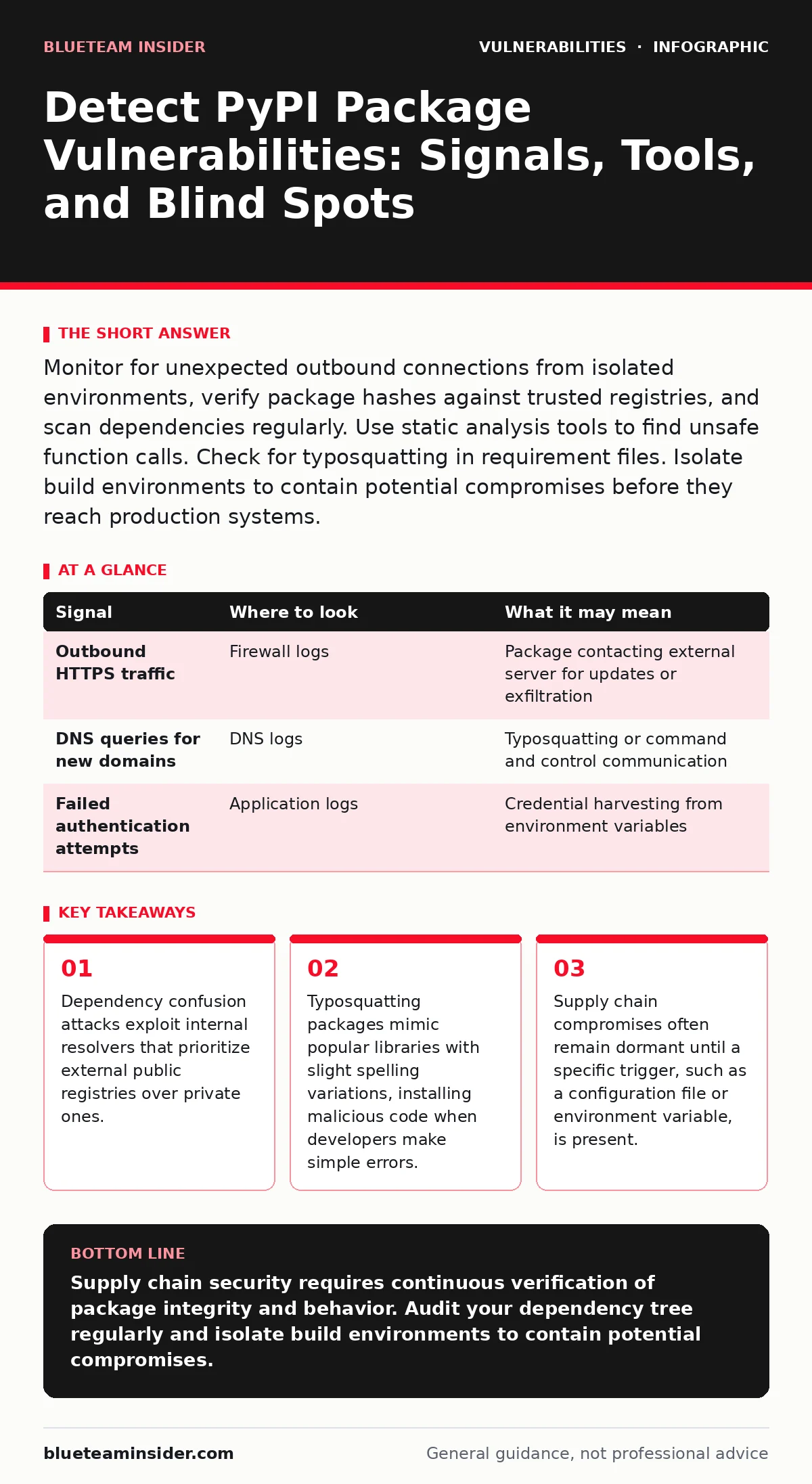
Monitor for unexpected outbound connections from isolated environments, verify package hashes against trusted registries, and scan dependencies regularly. Use static analysis tools to find unsafe function calls. Check for typosquatting in requirement files. Isolate build environments to contain potential compromises before they reach production systems.
Identify Anomalous Network Behavior in Logs
Package vulnerabilities often manifest through unexpected network activity. A compromised library may attempt to exfiltrate data or call back to a command and control server. You must monitor outbound traffic from build servers and development environments. Standard libraries rarely initiate external connections during installation or execution. Any HTTP or HTTPS request from a package manager process warrants immediate investigation.
Look for connections to unknown domains or IP addresses. Check for traffic on non-standard ports. A package that suddenly starts sending data to a new endpoint may be compromised. This behavior often occurs during the installation phase when the package executes setup scripts. These scripts run with elevated privileges in many environments.
| Signal | Where to look | What it may mean |
|---|---|---|
| Outbound HTTPS traffic | Firewall logs | Package contacting external server for updates or exfiltration |
| DNS queries for new domains | DNS logs | Typosquatting or command and control communication |
| Failed authentication attempts | Application logs | Credential harvesting from environment variables |
Detect Integrity Mismatches in Package Metadata
Package integrity is the first line of defense. Every package on PyPI has a cryptographic hash. You must verify that the hash of the downloaded package matches the hash recorded in the index. Mismatches indicate tampering or interception. Use tools that verify hashes automatically. Manual verification is error-prone and slow.
Check your requirements files for pinned versions. Floating version numbers allow attackers to push malicious updates to older, vulnerable versions. Pinning ensures you receive the exact code you tested. If a dependency updates unexpectedly, investigate the change. Review the diff between versions. Look for added imports or new network requests.
Scan Dependencies for Known Vulnerabilities
Static analysis tools identify known vulnerabilities in your dependency tree. These tools compare your installed packages against databases of reported issues. Run these scans in your continuous integration pipeline. Catching a vulnerability before deployment prevents it from reaching production. Schedule regular scans to catch newly disclosed issues.
Do not rely solely on automated scanners. They may miss logic flaws or context-specific vulnerabilities. Combine scanning with manual review of high-risk packages. Focus on packages that handle authentication, encryption, or file I/O. These components are common targets for attackers. Review the source code of critical dependencies if possible.
Monitor for Typosquatting and Dependency Confusion
Typosquatting packages have names similar to popular libraries. Developers may accidentally install them by misspelling the package name. These packages often contain malicious code that steals credentials or installs backdoors. Check your requirement files for spelling errors. Use tools that detect potential typosquatting candidates.
Dependency confusion occurs when an internal package manager prioritizes public registries over private ones. An attacker can upload a package with an internal name to PyPI. The internal resolver downloads the malicious package instead of the legitimate internal one. Ensure your package manager is configured to prefer private sources. Restrict access to internal registries.
Analyze Package Installation Scripts for Side Effects
Many packages use setup scripts to install dependencies or configure the environment. These scripts execute arbitrary code during installation. Attackers often hide malicious payloads in these scripts. Review the setup script of any package before installation. Look for network requests, file writes, or process executions.
Isolate the installation environment. Use virtual environments or containers to run setup scripts. This containment prevents malicious code from affecting the host system. Monitor the filesystem for changes during installation. Unexpected files or directories may indicate a compromise. Check for modifications to system binaries or configuration files.
Identify Blind Spots in Supply Chain Monitoring
Most organizations focus on direct dependencies. They ignore transitive dependencies, which are libraries required by your direct dependencies. Attackers often target these lower-level packages because they receive less scrutiny. A single compromised transitive dependency can affect thousands of applications. You must map your entire dependency tree.
Another blind spot is the build environment itself. If the build server is compromised, attackers can inject malicious code into any package. Verify the integrity of the build tools. Use reproducible builds to ensure consistency. Check for unauthorized changes to build scripts. Monitor the build server for unusual activity.
Implement Continuous Verification and Isolation
Continuous verification ensures that your supply chain remains secure over time. Package vulnerabilities are discovered daily. You must re-scan your dependencies regularly. Automate this process to reduce manual effort. Integrate verification into your deployment pipeline. Block deployments that contain vulnerable packages.
Isolation limits the impact of a compromise. Use least privilege principles for your build and runtime environments. Restrict network access for build servers. Allow only necessary outbound connections. This containment prevents lateral movement if a package is compromised. Regularly review and update your security policies.
For deeper context on how to structure these checks, see our guide on infrastructure as code scanning. Understanding how to secure the underlying infrastructure helps you protect the packages running on it. Additionally, review our guide on container image scanning to ensure your deployment artifacts are clean. You may also find threat modeling helpful in identifying potential attack vectors in your supply chain.
Key takeaways
- Dependency confusion attacks exploit internal resolvers that prioritize external public registries over private ones.
- Typosquatting packages mimic popular libraries with slight spelling variations, installing malicious code when developers make simple errors.
- Supply chain compromises often remain dormant until a specific trigger, such as a configuration file or environment variable, is present.
Supply chain security requires continuous verification of package integrity and behavior. Audit your dependency tree regularly and isolate build environments to contain potential compromises.
Frequently asked questions
How do I know if a PyPI package is compromised?
Check for unexpected network connections, verify package hashes, and scan for known vulnerabilities. Review the package source code for suspicious scripts.
What is the difference between direct and transitive dependencies?
Direct dependencies are packages you explicitly install. Transitive dependencies are packages required by your direct dependencies. Both can be vulnerable.
Can I prevent typosquatting attacks?
Use tools that check package names against known libraries. Pin package versions and verify hashes. Educate developers to double-check package names.
Why is isolation important for package installation?
Isolation limits the damage if a malicious package executes. Virtual environments and containers contain the execution, preventing impact on the host system.
How this guide was produced: written by the BlueTeam Insider editorial team with AI assistance, checked against the public references listed below, and reviewed when the facts change. See our editorial policy or report an error.