Pretexting vs Phishing: The Critical Difference in Social Engineering Attacks
Pretexting relies on a fabricated story to build trust, while phishing uses deceptive messages to steal credentials directly through urgency.

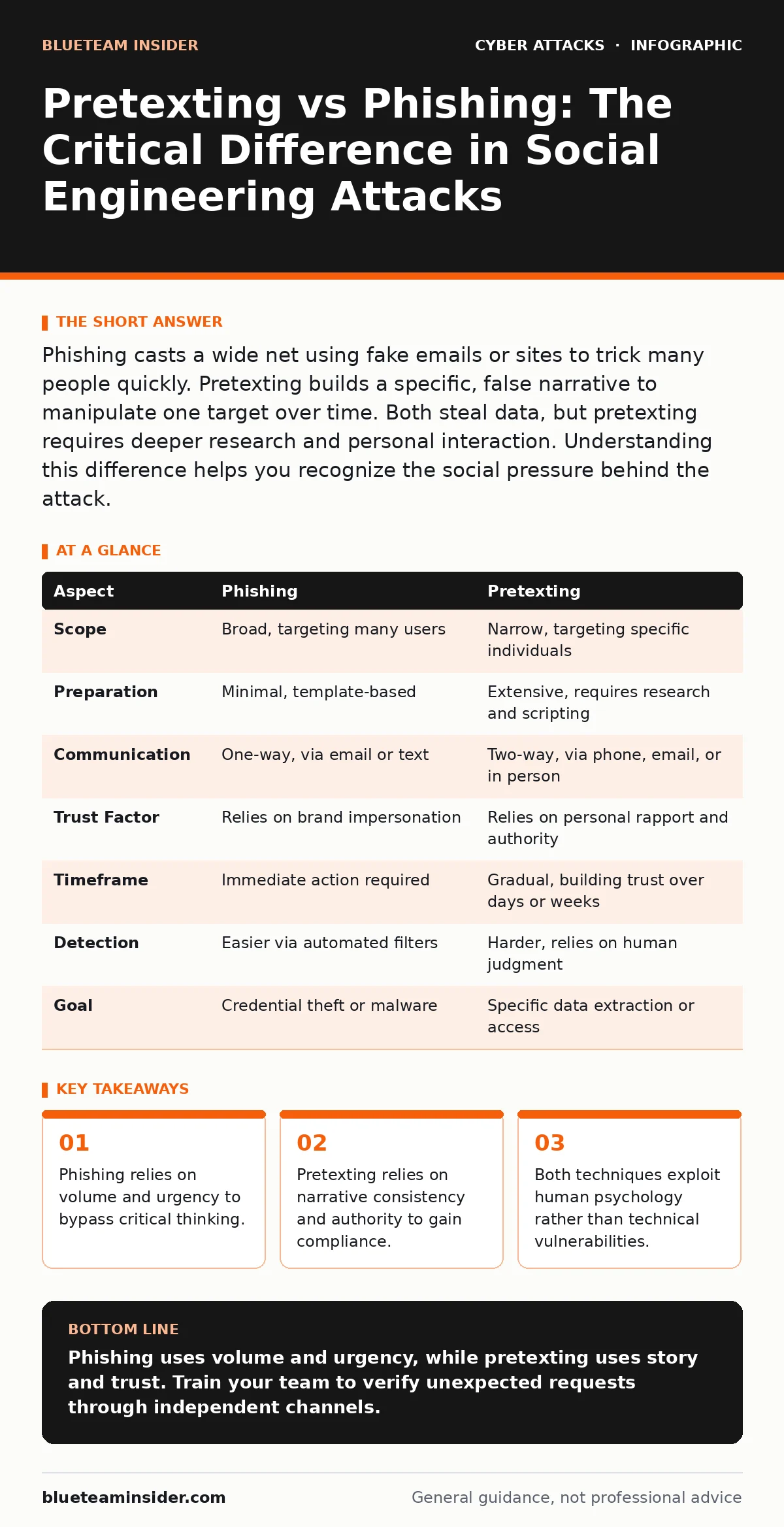
Phishing casts a wide net using fake emails or sites to trick many people quickly. Pretexting builds a specific, false narrative to manipulate one target over time. Both steal data, but pretexting requires deeper research and personal interaction. Understanding this difference helps you recognize the social pressure behind the attack.
The Core Difference Between Pretexting vs Phishing
Pretexting and phishing are both forms of social engineering, which is the art of manipulating people into breaking security procedures. The fundamental difference lies in the relationship and the timeline. It relies on speed and volume. Pretexting is a targeted conversation where the attacker creates a false scenario, or pretext, to establish trust with a specific victim. It relies on patience and story consistency.
While phishing asks you to act immediately, pretexting asks you to help. The attacker in a pretexting scenario might pretend to be IT support, a vendor, or a colleague needing urgent assistance. This fabricated role allows them to ask for information that a direct request would never yield. You might ignore a random email asking for your password, but you are likely to help a "colleague" who claims they are locked out of their account and need your verification code.
What Is Phishing?
Phishing is the most common entry point for cyber attacks. It typically begins with a deceptive communication, such as an email, text message, or instant message. The message appears to come from a trusted source, like a bank, a cloud provider, or a company executive. The goal is to create a sense of urgency or fear.
The message often contains a link to a fraudulent website that looks identical to the legitimate one. When you enter your login details, the attacker captures them. This technique exploits the human tendency to follow instructions from perceived authority figures. It does not require the attacker to know anything specific about you, other than that you use the targeted service. This makes it easy to scale.
What Is Pretexting?
Pretexting is a specialized form of social engineering that involves creating an elaborate, false scenario. The attacker researches their target beforehand, gathering information from public sources like social media or company directories. They then craft a story that justifies their request for sensitive information.
Imagine an attacker calls a help desk pretending to be a new employee who forgot their password. They provide correct personal details, such as their employee ID and department, which they found online. The help desk agent, trusting the story, resets the password. The attacker has now gained access without breaking any technical controls. This method is slower and more labor-intensive than phishing, but it is highly effective against targets with strong technical defenses.
Point-by-Point Comparison
| Aspect | Phishing | Pretexting |
|---|---|---|
| Scope | Broad, targeting many users | Narrow, targeting specific individuals |
| Preparation | Minimal, template-based | Extensive, requires research and scripting |
| Communication | One-way, via email or text | Two-way, via phone, email, or in person |
| Trust Factor | Relies on brand impersonation | Relies on personal rapport and authority |
| Timeframe | Immediate action required | Gradual, building trust over days or weeks |
| Detection | Easier via automated filters | Harder, relies on human judgment |
| Goal | Credential theft or malware | Specific data extraction or access |
When to Choose Which Defense
You cannot stop all attacks, but you can prioritize your defenses based on the threat model. Understanding when each technique is likely to be used helps you allocate resources effectively.
Choose anti-phishing measures when:
- You have a large user base with varying levels of security awareness.
- You rely heavily on email for business communication.
- You need to protect against automated, high-volume attacks.
- Technical controls like email authentication are easy to implement.
Choose anti-pretexting measures when:
- You handle highly sensitive data that requires manual verification.
- Your staff interacts directly with customers or partners.
- You have insider threats or compromised credentials that attackers might use.
- You need to protect against targeted attacks on executives or IT staff.
See also: Scareware Pop Up: How to Spot Fake Alerts and Stop the Threat · Phishing Defenses: Answers to 10 Critical Questions
Overlapping Defenses and Human Factors
Both attacks exploit human psychology, so technical controls alone are insufficient. You must combine technology with training. Email authentication protocols help stop phishing by verifying the sender's identity. However, they do not stop a pretexting attack that uses a legitimate, compromised account.
Training must go beyond simple awareness. Staff need to understand the mechanics of pretexting, such as why an attacker would call instead of email. They should know that legitimate IT staff will never ask for passwords or verification codes. Implementing strict verification procedures for sensitive requests is vital. This includes calling back known numbers or using out-of-band verification methods.
Related Security Considerations
Social engineering often combines with other techniques. Attackers might use email spoofing to make their phishing emails appear legitimate. They might use password spraying to test stolen credentials across multiple accounts. Understanding these related threats helps you see the full picture.
Incident response plans should include procedures for handling suspected social engineering. If an employee falls for a pretexting attack, the response must be swift to limit damage. Login alerts can help detect unauthorized access resulting from these attacks.
While bot protection stops automated attacks, it does not stop human-led pretexting. Man-in-the-middle attacks can intercept data during a conversation, adding another layer of risk. Shoulder surfing is a physical form of pretexting where attackers observe credentials. Baiting attacks use curiosity, similar to phishing, but often involve physical media.
Key takeaways
- Phishing relies on volume and urgency to bypass critical thinking.
- Pretexting relies on narrative consistency and authority to gain compliance.
- Both techniques exploit human psychology rather than technical vulnerabilities.
Phishing uses volume and urgency, while pretexting uses story and trust. Train your team to verify unexpected requests through independent channels.
Frequently asked questions
Can email filters stop pretexting?
No, because pretexting often uses legitimate accounts or phone calls, bypassing email filters entirely.
How do I know if a call is pretexting?
Look for pressure, urgency, or requests for sensitive information that violate standard procedures.
Is pretexting illegal?
Yes, pretexting is a form of fraud and is illegal in many jurisdictions.
Does multi-factor authentication stop pretexting?
It helps, but attackers may try to steal the second factor during the conversation.
How this guide was produced: written by the BlueTeam Insider editorial team with AI assistance, checked against the public references listed below, and reviewed when the facts change. See our editorial policy or report an error.