Difference Between Threat Modeling and Risk Assessment: Clear Distinctions
Threat modeling maps attack paths before code exists, while risk assessment calculates the financial impact of known vulnerabilities after deployment.

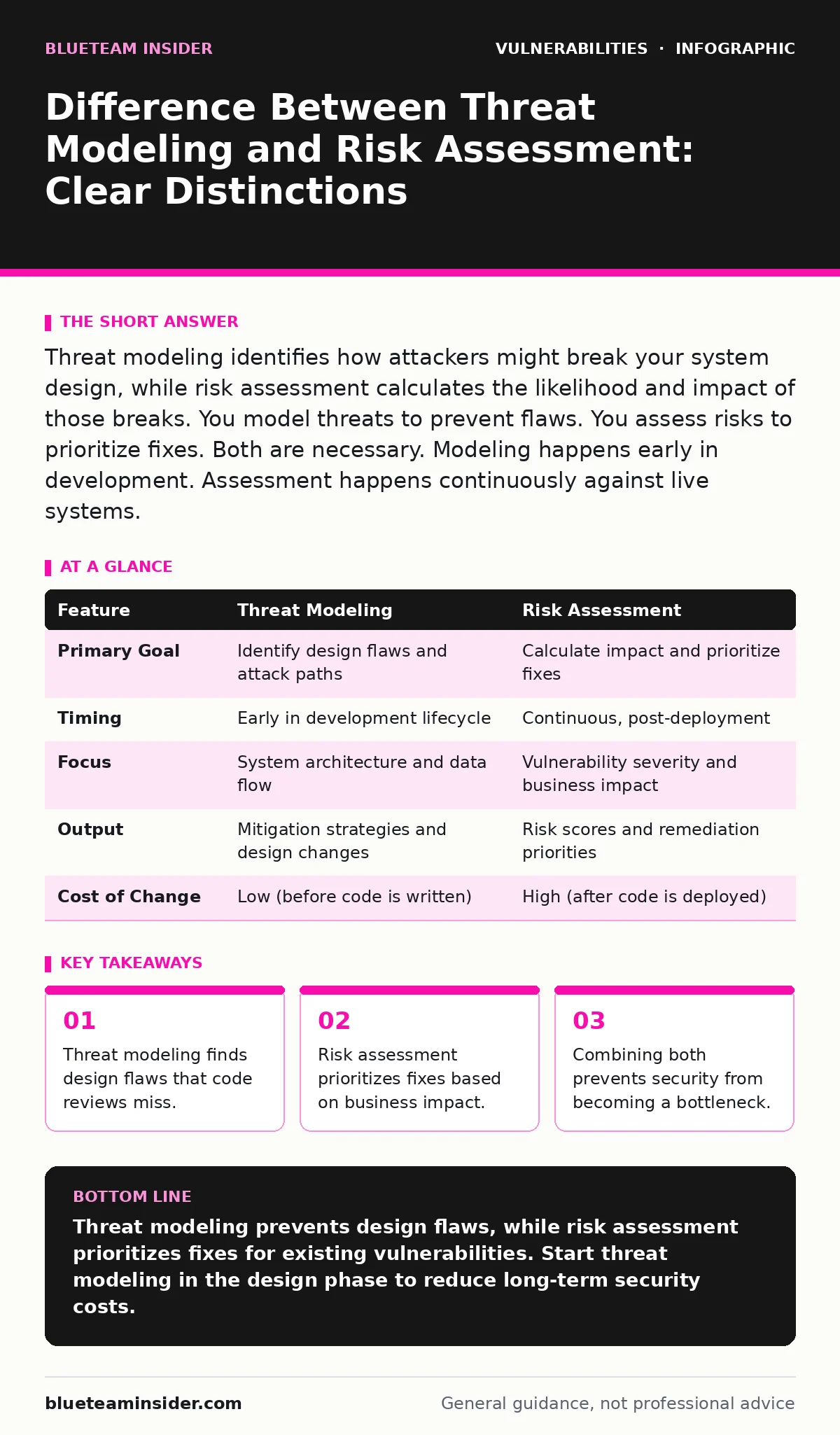
Threat modeling identifies how attackers might break your system design, while risk assessment calculates the likelihood and impact of those breaks. You model threats to prevent flaws. You assess risks to prioritize fixes. Both are necessary. Modeling happens early in development. Assessment happens continuously against live systems.
What is the difference between threat modeling and risk assessment?
Threat modeling identifies potential attack vectors against a system’s design, while risk assessment evaluates the probability and impact of those attacks occurring. Threat modeling is proactive and structural. It asks how an attacker could bypass controls. Risk assessment is reactive and quantitative. It asks how much damage a specific vulnerability will cause. You use threat modeling to build securely. You use risk assessment to manage existing security debt.
When should you perform threat modeling versus risk assessment?
Perform threat modeling during the architecture and design phases of development. This is when changing the system structure is cheap and easy. Risk assessment occurs continuously after deployment. It evaluates live systems against emerging threats. Suppose you design a new API. You model threats to ensure authentication is robust. Once the API is live, you assess risks from new exploits targeting that authentication method. Modeling prevents; assessment mitigates.
How does threat modeling prevent vulnerabilities before they exist?
Threat modeling forces engineers to think like attackers during the design phase. You map data flows and trust boundaries. You identify where data enters and leaves the system. This process reveals logical flaws that static code analysis cannot find. For example, you might discover that a component trusts input from an unauthenticated source. Fixing this in design costs nothing. Fixing it after deployment requires refactoring and potential downtime. This approach aligns with best practices for change management for security patches by reducing the volume of critical fixes needed later.
What is the hidden cost of skipping threat modeling?
Skipping threat modeling creates technical debt that compounds over time. Without a model, you assume the system is secure by default. This assumption fails when attackers find novel paths. You then discover flaws during penetration testing or after a breach. The cost of fixing a design flaw in production is significantly higher than in design. You must rewrite code, update documentation, and retrain staff. This delay also increases exposure window. Attackers often exploit known design patterns. A model helps you anticipate these patterns.
How does risk assessment prioritize security efforts?
Risk assessment assigns a value to each identified threat. It considers likelihood and impact. High-impact, high-likelihood threats get immediate attention. Low-impact, low-likelihood threats may be accepted. This prioritization ensures you spend resources where they matter most. You cannot fix every vulnerability. Risk assessment tells you which ones to fix first. It balances security needs against business constraints. This process helps you justify security spending to leadership. It turns abstract fears into concrete numbers.
See also: How External Attack Surface Scanning Works and Its Limits · Responsible Disclosure Best Practices for Secure Software
Why does risk assessment fail without threat modeling?
Risk assessment relies on a complete inventory of threats. If you did not model threats, you missed some. You cannot assess the risk of a threat you do not know exists. This leads to blind spots. Attackers exploit these blind spots. Threat modeling ensures you have a comprehensive list of potential attacks. Risk assessment then ranks them. Without modeling, your risk register is incomplete. You may focus on minor issues while ignoring major structural weaknesses. This misallocation of resources leaves you vulnerable.
| Feature | Threat Modeling | Risk Assessment |
|---|---|---|
| Primary Goal | Identify design flaws and attack paths | Calculate impact and prioritize fixes |
| Timing | Early in development lifecycle | Continuous, post-deployment |
| Focus | System architecture and data flow | Vulnerability severity and business impact |
| Output | Mitigation strategies and design changes | Risk scores and remediation priorities |
| Cost of Change | Low (before code is written) | High (after code is deployed) |
How do you integrate both processes effectively?
Integrate threat modeling into your software development lifecycle. Make it a mandatory step before coding begins. Use the output of threat modeling to inform your risk assessment. When new vulnerabilities emerge, update your threat model. Then reassess risks. This creates a feedback loop. You continuously improve your design and your risk posture. This approach prevents security from being an afterthought. It embeds security into the culture. You should also consider related topics like server-side request forgery (SSRF) when modeling cloud architectures, as these require specific design controls.
What are the common mistakes in threat modeling?
Teams often treat threat modeling as a one-time event. Security evolves. New technologies introduce new threats. You must update your model regularly. Another mistake is involving only security engineers. Developers and architects must participate. They understand the system best. Without their input, the model is theoretical and inaccurate. Also, do not ignore third-party components. They are part of your attack surface. This is especially relevant when dealing with firmware vulnerabilities in embedded devices, where the supply chain adds complexity.
How does threat modeling handle complex dependencies?
Modern systems rely on many external services. Threat modeling must map these dependencies. You must identify where trust is granted. You must ensure that a breach in one component does not compromise others. This is difficult with microservices. Each service has its own attack surface. You must model the interactions between services. This helps you identify subdomain takeover risks if you use dynamic hosting. It also helps you manage out-of-band patches for critical dependencies. Modeling these dependencies ensures you do not have single points of failure.
What is the role of risk assessment in incident response?
Risk assessment helps you prepare for incidents. By knowing the most likely and impactful threats, you can create specific response plans. You know what to monitor for. You know what data is at risk. This reduces response time. When an incident occurs, you can quickly assess the impact. You can prioritize containment and recovery. This structured approach minimizes damage. It also helps you communicate with stakeholders. You can explain the situation clearly. This reduces panic and confusion.
How do you measure the success of threat modeling?
Success is measured by the number of flaws found early. If threat modeling finds a critical design flaw before coding, it is a success. You also measure the reduction in high-severity vulnerabilities in production. Fewer critical bugs mean better design. You can track the time saved in debugging and fixing. This demonstrates the value of threat modeling. It shows that investing time upfront saves time later. This metric helps you justify the process to management. It proves that security engineering is efficient.
What about advanced vulnerabilities like use-after-free?
Some vulnerabilities are hard to model because they depend on specific code behavior. Use-after-free vulnerabilities occur when code accesses memory after it has been freed. Threat modeling can identify where memory management is critical. It can flag areas where manual memory management is used. Risk assessment can then prioritize these areas for rigorous testing. You cannot model every line of code. But you can model the components where such errors are likely. This targeted approach makes security testing more effective.
How does threat modeling support responsible disclosure?
Threat modeling helps you understand your attack surface. You can quickly assess the validity of a report. You can determine the impact. This speeds up the response process. It also helps you communicate with the reporter. You can provide accurate information. This builds trust. It encourages more researchers to report issues. This aligns with responsible disclosure practices. You turn potential PR crises into opportunities for improvement.
What is the impact of server-side template injection?
Server-side template injection allows attackers to execute code via template engines. Threat modeling identifies where templates are processed. It flags inputs that reach template engines. Risk assessment evaluates the impact of such an injection. If the template engine has access to sensitive data, the risk is high. You can then implement strict input validation. You can also restrict template functionality. This layered defense reduces the likelihood of successful exploitation. Modeling this specific threat ensures you do not overlook it.
Key takeaways
- Threat modeling finds design flaws that code reviews miss.
- Risk assessment prioritizes fixes based on business impact.
- Combining both prevents security from becoming a bottleneck.
Threat modeling prevents design flaws, while risk assessment prioritizes fixes for existing vulnerabilities. Start threat modeling in the design phase to reduce long-term security costs.
Frequently asked questions
Can I skip threat modeling for small projects?
No. Small projects can have critical flaws. Threat modeling scales down. You can use a simplified version. It still saves time and money. Skipping it risks security debt.
How often should I update my threat model?
Update it whenever you change the architecture. Also update it when new threats emerge. Regular reviews ensure accuracy. This keeps your security posture current.
Who should perform risk assessment?
Security teams lead risk assessment. Business owners provide impact data. Developers provide technical details. Collaboration ensures accurate results. Shared ownership improves outcomes.
Is threat modeling only for software?
No. It applies to hardware, networks, and processes. Any system with an attack surface needs modeling. This includes IoT devices and cloud configurations. Broad application enhances security.
How this guide was produced: written by the BlueTeam Insider editorial team with AI assistance, checked against the public references listed below, and reviewed when the facts change. See our editorial policy or report an error.