Security Advisory Reading: How to Parse Alerts for Real Risk
Most teams waste time reading security advisories by focusing on severity scores instead of the specific configuration required for exploitation.

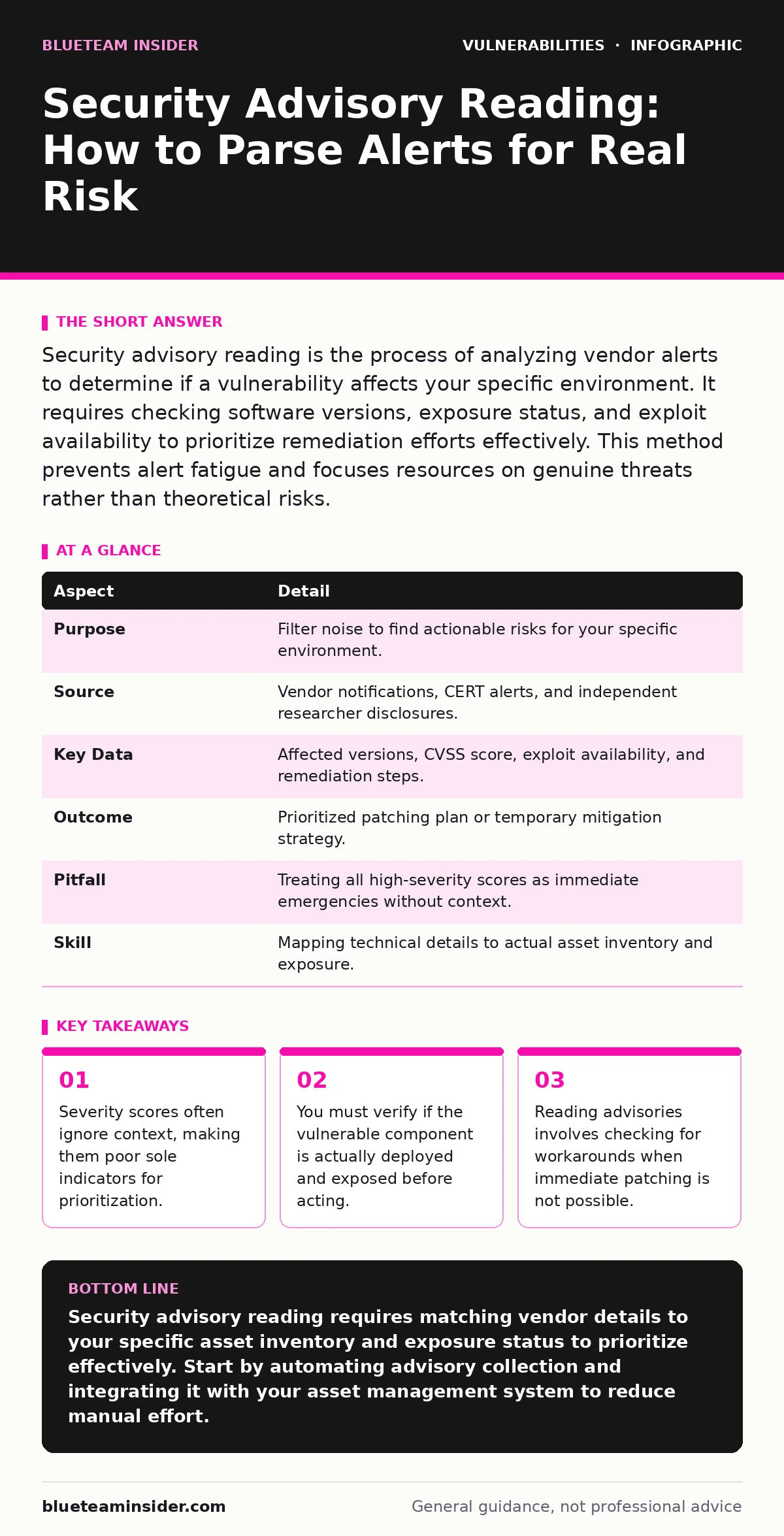
Security advisory reading is the process of analyzing vendor alerts to determine if a vulnerability affects your specific environment. It requires checking software versions, exposure status, and exploit availability to prioritize remediation efforts effectively. This method prevents alert fatigue and focuses resources on genuine threats rather than theoretical risks.
The Mechanics of Advisory Analysis
Imagine receiving a flood of letters from your insurance company warning about every possible disaster. You cannot fix every roof before checking which storms are actually heading your way. Security advisory reading works the same way. It is the structured process of evaluating vendor notifications to determine if a disclosed vulnerability impacts your specific systems. This practice separates noise from signal in a crowded threat environment.
Vendors publish these documents when they identify flaws in their software. The document typically lists the flaw, affected versions, and recommended fixes. Your job is not just to read them, but to translate the text into action items. This translation requires understanding your own infrastructure better than the vendor understands their code. You must map the advisory details to your asset inventory to find the intersection of risk.
| Aspect | Detail |
|---|---|
| Purpose | Filter noise to find actionable risks for your specific environment. |
| Source | Vendor notifications, CERT alerts, and independent researcher disclosures. |
| Key Data | Affected versions, CVSS score, exploit availability, and remediation steps. |
| Outcome | Prioritized patching plan or temporary mitigation strategy. |
| Pitfall | Treating all high-severity scores as immediate emergencies without context. |
| Skill | Mapping technical details to actual asset inventory and exposure. |
Deconstructing the Advisory Structure
A standard security advisory contains several distinct sections. The title usually names the product and a unique identifier. The description explains the technical flaw in plain language. You must look for the "Affected Versions" section first. This list tells you which software builds contain the bug. If your environment runs an older or newer version than listed, you can often dismiss the alert immediately.
The severity score provides a quick baseline. This score combines the base metrics of the flaw with environmental factors. It does not tell you if the flaw is reachable in your network. You must ignore the score if you do not know the exposure status. The remediation section offers patches or configuration changes. Some advisories also include workarounds. These are temporary fixes that reduce risk until a permanent patch is available. Always note if a workaround is listed.
Evaluating Real-World Exposure
Finding a match in your inventory is only step one. You must then determine if the vulnerable service is exposed to untrusted networks. A flaw in an internal database server poses less risk than the same flaw in a public-facing web server. This distinction drives your prioritization. You need to know who can talk to the service. If a firewall blocks all inbound traffic to the service, the risk drops significantly.
Consider the attack path. An attacker must reach the vulnerable component to exploit it. If the component sits behind multiple layers of authentication and network segmentation, the effective risk is lower. This analysis prevents you from treating every vulnerability as a critical emergency. It allows you to schedule patches during maintenance windows for lower-risk items. High-risk items that are exposed to the internet require immediate attention or mitigation.
The Misuse of Severity Scores
Many teams rely solely on severity scores to prioritize work. This is a common mistake. Scores are calculated based on theoretical maximum impact. They do not account for your specific defenses. A flaw with a high score might require user interaction to exploit. If your users never open files from unknown sources, the practical risk is low. Conversely, a medium-score flaw that allows automatic execution on a public server is dangerous.
You must look beyond the number. Read the technical description to understand the exploit conditions. Does it require authentication? Does it require specific input? Is there a known exploit in the wild? The presence of active exploitation changes the urgency dramatically. A flaw with an active exploit is a ticking clock. A flaw with no known exploit is a theoretical risk. Treat them differently. This nuanced view prevents burnout and ensures you address real threats.
Common Interpretation Errors
People often get wrong the scope of affected systems. Vendors sometimes list broad version ranges. You must verify the exact build numbers in your environment. A minor version difference might mean you are safe. Another error is ignoring the "Unaffected" section. Some advisories explicitly list versions that do not contain the flaw. Skipping this section leads to unnecessary patching efforts. You might spend hours preparing patches for systems that are already secure.
Another error is assuming a patch fixes everything. Some patches introduce new issues or require configuration changes. You must test patches in a non-production environment first. This step prevents breaking critical services. You also need to check for dependencies. A patch for one component might require an update to another. Ignoring these dependencies can lead to system instability. Always review the full advisory for such notes.
See also: Responsible Disclosure Best Practices for Secure Software
Integrating with Security Workflows
Security advisory reading should not be a manual, ad-hoc task. Integrate it into your change management process. Automate the collection of advisories for the software you use. Use tools to match advisories against your asset inventory. This automation reduces the manual effort required for each alert. It ensures you do not miss critical updates. You still need human judgment to prioritize and validate.
This practice connects to broader security disciplines. For instance, understanding firmware update management helps you handle hardware-level advisories that often lack detailed technical guidance. You also need to consider responsible disclosure timelines. Vendors may provide limited details initially to prevent widespread exploitation. As more information becomes available, your risk assessment may change. Stay updated on the evolving details of the vulnerability.
Managing Long-Term Risk
Advisory reading is an ongoing process. New flaws are discovered daily. You must maintain an up-to-date inventory of your assets. Without accurate inventory data, you cannot assess exposure. Regularly review your patch management policies. Ensure they account for different risk levels. Critical systems need faster turnaround times than non-critical ones. This tiered approach ensures you address the most dangerous flaws first.
You should also track trends. Notice if certain products are frequently vulnerable. This insight might lead you to replace aging software with more secure alternatives. Proactive replacement reduces the long-term burden of advisory reading. It shifts your focus from reactive patching to strategic security. This shift improves your overall security posture. You spend less time fighting fires and more time building defenses.
Key takeaways
- Severity scores often ignore context, making them poor sole indicators for prioritization.
- You must verify if the vulnerable component is actually deployed and exposed before acting.
- Reading advisories involves checking for workarounds when immediate patching is not possible.
Security advisory reading requires matching vendor details to your specific asset inventory and exposure status to prioritize effectively. Start by automating advisory collection and integrating it with your asset management system to reduce manual effort.
Frequently asked questions
How do I know if a security advisory applies to my system?
Check the "Affected Versions" section in the advisory. Compare these versions with the software installed on your systems. If your version is not listed, the advisory likely does not apply to you.
What should I do if a patch is not available yet?
Look for workarounds or mitigation steps in the advisory. These might include configuration changes or network restrictions. Implement these temporary fixes to reduce risk until a permanent patch is released.
Why is the CVSS score not enough for prioritization?
CVSS scores measure theoretical severity. They do not account for your specific environment, exposure, or existing defenses. You must consider context to determine real-world risk and prioritize accordingly.
How often should I review security advisories?
Review advisories daily for critical systems and weekly for others. Automate collection to ensure you do not miss alerts. Regular reviews help you stay ahead of emerging threats and maintain a secure environment.
How this guide was produced: written by the BlueTeam Insider editorial team with AI assistance, checked against the public references listed below, and reviewed when the facts change. See our editorial policy or report an error.