Responsible Disclosure Best Practices for Secure Software
Coordinated disclosure prevents chaotic exposure by allowing vendors to patch flaws before attackers exploit them, reducing the window of risk for all users.
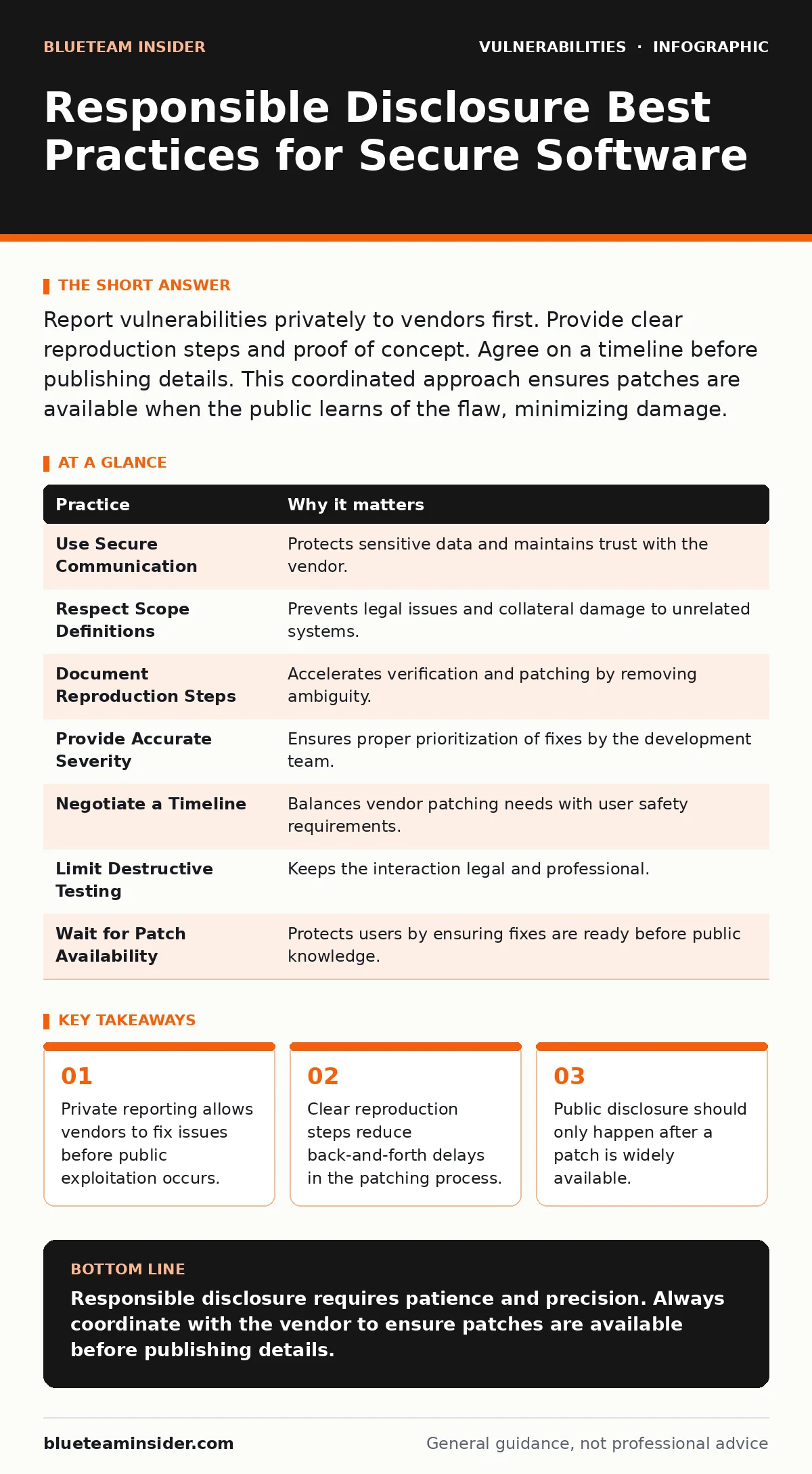
Report vulnerabilities privately to vendors first. Provide clear reproduction steps and proof of concept. Agree on a timeline before publishing details. This coordinated approach ensures patches are available when the public learns of the flaw, minimizing damage.
Establishing a Private Channel
You must report findings through a secure, private channel before sharing any details. Publicly posting a vulnerability on social media or a bug bounty platform without vendor consent creates immediate pressure. This pressure often forces rushed fixes that introduce new bugs. A private channel allows the vendor to assess the severity and scope without public scrutiny.
Imagine you discover a logic flaw in a login system. If you tweet about it, attackers will scan for the issue instantly. If you email the security team, they can prepare a mitigation while you refine your report. Use encrypted email or a dedicated security contact form if available. This step preserves the trust required for long-term collaboration.
1. Use Secure Communication Methods
Reasoning: Unencrypted emails can be intercepted, revealing sensitive details about your findings or the vendor’s infrastructure. This compromises both your safety and the integrity of the disclosure process.
Practical Tip: Send reports via PGP-encrypted email if you know the vendor’s key, or use the vendor’s designated security contact form which is often integrated with ticketing systems.
Defining Scope and Rules of Engagement
Not all systems are fair game. You must determine which assets are in scope for testing. Testing out-of-scope systems can violate terms of service or local laws. It can also disrupt services for innocent users who did not consent to your testing. Clear boundaries prevent legal disputes and ensure the vendor can focus on the intended targets.
Suppose you find a flaw in a third-party CDN used by the target. That CDN might be shared by thousands of other sites. Exploiting it could cause widespread denial of service. Stick to the vendor’s explicitly stated in-scope domains and IP ranges. This discipline protects your legal standing and keeps the focus on the specific product.
2. Respect Scope Definitions
Reasoning: Testing outside defined boundaries can cause collateral damage to unrelated systems and expose you to legal liability for unauthorized access.
Practical Tip: Review the vendor’s security policy or bug bounty program rules to identify explicitly excluded assets, such as staging environments or third-party dependencies.
Providing Reproducible Steps
A vague report is useless to a developer. You must provide exact steps to reproduce the issue. Include the environment, the input data, and the expected versus actual behavior. Without this, the vendor must guess what you did, which wastes time. Time is the most scarce resource in vulnerability remediation.
Imagine you report a cross-site scripting flaw but only say "input is not sanitized." The developer has no idea which field or parameter is affected. You must provide the specific HTTP request or user action that triggers the bug. This clarity accelerates the fix.
3. Document Reproduction Steps Clearly
Reasoning: Developers need precise instructions to verify and fix the issue quickly; ambiguity leads to delayed patches and increased risk.
Practical Tip: Include a minimal proof of concept, such as a curl command or a screenshot of the network traffic, that demonstrates the vulnerability without requiring complex setup.
Assessing Impact Objectively
You must accurately describe the impact of the vulnerability. Do not exaggerate the severity to get attention. Do not minimize it to avoid scrutiny. An accurate assessment helps the vendor prioritize the fix. Misleading severity ratings erode trust and can lead to misallocated resources.
Suppose you find a low-impact information disclosure. Labeling it as critical will cause the vendor to deprioritize your report while they handle actual emergencies. Be honest about what an attacker can actually do. This honesty ensures your high-severity reports are taken seriously in the future.
4. Provide Accurate Severity Ratings
Reasoning: Correct severity assessment allows vendors to triage effectively, ensuring critical issues are patched before less severe ones.
Practical Tip: Use standard frameworks like CVSS to calculate a score, but explain the reasoning behind your rating in plain language for the developer.
Agreeing on a Timeline
You and the vendor must agree on a disclosure timeline. Vendors need time to develop, test, and deploy patches. Users need time to update their systems. Rushing disclosure leaves users exposed. Waiting too long leaves you vulnerable to accusations of silence. A mutual agreement balances these competing needs.
Imagine you find a flaw in a widely used library. The vendor needs four weeks to patch and distribute the update. Agreeing on a six-week public disclosure date gives users two weeks to apply the patch. This buffer reduces the window of exposure.
5. Negotiate a Disclosure Deadline
Reasoning: A mutually agreed timeline ensures users have time to patch before the vulnerability becomes public, reducing the attack surface.
Practical Tip: Propose a standard window, such as 90 days for critical issues, and adjust based on the vendor’s development cycle and the severity of the flaw.
See also: Difference Between Threat Modeling and Risk Assessment: Clear Distinctions
Avoiding Exploitation During Testing
You must not exploit the vulnerability to prove its existence if doing so causes damage. Do not steal data, delete records, or disrupt services. Your goal is to demonstrate the flaw, not to abuse it. Exploitation during testing can be illegal and destroys trust.
Suppose you find a way to access user emails. Reading one email to prove access is often considered acceptable in some contexts, but reading many or deleting them is not. Stick to the minimum necessary action to demonstrate the issue. This restraint keeps the interaction professional and legal.
6. Limit Testing to Non-Destructive Actions
Reasoning: Destructive testing can cause data loss or service disruption, leading to legal consequences and loss of trust with the vendor.
Practical Tip: Use read-only queries or isolated test accounts to demonstrate the vulnerability without affecting production data or availability.
Publishing After Patching
You should only publish details after the vendor has released a patch. Public disclosure before patching gives attackers a free roadmap. It also punishes users who have not yet updated. Coordinated disclosure protects the ecosystem. Publishing too early is considered irresponsible.
Imagine you find a flaw in a popular operating system. If you publish before the patch is out, every script kiddie will exploit it within hours. If you wait until the patch is widely available, users are protected when they see your article. This timing is the core of responsible disclosure.
7. Wait for Patch Availability
Reasoning: Disclosing details before a fix is available exposes users to immediate exploitation, undermining the purpose of the report.
Practical Tip: Confirm with the vendor that the patch is released and available to all users before publishing any technical details or write-ups.
| Practice | Why it matters |
|---|---|
| Use Secure Communication | Protects sensitive data and maintains trust with the vendor. |
| Respect Scope Definitions | Prevents legal issues and collateral damage to unrelated systems. |
| Document Reproduction Steps | Accelerates verification and patching by removing ambiguity. |
| Provide Accurate Severity | Ensures proper prioritization of fixes by the development team. |
| Negotiate a Timeline | Balances vendor patching needs with user safety requirements. |
| Limit Destructive Testing | Keeps the interaction legal and professional. |
| Wait for Patch Availability | Protects users by ensuring fixes are ready before public knowledge. |
Handling Silence and Escalation
What happens if the vendor does not respond? You must have a plan for silence. Ignoring a vendor’s silence is not an option. Ignoring your own silence is not an option. You must escalate responsibly. This might mean contacting higher management or using a trusted intermediary.
Suppose you report a critical flaw and hear nothing for two months. The risk remains high. You can contact the vendor’s public relations team or a trusted industry body. This pressure should be professional, not threatening. It signals that you are serious about security, not just attention.
For deeper technical context on how these vulnerabilities manifest, see our guides on API vulnerabilities and server-side template injection. Understanding the specific flaw helps you communicate its impact more effectively. Also, review firmware vulnerabilities to understand why some patches take longer to deploy.
Key takeaways
- Private reporting allows vendors to fix issues before public exploitation occurs.
- Clear reproduction steps reduce back-and-forth delays in the patching process.
- Public disclosure should only happen after a patch is widely available.
Responsible disclosure requires patience and precision. Always coordinate with the vendor to ensure patches are available before publishing details.
Frequently asked questions
What if the vendor refuses to fix the vulnerability?
You may need to escalate to higher management or use a trusted intermediary to facilitate communication and pressure for a fix.
How long should I wait before disclosing?
Standard practice is 90 days for critical issues, but this should be negotiated based on the vendor’s patching cycle and the severity of the flaw.
Can I share the vulnerability with a bug bounty program?
Yes, if the program is run by the vendor or a trusted partner, but ensure you follow their specific rules of engagement and scope.
What if I accidentally cause damage during testing?
Immediately notify the vendor, provide full details of what happened, and cooperate fully with their investigation to mitigate the impact.
How this guide was produced: written by the BlueTeam Insider editorial team with AI assistance, checked against the public references listed below, and reviewed when the facts change. See our editorial policy or report an error.