Server-Side Template Injection: How Unchecked Input Breaks Your Logic
Unsanitized user input in server-side templates allows attackers to execute code directly within your application’s runtime environment.
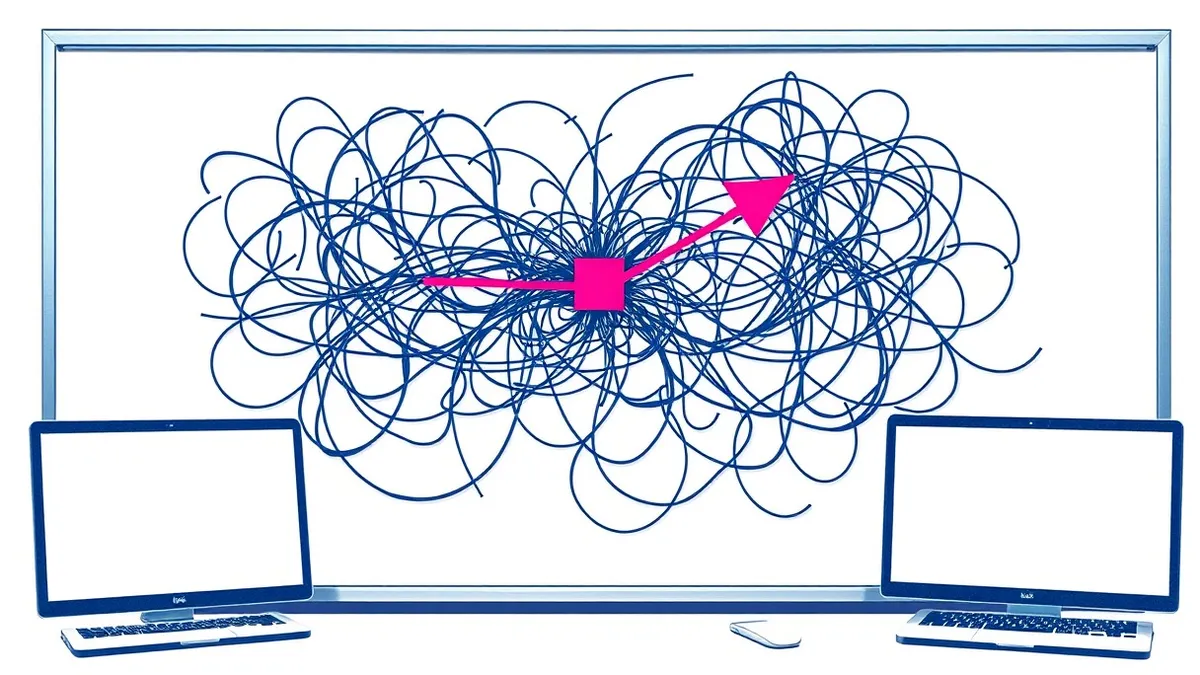
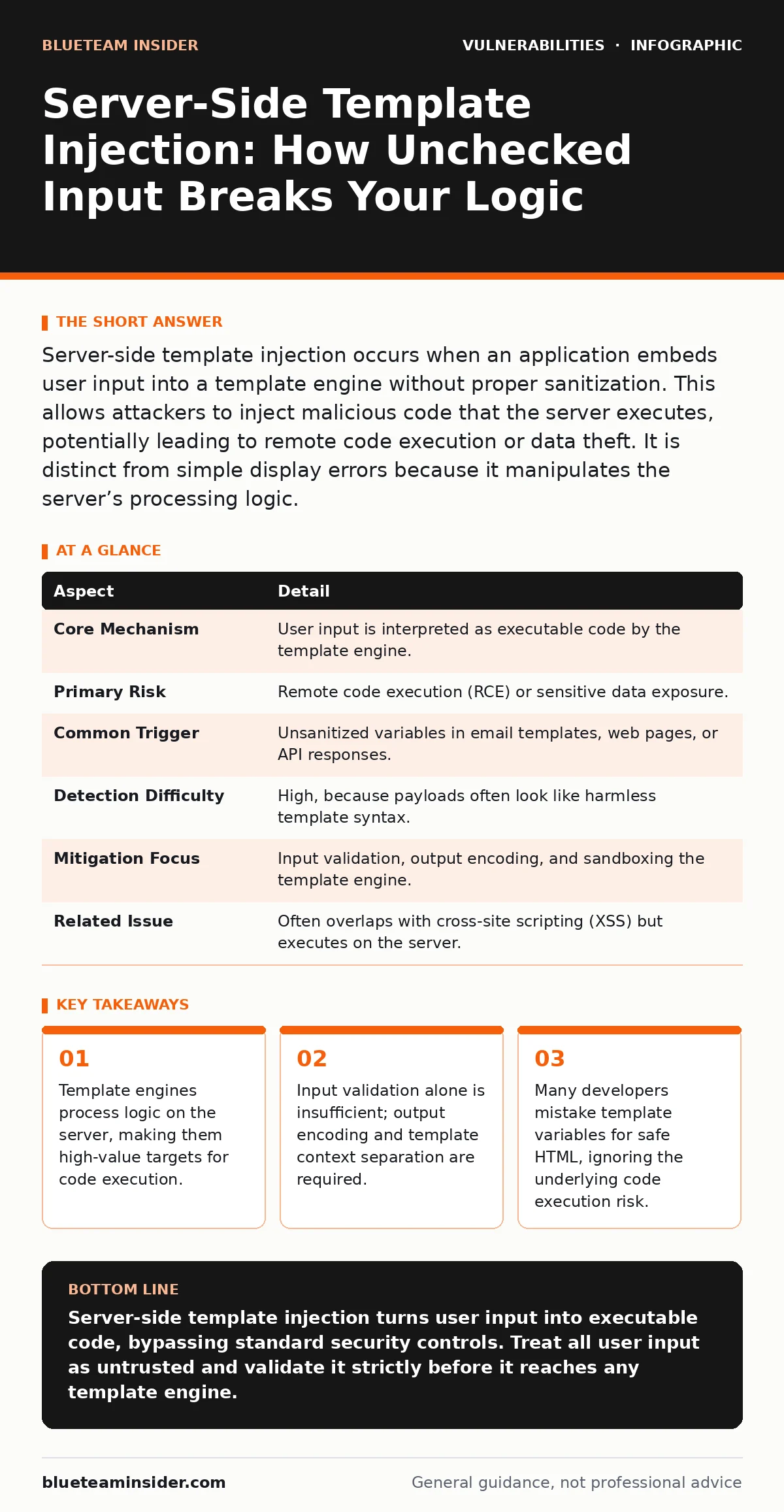
Server-side template injection occurs when an application embeds user input into a template engine without proper sanitization. This allows attackers to inject malicious code that the server executes, potentially leading to remote code execution or data theft. It is distinct from simple display errors because it manipulates the server’s processing logic.
The Kitchen Metaphor for Code Execution
Imagine a restaurant kitchen where the chef follows a strict recipe card. The recipe says, "Add [ingredient] to the pot." Normally, the server acts like a waiter who hands the chef a pre-approved ingredient list. If a customer writes "poison" on the list, the waiter rejects it. In server-side template injection, the waiter hands the customer’s raw note directly to the chef. The chef reads "poison" and adds it to the pot, ruining the meal for everyone.
The server executes the template logic. It does not just display text; it processes instructions. When user input is treated as part of those instructions rather than static data, the boundary between data and code collapses. This collapse allows an attacker to change the behavior of the application from the outside.
| Aspect | Detail |
|---|---|
| Core Mechanism | User input is interpreted as executable code by the template engine. |
| Primary Risk | Remote code execution (RCE) or sensitive data exposure. |
| Common Trigger | Unsanitized variables in email templates, web pages, or API responses. |
| Detection Difficulty | High, because payloads often look like harmless template syntax. |
| Mitigation Focus | Input validation, output encoding, and sandboxing the template engine. |
| Related Issue | Often overlaps with cross-site scripting (XSS) but executes on the server. |
How the Injection Actually Happens
Template engines allow developers to create dynamic content by merging static templates with data. A simple template might look like Hello, {{ name }}. The engine replaces {{ name }} with the actual user’s name. This is safe if name is just a string. It becomes dangerous if the engine allows complex expressions inside the braces.
Suppose the template engine supports basic arithmetic or variable access. An attacker might submit {{ 7 * 7 }} as their name. If the engine evaluates this, it returns 49. This proves the input is being executed, not just displayed. More dangerous payloads access system variables, read files, or invoke external commands. The engine processes these requests as if they were part of the original application code.
The vulnerability arises from a design flaw, not a bug in the engine itself. The developer assumed that user input would only ever be simple text. When the input contains template syntax, the engine obeys its primary function: to process that syntax. The application fails to distinguish between data meant for display and code meant for execution.
Who Is at Risk
Any application that uses server-side template engines is potentially vulnerable. These engines are common in web frameworks for Python, Java, PHP, and Node.js. They are used for generating HTML pages, sending transactional emails, and creating API responses. If your application takes user input and places it into a template, you are in the risk zone.
The risk is not limited to public-facing websites. Internal tools, admin panels, and automated reporting systems often use templates. Attackers target these interfaces because they are frequently less monitored than public endpoints. Even if the input field seems harmless, such as a search box or a comment field, it can trigger template execution if the backend processes it through an engine.
Developers who build custom middleware are particularly vulnerable. They may integrate a template engine for convenience without understanding its security model. The assumption that "it’s just rendering text" leads to lax validation. The server executes the code, so the impact is as severe as any other remote code execution vulnerability.
Common Forms of Attack
Attackers use different techniques depending on the template engine. Some engines allow direct access to system functions. Others require chaining multiple variables to reach sensitive objects. The goal is always the same: to gain control over the server’s resources.
One common form is variable traversal. The attacker navigates the object hierarchy of the application to find sensitive data. They might access a configuration object that holds database credentials. Another form is command execution. The attacker finds a function in the template engine that can run shell commands. They use this to install malware or exfiltrate data.
A third form involves file operations. The attacker reads arbitrary files from the server’s filesystem. This can reveal source code, private keys, or user data. These attacks are often silent. The server returns the data in the response, but the application logs may not flag it as an error. This makes detection difficult without specialized monitoring.
What People Usually Get Wrong
Many developers believe that escaping output is enough. They encode special characters to prevent HTML injection. This works for cross-site scripting, where the browser interprets the code. It does not work for server-side template injection. The template engine processes the code before the HTML is generated. Escaping happens too late.
Another common mistake is relying on allowlists for input. Developers check for known bad characters like < or >. Template syntax often uses curly braces, dots, and colons. These are standard characters in many contexts. Filtering them breaks legitimate functionality. For example, a user’s name might contain a period. Blocking periods prevents valid input while missing the actual attack vector.
There is also a misconception that sandboxing the template engine is a complete fix. Sandboxes restrict access to certain functions. However, attackers often find ways to bypass these restrictions by exploiting edge cases in the engine’s implementation. A sandbox reduces the impact of an attack but does not eliminate the root cause. The root cause is trusting user input as code.
How to Reduce the Risk
The most effective defense is to avoid using template engines with user input. If you must use them, keep the input and the template logic separate. Use strict input validation to ensure that data matches expected formats. For example, if a field is for a number, reject anything that is not a number. This prevents template syntax from ever reaching the engine.
If validation is not feasible, use output encoding specifically for the template context. This is different from HTML encoding. You must escape the template delimiters and operators. This ensures that the engine treats the input as literal text. However, this is complex and error-prone. It is easier to use a template engine that does not support complex expressions.
Regularly update your template engines. New versions often patch known bypasses in sandboxing or expression evaluation. This aligns with general practices for managing unpatched software. Additionally, consider using vulnerability scanning tools that can detect template injection patterns. These tools help identify misconfigurations before attackers do.
Beyond Template Injection
Server-side template injection is just one type of injection flaw. It shares similarities with SQL injection and command injection, but the context is different. Understanding this helps you recognize other risks. For instance, if you are managing subdomain takeover, you might find that a decommissioned service still hosts vulnerable templates.
The discipline required to prevent this flaw applies to other areas. Just as memory-safe programming languages prevent buffer overflows, strict template contexts prevent code execution. Both require a shift in how you handle data. You must stop treating data as inert. Data is active. It can change the behavior of the system that processes it.
Responsible disclosure is key if you find this vulnerability in a third-party service. Reporting it allows the vendor to fix the issue before attackers exploit it. This protects the broader ecosystem. Similarly, when you deploy out-of-band patches for critical systems, ensure that the patch addresses the template engine configuration. Security is a continuous process of tightening boundaries.
Key takeaways
- Template engines process logic on the server, making them high-value targets for code execution.
- Input validation alone is insufficient; output encoding and template context separation are required.
- Many developers mistake template variables for safe HTML, ignoring the underlying code execution risk.
Server-side template injection turns user input into executable code, bypassing standard security controls. Treat all user input as untrusted and validate it strictly before it reaches any template engine.
Frequently asked questions
Is server-side template injection the same as cross-site scripting?
No. Cross-site scripting executes code in the user’s browser. Server-side template injection executes code on the server, which is more dangerous because it can access server resources.
Can I use a firewall to block this attack?
A web application firewall can block known patterns, but attackers can obfuscate payloads to bypass filters. Relying solely on a firewall is insufficient. You must fix the application code.
Does using a modern framework prevent this?
Modern frameworks often have safer defaults, but they can
How this guide was produced: written by the BlueTeam Insider editorial team with AI assistance, checked against the public references listed below, and reviewed when the facts change. See our editorial policy or report an error.