Memory-Safe Languages Explained: Stop Bugs Before They Happen
Switching to memory-safe languages removes entire classes of software defects by enforcing safety rules at compile time rather than relying on runtime luck.

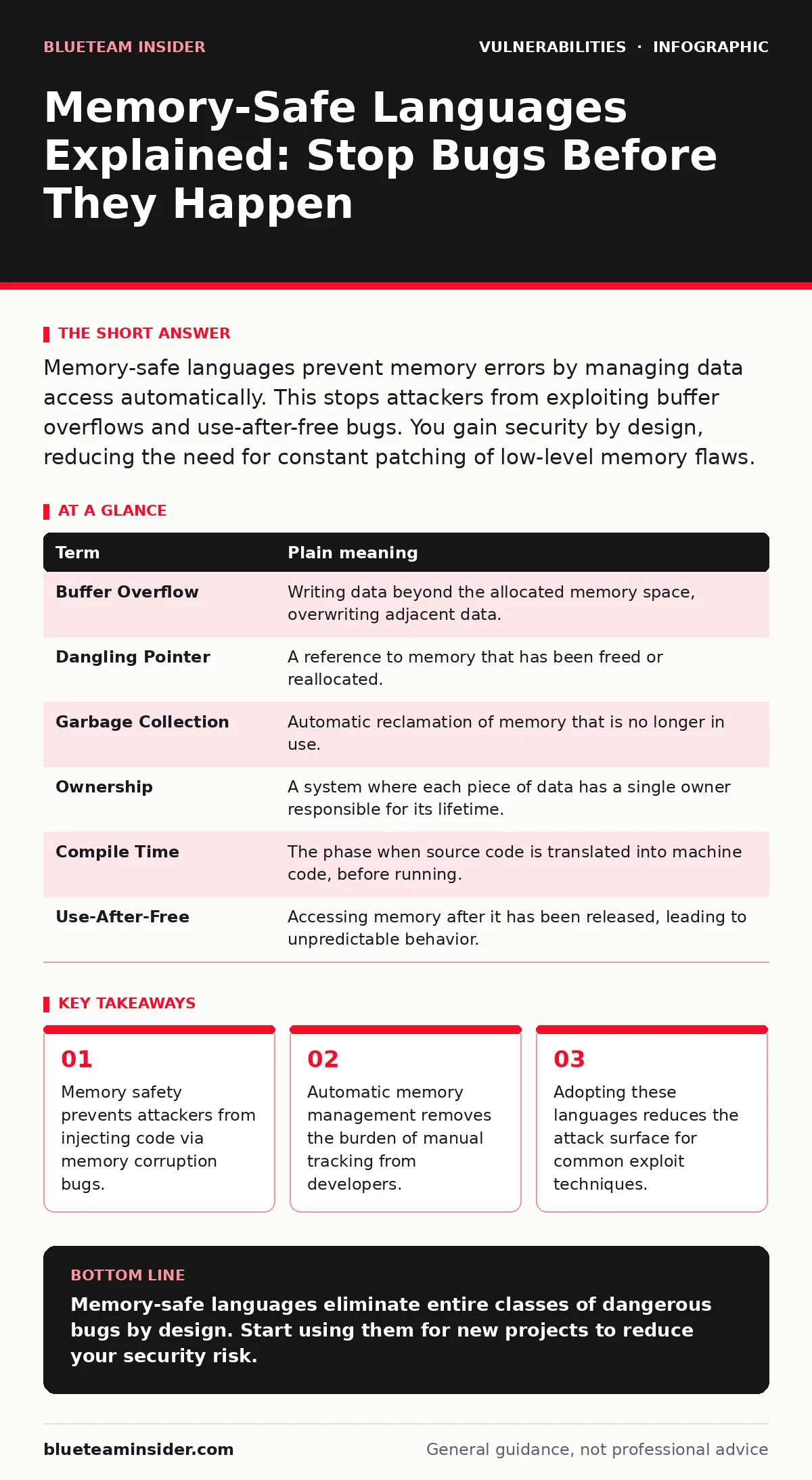
Memory-safe languages prevent memory errors by managing data access automatically. This stops attackers from exploiting buffer overflows and use-after-free bugs. You gain security by design, reducing the need for constant patching of low-level memory flaws.
The Library Book Analogy
Imagine a library where every book is checked out by a patron. In a traditional system, the librarian trusts the patron to return the book to the exact shelf. If the patron forgets, the book is lost. If they place it on the wrong shelf, it might overwrite another book. This is how traditional programming languages like C handle memory. The developer must manually allocate and free memory. A mistake leads to chaos.
Now imagine a library with an automated return system. When a patron finishes a book, they place it in a drop box. The system automatically sorts and shelves it. If the patron tries to read a book they have already returned, the system blocks them. They cannot access data that no longer belongs to them. This is the core promise of memory-safe programming languages. The language itself manages the data lifecycle, preventing errors before the code even runs.
Why Memory Matters
Computer memory is like a grid of storage cells. Programs store data in these cells while running. When a program finishes using a piece of data, it should release that cell for others. If it fails to do so, or if it tries to use a cell after releasing it, the system becomes unstable. Attackers exploit these mistakes. They write malicious code into memory cells that should be empty or protected. This is the root cause of many severe vulnerabilities.
The danger is not just crashes. It is control. If an attacker can write to memory they do not own, they can change how the program behaves. They might elevate their privileges or access sensitive files. Traditional languages give developers full control over memory. This freedom is powerful but dangerous. One small error in a pointer calculation can open the door to a full system compromise.
The Hidden Cost of Freedom
Developers love traditional languages for their performance and control. They can optimize every byte of memory. This is useful for hardware drivers or embedded systems. However, this freedom comes with a hidden cost. Developers must constantly verify that their memory management is correct. This takes time and expertise. Even experienced engineers make mistakes. These mistakes often slip through testing and end up in production.
Consider the effort required to audit code for memory errors. You must trace every allocation and deallocation. You must ensure no pointer is dangling. This is tedious and error-prone. It is why unpatched software remains a persistent threat. Many vulnerabilities are simply memory errors that were missed during development. Fixing them later requires out-of-band patches that disrupt operations.
How Safe Languages Work
Memory-safe languages like Rust, Go, and Swift handle memory differently. They use mechanisms like garbage collection or ownership systems. In Rust, for example, the compiler tracks who owns each piece of data. When the owner goes out of scope, the data is automatically freed. You cannot access it after that point. The compiler will refuse to build the program if you try.
This shifts the safety check from runtime to compile time. You catch errors before the software is released. This prevents entire classes of bugs. You no longer need to worry about use-after-free vulnerabilities where code accesses memory that has been freed. The language rules make such bugs impossible to write. This reduces the attack surface significantly.
The Trade-Offs You Must Accept
Nothing is free in engineering. Memory-safe languages require a different mindset. You must learn the rules of the language’s memory model. In Rust, this means understanding borrowing and lifetimes. It can feel restrictive at first. You might fight the compiler for hours. This learning curve is a real cost. Teams must invest time in training.
Performance is another consideration. Automatic memory management can add overhead. Garbage collectors pause the program to clean up memory. This can cause latency spikes. For real-time systems, this might be unacceptable. However, for most applications, the trade-off is worth it. The security gains outweigh the minor performance costs. You gain stability and safety. You lose some low-level control.
Integrating With Legacy Code
You cannot rewrite every legacy system overnight. Many critical systems are written in C or C++. These systems are deeply entrenched. Replacing them is risky and expensive. Instead, you can use memory-safe languages for new components. You can wrap legacy code with safe interfaces. This limits the exposure of unsafe code.
This approach reduces the risk of firmware vulnerabilities in new devices. You can write the application layer in a safe language. The low-level drivers remain in C. You isolate the unsafe parts. This containment strategy is practical. It allows you to improve security incrementally. You do not need to discard existing investments. You build safer layers on top.
A First Practical Step
Start by auditing your new projects. Ask which languages are used for new features. If you are starting a new service, consider a memory-safe option. Evaluate Rust or Go for backend services. Evaluate Swift for iOS applications. These languages have strong ecosystems and community support.
Do not ignore vulnerability scanning for existing code. Scanners can find memory errors in C and C++ code. Use them to identify high-risk areas. Prioritize refactoring these areas. You can rewrite critical modules in a safe language. This reduces the most dangerous risks first. It is a manageable path to better security.
| Term | Plain meaning |
|---|---|
| Buffer Overflow | Writing data beyond the allocated memory space, overwriting adjacent data. |
| Dangling Pointer | A reference to memory that has been freed or reallocated. |
| Garbage Collection | Automatic reclamation of memory that is no longer in use. |
| Ownership | A system where each piece of data has a single owner responsible for its lifetime. |
| Compile Time | The phase when source code is translated into machine code, before running. |
| Use-After-Free | Accessing memory after it has been released, leading to unpredictable behavior. |
- Identify one new project to start with a memory-safe language.
- Train your team on the specific memory model of that language.
- Use static analysis tools to find memory errors in existing C/C++ code.
The Long-Term View
The shift toward memory safety is inevitable. More organizations are recognizing the cost of memory bugs. The effort to patch API vulnerabilities and other flaws is high. Preventing them at the source is cheaper. It is also more reliable. You reduce the need for constant emergency fixes.
This change also impacts how you think about security. It is not just about firewalls and scanners. It is about the code itself. Secure code is the best defense. It reduces the number of entry points for attackers. It makes your systems more resilient. You are not just fixing bugs. You are building a stronger foundation.
Key takeaways
- Memory safety prevents attackers from injecting code via memory corruption bugs.
- Automatic memory management removes the burden of manual tracking from developers.
- Adopting these languages reduces the attack surface for common exploit techniques.
Memory-safe languages eliminate entire classes of dangerous bugs by design. Start using them for new projects to reduce your security risk.
Frequently asked questions
Are memory-safe languages slower than C?
They can be slightly slower due to safety checks, but the difference is often negligible for most applications.
Can I use Rust with existing C code?
Yes, Rust can interface with C libraries, allowing you to wrap unsafe code with safe abstractions.
Is Go memory-safe?
Yes, Go uses garbage collection to manage memory, preventing most common memory errors.
Do I need to rewrite my whole app?
No, you can adopt safe languages incrementally, starting with new components and critical modules.
How this guide was produced: written by the BlueTeam Insider editorial team with AI assistance, checked against the public references listed below, and reviewed when the facts change. See our editorial policy or report an error.