Why is oversharing on social media risks: The Hidden Attack Surface
Public posts provide attackers with the specific context needed to bypass multi-factor authentication and impersonate legitimate staff.
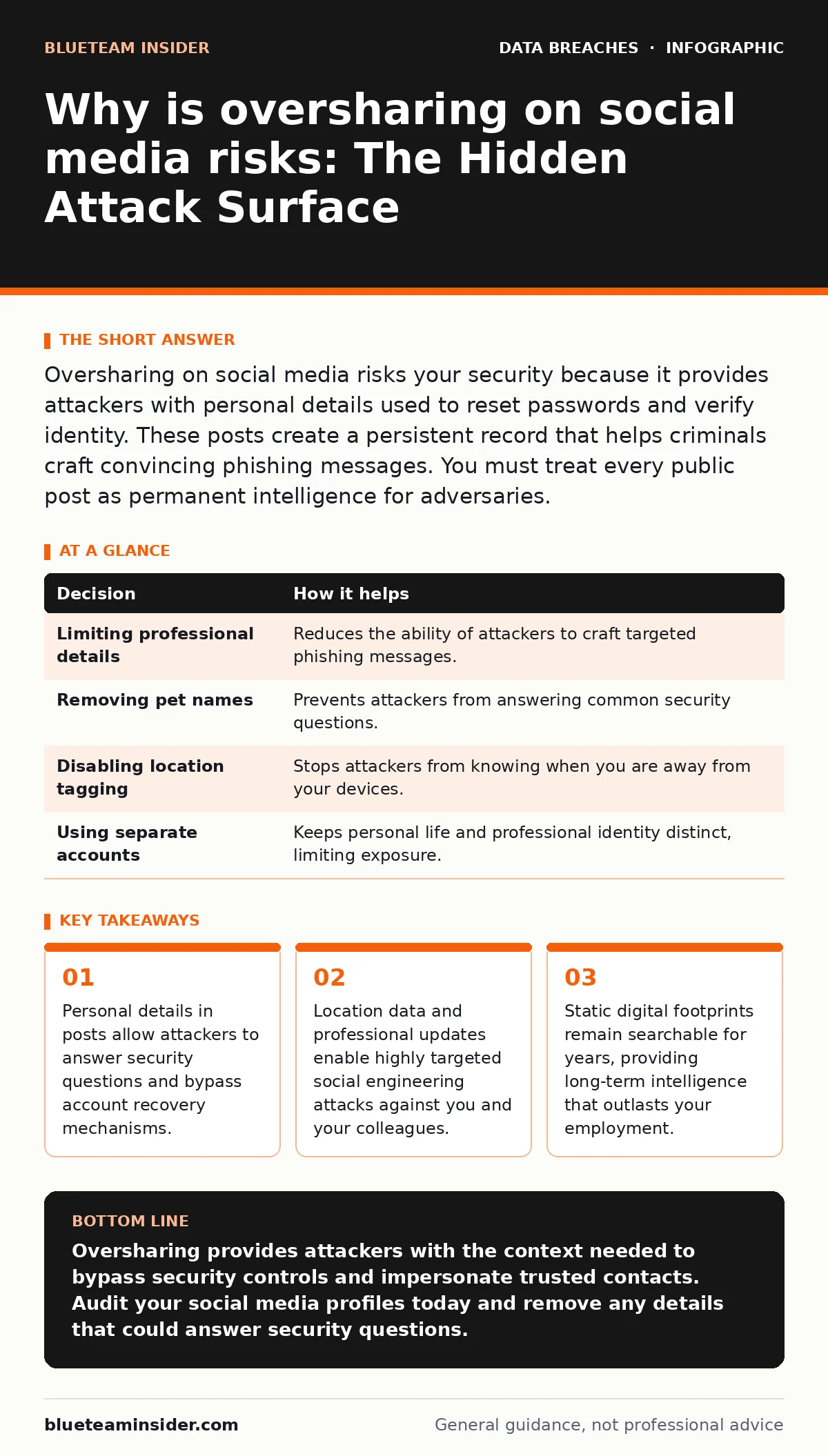
Oversharing on social media risks your security because it provides attackers with personal details used to reset passwords and verify identity. These posts create a persistent record that helps criminals craft convincing phishing messages. You must treat every public post as permanent intelligence for adversaries.
The Core Mechanism of Social Media Risk
Why is oversharing on social media risks so significant for your personal and professional security? The danger lies in the aggregation of data. Individual posts seem harmless, but combined, they form a detailed profile. Attackers use this profile to predict your behavior and guess your credentials. This process is known as OSINT, or Open Source Intelligence. It relies on information you voluntarily published. You cannot delete the past. Even deleted posts may be cached or archived by third-party services. The risk is not the post itself, but the pattern it reveals.
Reasons Ranked by Security Weight
Not all oversharing carries equal risk. Some details are more dangerous than others. Understanding the hierarchy of risk helps you prioritize your defenses. The weight of risk depends on how easily an attacker can use the data to gain access.
- Identity Verification Data: Birthdays, pet names, and hometowns are often used as answers to security questions. These are the highest risk items because they directly unlock accounts.
- Professional Context: Job titles, project names, and internal software tools help attackers craft realistic phishing emails. This context makes fraud believable to your colleagues.
- Location and Routine: Check-ins and vacation photos reveal when you are away from your devices. This timing allows attackers to target you when you are less likely to notice suspicious activity.
- Relationship Maps: Photos with colleagues or family members reveal your network. Attackers use this to impersonate trusted contacts or target those around you.
The Consequence of Unchecked Sharing
When you share too much, you remove the friction between an attacker and your accounts. Friction is good for security. It slows down bad actors. Oversharing removes that barrier. An attacker no longer needs to guess your password. They can look up your dog’s name on Instagram. They can see your birthday on Facebook. They can verify your employment on LinkedIn. This reduces the effort required for a breach to minutes. The result is often identity theft or unauthorized access to corporate systems. You become the weakest link in the chain.
Contrast: Two Hypothetical Teams
Imagine two security teams facing the same phishing campaign. Team Alpha restricts public social media. Team Beta encourages open sharing. The attacker targets both teams with an email that appears to come from a vendor.
This example shows how public data validates malicious requests. The attacker used oversharing to build credibility. Without that public confirmation, the email looks suspicious. With it, the email looks routine. The difference is not the email, but the context provided by social media.
| Decision | How it helps |
|---|---|
| Limiting professional details | Reduces the ability of attackers to craft targeted phishing messages. |
| Removing pet names | Prevents attackers from answering common security questions. |
| Disabling location tagging | Stops attackers from knowing when you are away from your devices. |
| Using separate accounts | Keeps personal life and professional identity distinct, limiting exposure. |
What Goes Wrong in Recovery
When a breach occurs, the recovery process often fails because of prior oversharing. Account recovery relies on secret questions. If you answered those questions using public data, the attacker can reset your password. This is a common failure point. You may have a strong password, but if the attacker can bypass it using your birthday, the password is useless. This is why identity theft spreads so quickly. The attacker does not need to hack the bank. They just need to reset the password using information you posted. The system trusts the public data as proof of identity.
See also: What Is Tokenization: How to Secure Data Without Storing It
Actionable Steps for Mitigation
You can reduce risk by changing how you manage your digital presence. This is not about deleting your accounts. It is about controlling the data you expose. Start with an audit of your current profiles. Look for details that answer security questions. Remove them. Change your privacy settings to limit who can see your posts. Use a separate email for social media. This prevents attackers from linking your social identity to your professional email. Implement data minimization principles in your personal life. Share less, and share only what is necessary.
- Audit your profiles for security question answers.
- Remove location data from photos before posting.
- Separate personal and professional social media accounts.
- Regularly review who can see your old posts.
The Long-Term Digital Footprint
Your digital footprint is permanent. Even if you delete a post, copies may exist. Search engines cache pages. Other users may screenshot or repost content. This means your oversharing has a long half-life. An attacker can find old posts from years ago. This is why you must think long-term. What is funny now may be dangerous later. What is innocent now may be useful for social engineering in five years. You cannot control the future, but you can control what you publish today. Assume every post is permanent. Assume every post is public. This mindset changes how you share.
Integrating with Broader Security
Oversharing is not an isolated issue. It connects to broader security practices. For example, employee data breaches often start with social media reconnaissance. Attackers map your team to find the right person to target. Similarly, identity theft relies on the personal details found in public profiles. By reducing oversharing, you reduce the surface area for these attacks. This complements other security measures like multi-factor authentication. It does not replace them. It adds a layer of obscurity that makes attacks harder. You must also consider backup testing to ensure you can recover if a breach occurs. But prevention is always better than recovery.
Key takeaways
- Personal details in posts allow attackers to answer security questions and bypass account recovery mechanisms.
- Location data and professional updates enable highly targeted social engineering attacks against you and your colleagues.
- Static digital footprints remain searchable for years, providing long-term intelligence that outlasts your employment.
Oversharing provides attackers with the context needed to bypass security controls and impersonate trusted contacts. Audit your social media profiles today and remove any details that could answer security questions.
Frequently asked questions
Does deleting old posts remove the risk?
No, because search engines and third-party sites may have cached the content. Assume the data remains available to attackers.
Is it safer to use a pseudonym?
Yes, a pseudonym reduces the link between your online activity and your real identity. This makes it harder for attackers to verify your details.
How do I protect my colleagues?
Encourage them to limit professional details on public profiles. Share this guide with your team to raise awareness of the risks.
What about professional networking sites?
These sites are high-risk because they confirm your employment and role. Limit the details you share about your projects and internal tools.
How this guide was produced: written by the BlueTeam Insider editorial team with AI assistance, checked against the public references listed below, and reviewed when the facts change. See our editorial policy or report an error.