Use-After-Free Vulnerabilities: How Memory Errors Become Hacks
A use-after-free error turns normal memory management into a backdoor by letting code read or write data that the system has already discarded.

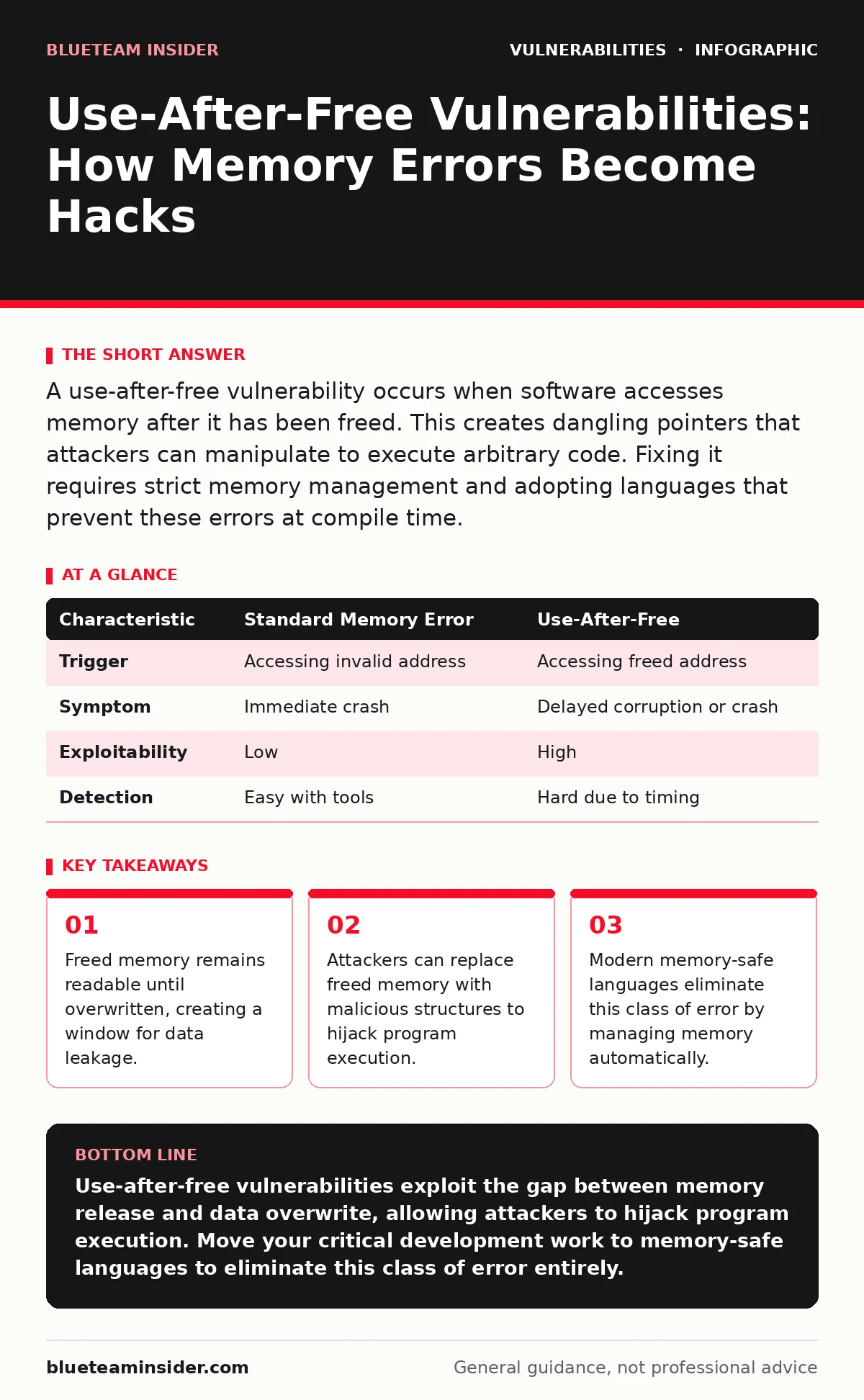
A use-after-free vulnerability occurs when software accesses memory after it has been freed. This creates dangling pointers that attackers can manipulate to execute arbitrary code. Fixing it requires strict memory management and adopting languages that prevent these errors at compile time.
What is a use-after-free vulnerability?
A use-after-free vulnerability occurs when a program continues to use a memory reference after the memory it points to has been released. The program thinks the data is still valid, but the operating system has marked that space as available for other tasks. This mismatch between the program’s expectation and the system’s reality creates a security gap.
Why does freeing memory create a security risk?
Freeing memory does not immediately erase the data stored in that location. The content remains in place until another process or function writes new information into that same address. If an attacker can predict when and where new data will be allocated, they can place malicious content in that specific spot. The vulnerable program then reads or executes this attacker-controlled data as if it were legitimate.
How do attackers exploit dangling pointers?
A dangling pointer is a reference to memory that has been freed. Attackers exploit this by forcing the system to reuse that memory address for their own data. When the vulnerable program follows the dangling pointer, it interacts with the attacker’s data instead of the original structure. This can allow the attacker to modify critical variables or redirect the program’s execution flow.
What is heap spraying in this context?
Heap spraying is a technique used to increase the chance of hitting a specific memory address. The attacker floods the heap, which is the area of memory used for dynamic allocation, with controlled data. This increases the probability that a freed block will be reused by the attacker’s payload. It turns a random chance of exploitation into a reliable attack vector.
Can this vulnerability leak sensitive information?
Yes, because the data in freed memory is not automatically cleared. If a program frees a buffer containing credentials or encryption keys but keeps a pointer to it, that data remains accessible. An attacker who triggers the use-after-free condition can read this residual data. This turns a memory management error into a direct information disclosure issue.
Why are these bugs hard to find?
Use-after-free errors are often non-deterministic, meaning they do not happen every time the program runs. The timing of memory allocation and deallocation depends on many factors, including system load and other running processes. This makes the bug intermittent and difficult to reproduce during testing. Standard testing often misses these edge cases because they require very specific memory states.
| Characteristic | Standard Memory Error | Use-After-Free |
|---|---|---|
| Trigger | Accessing invalid address | Accessing freed address |
| Symptom | Immediate crash | Delayed corruption or crash |
| Exploitability | Low | High |
| Detection | Easy with tools | Hard due to timing |
How do memory-safe languages help?
Languages like Rust or Go manage memory automatically, preventing dangling pointers from existing. They use mechanisms like automatic garbage collection or ownership tracking to ensure no pointer references freed memory. This eliminates the possibility of use-after-free errors at the code level. For more details on this shift, see our guide on memory-safe programming languages.
What is double-free and how does it relate?
A double-free error happens when a program attempts to free the same memory block twice. This can corrupt the internal structures the memory manager uses to track allocations. Attackers can leverage this corruption to write to arbitrary memory locations. It is often a precursor to or a variant of use-after-free exploitation.
Why is patching not enough?
Patching fixes the specific bug in the current version of the software. It does not prevent new use-after-free errors from being introduced in future updates. Developers must change their coding practices to prevent these errors from being written in the first place. Relying solely on patches leaves a constant window of exposure between the bug’s introduction and its fix.
How do you protect against these flaws?
You must adopt defensive coding practices that validate pointers before use. Additionally, integrating static analysis tools into your build process can catch many of these errors before deployment. For a broader view on managing these risks, refer to our section on vulnerability scanning. This helps identify unpatched software that may still contain known issues.
What is the role of ASLR?
Address space layout randomization randomizes the memory locations where code and data are loaded. This makes it difficult for an attacker to predict where to place their malicious data. While it does not fix the use-after-free bug, it significantly raises the difficulty of exploitation. It adds a layer of uncertainty that breaks many automated attacks.
How do you report these findings?
If you discover a use-after-free vulnerability, follow a responsible disclosure process. Contact the vendor privately and provide detailed steps to reproduce the issue. This allows them to fix the bug before public knowledge enables widespread exploitation. Learn more about best practices in our guide on responsible disclosure.
Why do these bugs persist in modern software?
Legacy codebases often rely on manual memory management, which is prone to human error. Refactoring these systems is expensive and risky, so many organizations continue to patch rather than rewrite. This creates a persistent baseline of risk in widely used software. Understanding the trade-offs is key to managing this risk effectively.
What is the connection to firmware?
Firmware often runs on embedded devices with limited memory management features. Use-after-free errors in firmware can be particularly dangerous because they are hard to patch. Users may not update their devices, leaving them vulnerable for years. See our analysis of firmware vulnerabilities for more on this specific risk.
Key takeaways
- Freed memory remains readable until overwritten, creating a window for data leakage.
- Attackers can replace freed memory with malicious structures to hijack program execution.
- Modern memory-safe languages eliminate this class of error by managing memory automatically.
Use-after-free vulnerabilities exploit the gap between memory release and data overwrite, allowing attackers to hijack program execution. Move your critical development work to memory-safe languages to eliminate this class of error entirely.
Frequently asked questions
Is use-after-free the same as buffer overflow?
No, buffer overflow involves writing beyond the bounds of a buffer, while use-after-free involves accessing memory that has already been released. Both can lead to code execution but through different mechanisms.
Can antivirus software detect use-after-free attacks?
Antivirus software can sometimes detect the malicious payload used in the attack, but it often cannot prevent the initial exploitation of the memory error.
Does turning off the internet stop these vulnerabilities?
No, use-after-free is a local software flaw. It can be triggered by local files or actions without any network connection.
Are mobile apps susceptible to use-after-free?
Yes, mobile apps written in languages like C or C++ are susceptible. However, apps written in Java or Swift are less likely to suffer from these specific memory errors.
How this guide was produced: written by the BlueTeam Insider editorial team with AI assistance, checked against the public references listed below, and reviewed when the facts change. See our editorial policy or report an error.