Threat Actor Profiling: Answering 8 Key Questions
Profiling attackers reveals hidden behavioral patterns that static indicators miss, allowing defenders to predict future moves based on past operational habits.

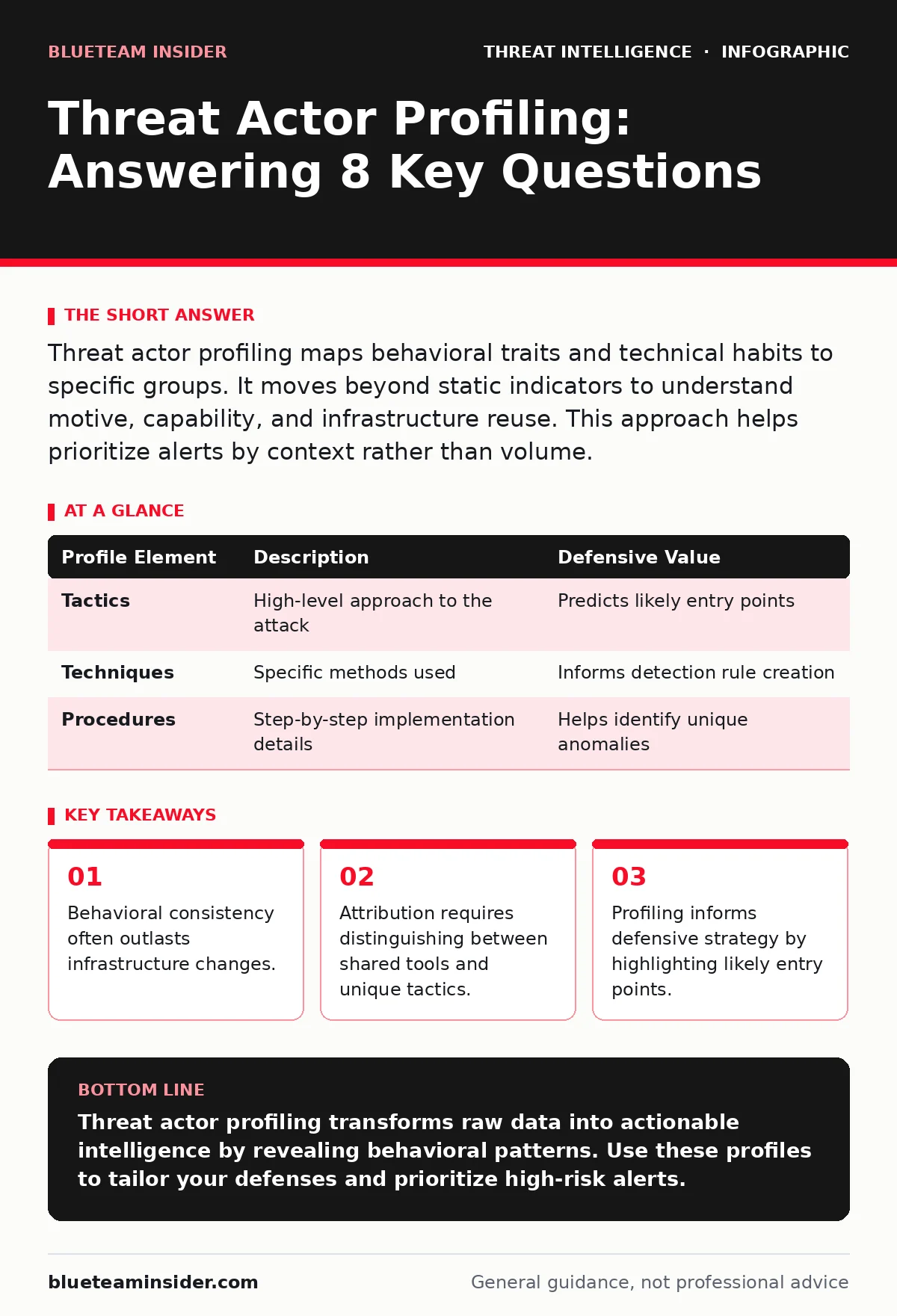
Threat actor profiling maps behavioral traits and technical habits to specific groups. It moves beyond static indicators to understand motive, capability, and infrastructure reuse. This approach helps prioritize alerts by context rather than volume.
What is threat actor profiling?
Threat actor profiling is the systematic analysis of an adversary’s behavior, tools, and motives to create a distinct identity. It goes beyond collecting single indicators of compromise to understand the "who" and "why" behind an attack. This process links disparate data points into a coherent narrative of operational habits.
How does profiling differ from IOC enrichment?
Indicators of compromise enrichment adds context to a single file hash or IP address, such as its reputation or geolocation. Profiling synthesizes these indicators with tactics, techniques, and procedures to describe the attacker’s methodology. While enrichment tells you what a file is, profiling tells you who likely created it and why. See our guide on IOC enrichment for details on adding context to raw data.
Why do attackers reuse infrastructure?
Attackers often reuse domains, servers, and code snippets to save time and reduce development costs. This laziness creates a predictable pattern that defenders can track across different campaigns. However, they also rotate infrastructure to avoid detection, making historical data vital for connecting new attacks to old ones. Understanding this balance helps in correlating events that appear unrelated on the surface.
Can you attribute an attack to a specific group?
Attribution is rarely definitive in the early stages of an investigation. You can assign a high confidence level to a group based on unique coding errors, language markers, or specific tool combinations. However, open-source tools are widely used, meaning many groups may look similar. True attribution requires identifying unique behavioral fingerprints that are difficult to replicate or steal.
What is island hopping in profiling?
Island hopping refers to attackers moving laterally through less secure systems to reach high-value targets. In profiling, this reveals a preference for indirect access paths over direct breaches. Recognizing this pattern helps you monitor internal network segments that are often overlooked by perimeter defenses. Our guide on island hopping attacks explains how to detect these lateral movements in your environment.
See also: IOC Enrichment Errors: Fix 7 Common Analyst Mistakes · Detect Phishing Infrastructure: Signals, Blind Spots and Tools
How do you identify a group’s motive?
Motive drives the selection of targets and the methods used to extract value. Financial gain often leads to ransomware deployment and data exfiltration, while espionage focuses on long-term persistence and quiet data theft. Political motives may involve disruption or public embarrassment rather than financial reward. Aligning your detection rules with the likely motive reduces noise from irrelevant alerts.
Does the same group use different tactics?
Groups evolve their tactics to bypass new defenses and adapt to changing environments. A group known for phishing may shift to exploiting remote desktop vulnerabilities if email filters improve. Tracking these shifts requires looking at the underlying objective rather than just the entry vector. For instance, see our section on remote desktop abuse to understand how attackers pivot when primary access methods fail.
How does profiling improve SOC playbooks?
Profiles allow you to tailor response actions to the likely capabilities of the attacker. If a group is known for rapid data exfiltration, your playbook should prioritize network containment over forensic imaging. This customization ensures that your team spends resources on the most critical containment steps first. Refer to our guide on SOC playbooks for structuring these response workflows.
What are the limitations of behavioral profiling?
Profiling relies on historical data, which may not reflect an attacker’s current capabilities or new alliances. Attackers can also mimic other groups to create confusion or misdirect investigations. Over-reliance on past behavior can blind you to novel techniques or unexpected shifts in strategy. Always validate behavioral assumptions with fresh evidence from current incidents.
| Profile Element | Description | Defensive Value |
|---|---|---|
| Tactics | High-level approach to the attack | Predicts likely entry points |
| Techniques | Specific methods used | Informs detection rule creation |
| Procedures | Step-by-step implementation details | Helps identify unique anomalies |
How do you validate a profile?
Validation requires cross-referencing multiple independent data sources, such as malware code analysis, network traffic patterns, and witness reports. A single data point is rarely sufficient for a confident profile. Consistency across different campaigns strengthens the validity of the profile. This process ensures that you are not misidentifying a group due to shared open-source tools.
What role does packet capture analysis play?
Packet capture analysis provides deep visibility into the communication between an attacker’s tools and your network. It reveals command-and-control patterns, data exfiltration methods, and protocol anomalies that logs might miss. This technical evidence supports the behavioral profile with hard data. Our guide on packet capture analysis details how to extract these insights from raw network traffic.
How do you update profiles over time?
Profiles must be updated as attackers change their infrastructure, tools, and tactics. Regularly review new incident data to identify shifts in behavior or new capabilities. Collaborate with other security teams to share insights on emerging patterns. Stale profiles lead to missed detections and inappropriate response actions.
What is the impact of phishing infrastructure changes?
Attackers frequently change their phishing infrastructure to avoid domain blacklisting and email filter detection. However, the underlying social engineering tactics and payload delivery methods often remain consistent. Monitoring for these consistent elements allows you to detect new campaigns even when the domains change. See our guide on phishing infrastructure for techniques to track these evolving networks.
How do you handle false positives in profiling?
False positives occur when benign activity mimics known attacker behavior. To reduce these, refine your detection rules to require multiple correlated indicators rather than a single match. Review alerts manually to distinguish between automated scanning tools and targeted attacks. This careful tuning prevents alert fatigue and ensures that your team focuses on genuine threats.
What is the next step after profiling?
Use the profile to prioritize your defensive efforts and tailor your security metrics. Focus on the attack vectors and techniques most likely to be used by the identified group. Measure the effectiveness of your controls against these specific threats. Our guide on security metrics helps you define the right measures for your defense strategy.
How do you share profiles securely?
Sharing profiles with other organizations can improve collective defense but carries risks of exposing your own detection capabilities. Use trusted information sharing platforms that allow for anonymized data exchange. Ensure that shared information is accurate and does not reveal sensitive internal details. This collaborative approach strengthens the overall security posture of the community.
How do you detect port scanning from a known group?
Port scanning is a common reconnaissance technique used by many attackers. To detect scanning from a specific group, look for unique scanning patterns, such as specific port orders or timing intervals. Correlate these patterns with other known behaviors of the group. This helps distinguish their activity from general background noise. Our guide on port scanning provides methods to identify and block these reconnaissance efforts.
Key takeaways
- Behavioral consistency often outlasts infrastructure changes.
- Attribution requires distinguishing between shared tools and unique tactics.
- Profiling informs defensive strategy by highlighting likely entry points.
Threat actor profiling transforms raw data into actionable intelligence by revealing behavioral patterns. Use these profiles to tailor your defenses and prioritize high-risk alerts.
Frequently asked questions
Can AI automate threat actor profiling?
AI can assist in correlating large datasets and identifying patterns, but human expertise is required to interpret context and validate attributions.
How often should profiles be updated?
Profiles should be updated whenever new significant activity is observed or when an attacker changes their primary tactics.
Is profiling useful for small organizations?
Yes, even small organizations can benefit by focusing on the most common and relevant threat actors targeting their industry.
What is the difference between APT and cybercriminal profiling?
APT profiling focuses on long-term persistence and espionage motives, while cybercriminal profiling emphasizes financial gain and rapid impact.
How this guide was produced: written by the BlueTeam Insider editorial team with AI assistance, checked against the public references listed below, and reviewed when the facts change. See our editorial policy or report an error.