Dark Web Search Engines: Uncovering Reality Behind Myths
Dark web search engines do not index the entire hidden web, instead relying on static directories and user submissions that leave massive gaps.

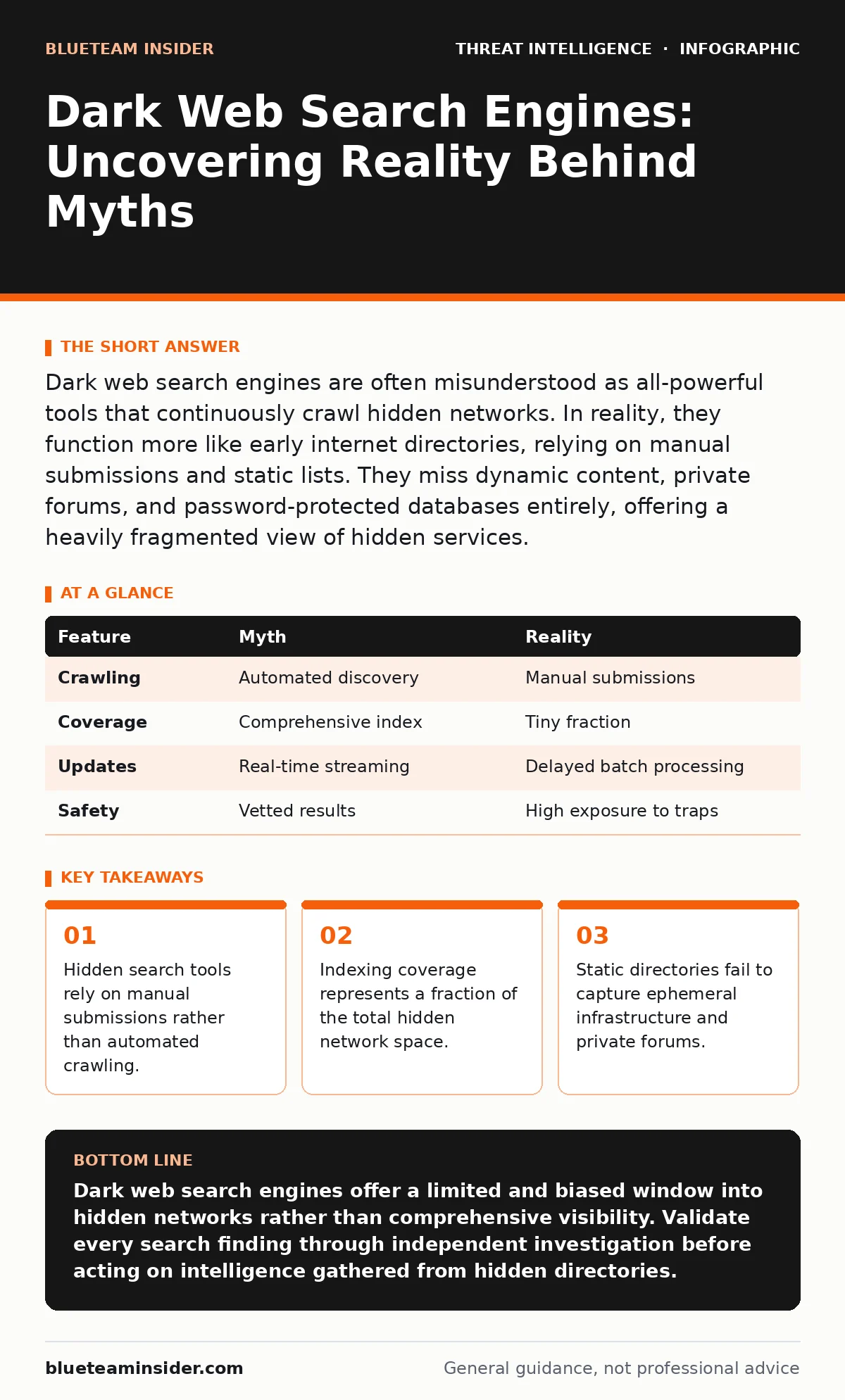
Dark web search engines are often misunderstood as all-powerful tools that continuously crawl hidden networks. In reality, they function more like early internet directories, relying on manual submissions and static lists. They miss dynamic content, private forums, and password-protected databases entirely, offering a heavily fragmented view of hidden services.
Myth: Dark web search engines crawl hidden sites automatically
Reality: Automated web crawlers struggle to navigate onion routing networks because hidden services lack standardized directory structures and often demand authentication. Indexing engines rely almost entirely on manual URL submissions from site operators or users. This reliance creates massive blind spots, meaning search results reflect only what owners actively choose to advertise rather than what actually exists online.
Imagine an analyst attempting to map threat actor infrastructure using only automated queries, only to miss half the active forums because those sites block automated HTTP requests. Network administrators often configure hidden servers to reject incoming crawler traffic to preserve bandwidth and evade attribution. Consequently, dark web search results display a heavily skewed sample biased toward public marketplaces and forums.
Myth: Hidden search tools provide a complete index of the dark web
Reality: The total volume of indexed hidden content represents a tiny fraction of the active network because ephemeral services vanish faster than scrapers can process them. Many hidden services require specific invitation tokens, solve cryptographic challenges, or depend on domain generation algorithms to rotate access points constantly. Search engines cannot index content hidden behind access controls or payment gateways.
You face a fundamental indexing barrier when dealing with infrastructure that changes daily to thwart automated port scanning and enumeration attempts. When a hidden marketplace migrates to a new address, the old search index points to a dead end until someone manually updates the directory entry. Static indexing models break down entirely in environments engineered for maximum transience and secrecy.
Myth: Search queries on hidden networks protect user anonymity completely
Reality: Entering search terms into a web interface hosted on an onion network exposes your query patterns to the operators of that specific search platform. Rogue search engines can log search phrases, user timestamps, and client characteristics to build behavioral profiles. Anonymity depends entirely on the browser configuration, protocol hygiene, and the trustworthiness of the specific portal handling your request.
Suppose a security researcher investigates credential leaks by querying a hidden search engine without stripping telemetry from the client environment. The search portal logs the origin circuit, browser version, and specific keyword combinations, allowing platform administrators to track investigative interests. Hidden search tools introduce telemetry risks similar to traditional web platforms if users fail to respect Tor browser privacy risks.
Myth: Dark web search results are always safe to click
Reality: Clicking links retrieved from hidden search engines frequently leads to browser exploitation, malicious downloads, or credential harvesting traps. Threat actors regularly optimize malicious hidden services to rank high in search directories through aggressive keyword stuffing. These deceptive sites often mimic legitimate communication platforms or file-sharing portals to capture sensitive authentication material.
You encounter severe compromise risks when interacting with unverified binary downloads or web forms hosted on scraped hidden services. Attackers routinely weaponize common file formats or exploit unpatched browser vulnerabilities when visitors load pages returned by untrusted directories. Treat every unfamiliar onion link with the same caution you apply during IOC enrichment workflows on the open internet.
Myth: Hidden search engines update their databases in real time
Reality: Index updates occur through batch processing schedules or manual administrative interventions rather than instant event-driven triggers. A newly launched hidden service can remain invisible to search tools for weeks until an operator submits the address to a directory. Conversely, dead services often linger in search results long after the underlying servers go offline.
Network defenders tracking threat actor migration patterns must account for these indexing delays when assessing adversary posture. Relying on outdated search results can cause analysts to target decommissioned infrastructure while active operations shift elsewhere. Effective threat intelligence requires direct observation rather than dependence on lagging directory updates.
| Feature | Myth | Reality |
|---|---|---|
| Crawling | Automated discovery | Manual submissions |
| Coverage | Comprehensive index | Tiny fraction |
| Updates | Real-time streaming | Delayed batch processing |
| Safety | Vetted results | High exposure to traps |
See also: Threat Actor Profiling: Answering 8 Key Questions · Detect Phishing Infrastructure: Signals, Blind Spots and Tools
Myth: Search engines can locate private communication channels
Reality: Private messaging groups, encrypted chat servers, and invitation-only forums remain entirely invisible to public search engines. These communication silos operate behind strict authentication layers and lack public landing pages for crawlers to index. Finding such channels requires out-of-band social engineering, insider access, or membership in trusted peer networks.
Imagine monitoring a threat group that uses encrypted messaging nodes deployed via bulletproof hosting providers. Public search engines cannot pierce the authentication barrier protecting those discussion channels, rendering standard keyword queries useless. Analysts must rely on alternative reconnaissance methods to map closed-loop communication ecosystems.
Key takeaways
- Hidden search tools rely on manual submissions rather than automated crawling.
- Indexing coverage represents a fraction of the total hidden network space.
- Static directories fail to capture ephemeral infrastructure and private forums.
Dark web search engines offer a limited and biased window into hidden networks rather than comprehensive visibility. Validate every search finding through independent investigation before acting on intelligence gathered from hidden directories.
Frequently asked questions
Can law enforcement track you through dark web search engines?
Platform operators can log your search queries and connection metadata if the search interface captures telemetry or if you use compromised client configurations.
Why do some dark web links from search engines never load?
Hidden services frequently change addresses, suffer from denial of service attacks, or shut down entirely faster than search directories can update their indexes.
Are there paid search engines on the dark web?
Some platforms demand cryptocurrency payments for advanced features or API access, though these services often operate as scams or honey pots.
How do search engines make money on the dark web?
Monetization models on hidden search platforms typically rely on banner advertisements for illicit goods, referral commissions for marketplaces, or extortion schemes.
How this guide was produced: written by the BlueTeam Insider editorial team with AI assistance, checked against the public references listed below, and reviewed when the facts change. See our editorial policy or report an error.