Stop Bulletproof Hosting: Practical Prevention Measures
Most bulletproof hosting fails because operators ignore financial audits, not because they lack technical defenses.

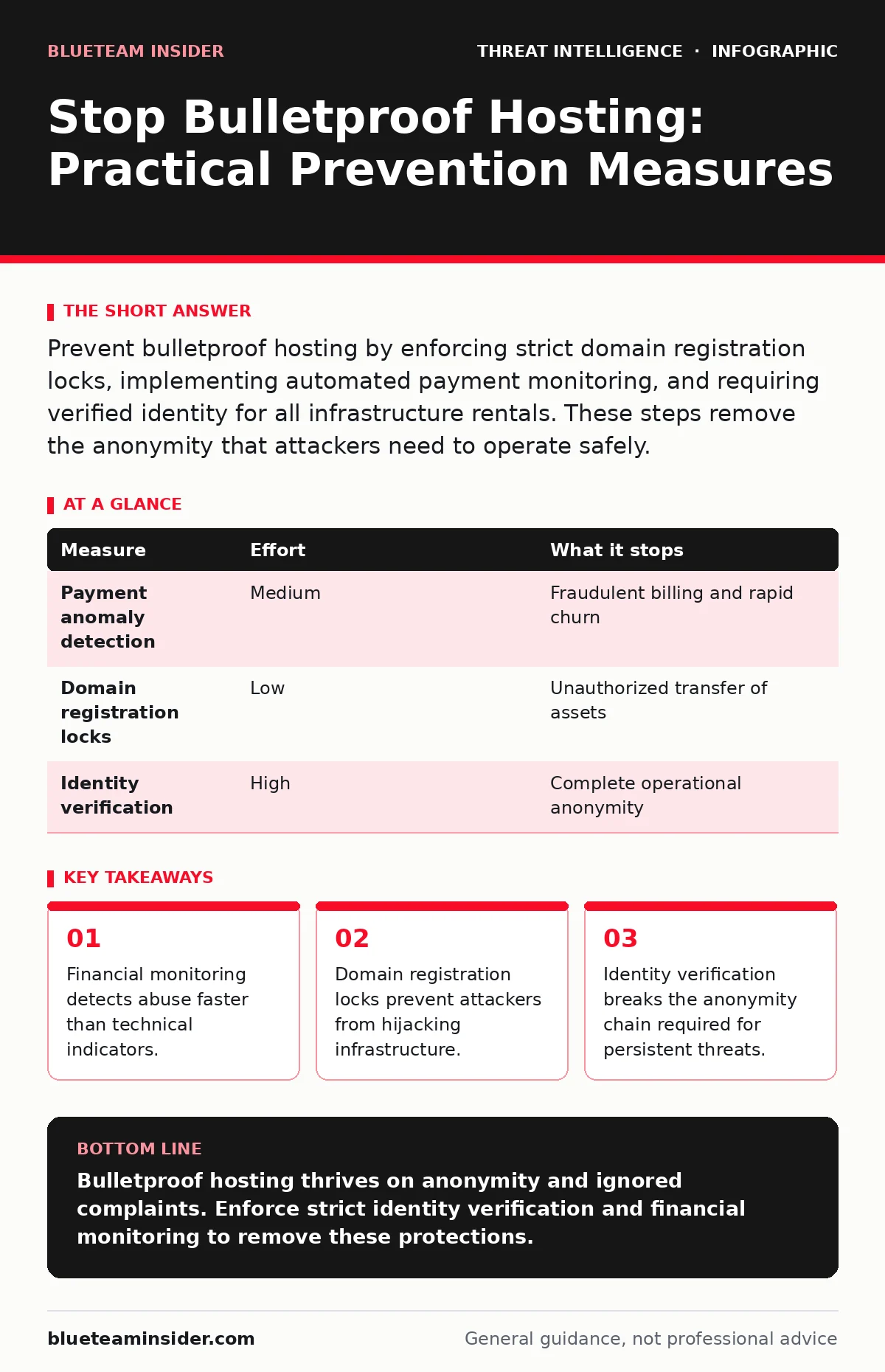
Prevent bulletproof hosting by enforcing strict domain registration locks, implementing automated payment monitoring, and requiring verified identity for all infrastructure rentals. These steps remove the anonymity that attackers need to operate safely.
The Anatomy of Anonymity
Bulletproof hosting relies on a single vulnerability: the willingness of a provider to ignore abuse. You cannot patch this with firewalls. The risk exists because the host prioritizes revenue over reputation. Attackers seek providers who will not disconnect service when complaints arrive. This creates a safe haven for malware distribution, phishing, and command-and-control servers.
To prevent your infrastructure from becoming bulletproof hosting, you must remove the anonymity that protects the abuser. If you manage servers, you must ensure your own practices do not inadvertently support this model. If you are a victim, you must understand why standard takedown requests often fail. The failure usually stems from a lack of verifiable ownership data at the registration level.
Financial Monitoring as a Defense
The most effective way to stop bulletproof hosting is to watch the money. Technical defenses can be bypassed. Financial records are harder to hide. Attackers often use stolen credit cards, prepaid vouchers, or cryptocurrencies to pay for hosting. These payment methods leave a trail that can be traced back to the user.
Implement automated monitoring for payment anomalies. Look for multiple small transactions from different cards charging to the same account. Detect payments from high-risk jurisdictions combined with high-bandwidth usage. This approach identifies abuse before the malware spreads. It forces the attacker to move frequently, increasing their operational cost.
| Measure | Effort | What it stops |
|---|---|---|
| Payment anomaly detection | Medium | Fraudulent billing and rapid churn |
| Domain registration locks | Low | Unauthorized transfer of assets |
| Identity verification | High | Complete operational anonymity |
Domain Registration Locks
Domain names are the address of the attack. If an attacker can change the nameservers or transfer the domain, they can redirect traffic instantly. This is a common tactic in defense evasion. By locking the domain registration, you prevent unauthorized transfers. This stops the attacker from moving the infrastructure to a new provider when pressure mounts.
Enable transfer locks on all domains you manage. Require multi-factor authentication for any changes to the domain registrar account. This adds friction to the attacker’s workflow. Friction reduces the speed at which they can pivot. Speed is often the only advantage an attacker has over defenders.
Identity Verification Requirements
Anonymity is the fuel for bulletproof hosting. Without it, attackers face legal consequences. Require verified identity for all new accounts. This means government-issued ID and proof of address. Do not accept generic email addresses or unverified phone numbers. This step raises the barrier to entry for casual threat actors.
It does not stop state-sponsored groups or highly sophisticated criminals. They will use stolen identities or shell companies. However, it stops the majority of opportunistic attackers. These attackers look for the path of least resistance. By making the path difficult, you reduce the volume of abuse significantly.
Automated Abuse Response
Speed matters in containment. Manual review of abuse reports takes too long. Implement automated systems that flag suspicious activity. Look for high volumes of outbound connections to known bad ports. Detect unusual DNS queries that match patterns seen in threat actor profiling.
Automate the suspension of accounts that trigger these alerts. Do not wait for human approval for low-confidence hits. The goal is to disrupt the attack chain quickly. Even a temporary suspension forces the attacker to pause. This pause gives you time to investigate and gather evidence.
Supply Chain Due Diligence
If you rent infrastructure, you inherit the security posture of your provider. Many organizations fail to check the background of their hosting vendors. This is a critical gap. A reputable provider will have a clear abuse contact and a history of responding to complaints.
Check the provider’s terms of service for acceptable use policies. Look for transparency reports that show how they handle abuse cases. Avoid providers that advertise "no questions asked" hosting. These providers are explicitly seeking to enable illegal activity. Your choice of vendor directly impacts your exposure to remote desktop abuse and other lateral movement techniques.
What Does Not Work
Many defenders focus on technical controls that fail against bulletproof hosting. Geo-blocking is ineffective. Attackers use proxies and VPNs to mask their location. Content filtering misses encrypted traffic. Attackers use standard protocols to hide their commands.
Signature-based detection falls behind. Attackers update their malware faster than you can update your signatures. Relying solely on these tools leaves you exposed. You must combine technical controls with administrative and financial measures. This layered approach closes the gaps that individual tools leave open.
Closing Checklist
Take these three steps today to reduce your risk. They require minimal effort but provide significant protection.
- Enable transfer locks on all domain registrations to prevent hijacking.
- Implement automated monitoring for payment anomalies in your billing system.
- Verify the identity of all new users or customers accessing your infrastructure.
These actions address the root causes of bulletproof hosting. They remove the anonymity and financial flexibility that attackers rely on. Consistency in applying these measures is key. One weak link can compromise the entire chain.
Key takeaways
- Financial monitoring detects abuse faster than technical indicators.
- Domain registration locks prevent attackers from hijacking infrastructure.
- Identity verification breaks the anonymity chain required for persistent threats.
Bulletproof hosting thrives on anonymity and ignored complaints. Enforce strict identity verification and financial monitoring to remove these protections.
Frequently asked questions
How do I know if my hosting provider is bulletproof?
Check if they have a public abuse contact and a history of responding to complaints. Providers that ignore reports or require excessive proof are likely bulletproof.
Can I use legal action to shut down bulletproof hosting?
Legal action is slow and often ineffective against offshore providers. Focus on technical and financial measures to disrupt their operations faster.
What is the role of domain registrars in this?
Registrars control the domain name. They can suspend the domain if abuse is reported. Ensure your registrar has a clear abuse policy and response process.
How does this relate to packet capture analysis?
Packet capture analysis helps identify malicious traffic patterns. Use this data to feed your automated abuse detection systems for faster response.
How this guide was produced: written by the BlueTeam Insider editorial team with AI assistance, checked against the public references listed below, and reviewed when the facts change. See our editorial policy or report an error.