Threat Actor Examples: Profiling Methods and Real-World Patterns
Threat actor profiling reveals hidden financial motives and infrastructure reuse that standard signature detection misses entirely.

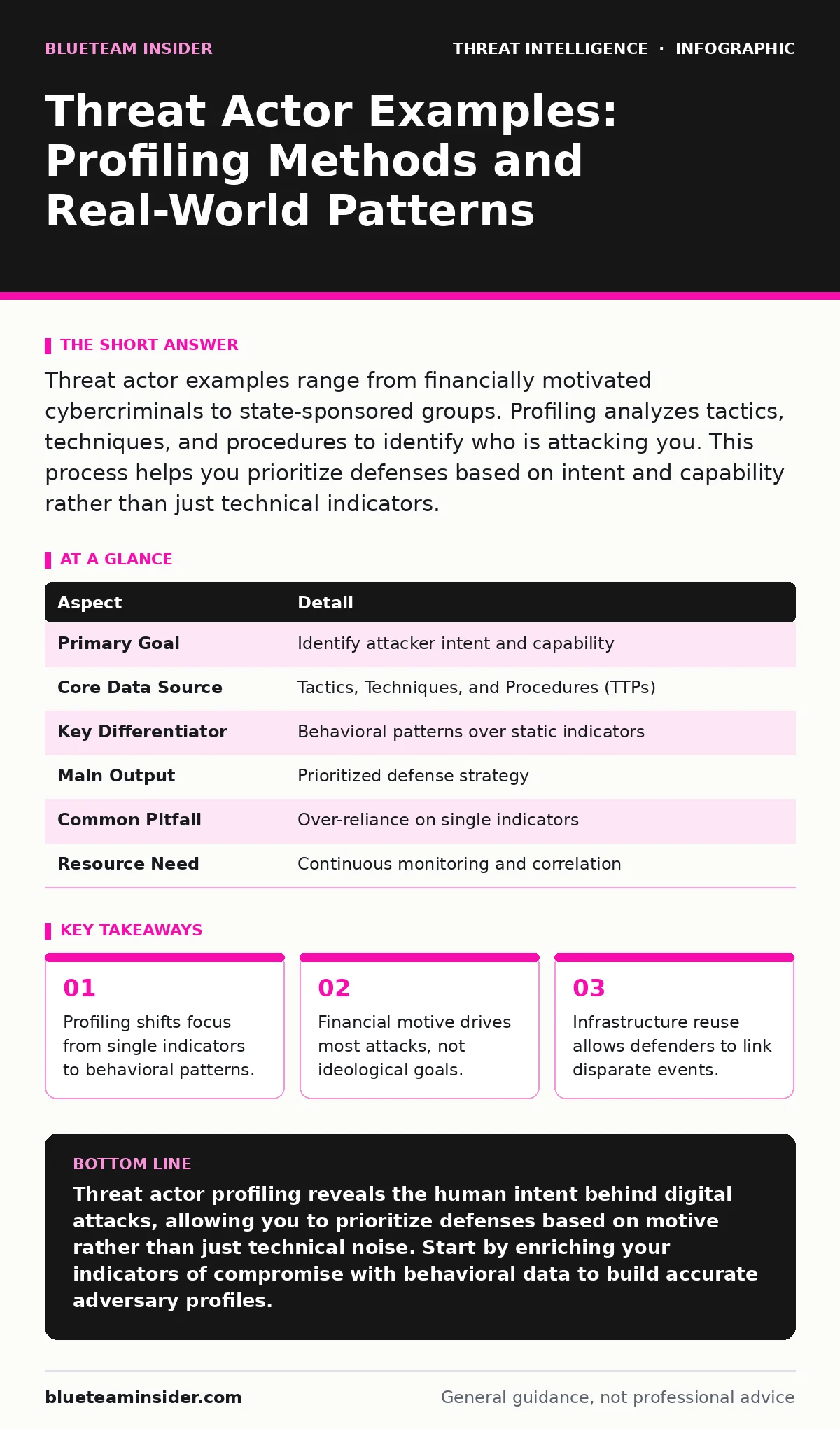
Threat actor examples range from financially motivated cybercriminals to state-sponsored groups. Profiling analyzes tactics, techniques, and procedures to identify who is attacking you. This process helps you prioritize defenses based on intent and capability rather than just technical indicators.
Understanding Threat Actor Profiling
Threat actor profiling is the systematic analysis of an adversary’s behavior, motives, and capabilities. It moves beyond simple detection to explain why an attack occurred and what the attacker likely wants next. Imagine a burglar who always targets homes with specific fence styles and leaves a distinct tool behind. You stop looking for broken windows and start watching for that tool.
This discipline transforms raw data into actionable context. You stop reacting to every alert and start anticipating the next move. The goal is not to name every criminal but to understand the playbook.
| Aspect | Detail |
|---|---|
| Primary Goal | Identify attacker intent and capability |
| Core Data Source | Tactics, Techniques, and Procedures (TTPs) |
| Key Differentiator | Behavioral patterns over static indicators |
| Main Output | Prioritized defense strategy |
| Common Pitfall | Over-reliance on single indicators |
| Resource Need | Continuous monitoring and correlation |
Why Threat Actor Examples Matter
You search for threat actor examples to understand the human element behind digital noise. A virus is just code. The person writing it has goals, constraints, and habits. Knowing these details changes how you defend your network. A financially motivated group will try to monetize data quickly. A state actor may wait months to steal intellectual property.
The distinction dictates your response time. Financial actors require immediate containment to stop data exfiltration. Espionage actors require long-term monitoring to map their access. You cannot apply the same urgency to both. This nuance saves resources and reduces alert fatigue.
Common Threat Actor Examples
Most attacks come from organized criminal groups seeking profit. These groups operate like businesses. They hire developers, rent infrastructure, and sell stolen credentials. They prefer low-risk, high-reward targets. Ransomware operations are the most visible example. They encrypt files and demand payment.
State-sponsored actors represent a different tier. They have unlimited resources and long timelines. Their goal is often espionage or disruption. They use advanced defense evasion techniques to avoid detection for years. These actors do not care about noise. They care about persistence.
Hacktivists attack for political or social reasons. They often use publicly available tools. Their goal is visibility, not profit. They deface websites or leak data to make a statement. Their attacks are loud but often technically simple. Understanding these categories helps you guess the next step.
How Profiling Works in Practice
Profiling starts with collecting data from security logs and network traffic. You look for patterns that repeat across incidents. This process relies heavily on IOC enrichment. An indicator of compromise, like an IP address, tells you where an attack came from. Enrichment tells you who owns it and what else it has done.
You correlate these enriched indicators with known behaviors. If an IP address is linked to a specific malware family, you know the attacker’s toolkit. You then map these tools to a known group’s TTPs. This mapping creates a profile. The profile predicts future actions. It tells you which ports they will scan and which credentials they will steal.
What People Usually Get Wrong
Many defenders assume that finding a specific malware strain identifies the attacker. This is a dangerous shortcut. Malware code is often sold on underground markets. Multiple groups can use the same tool. Relying on the tool alone leads to misattribution. You might prepare for a sophisticated state actor when you are facing a script kiddie.
Another common error is ignoring the financial motive. Most attackers are not ideologically driven. They are paid to deliver results. Assuming a political motive can lead to unnecessary panic. It can also cause you to miss the simple financial trail. Follow the money, not the manifesto.
See also: IOC Enrichment Errors: Fix 7 Common Analyst Mistakes · Detect Phishing Infrastructure: Signals, Blind Spots and Tools
Advanced Detection Techniques
To profile actors accurately, you need visibility into process execution. Tools like Sysmon provide detailed logs of system activity. They record process creation, network connections, and file changes. This data reveals the steps an attacker takes after initial access.
You also need to analyze network traffic for anomalies. Packet capture analysis allows you to inspect the content of network packets. This helps you identify command and control channels. These channels often use domain generation algorithms to create new domains dynamically. Detecting these patterns requires looking at the entire domain name, not just the current one.
Infrastructure and Hosting Realities
Attackers need a place to host their tools and command servers. They often use bulletproof hosting providers. These providers ignore abuse reports and do not cooperate with law enforcement. This makes taking down their infrastructure difficult.
However, even these providers have limits. Attackers often reuse IP addresses or domains. This reuse creates a digital fingerprint. By tracking these reuse patterns, you can link separate attacks to the same group. This linkage is the foundation of accurate profiling. It turns isolated incidents into a coherent narrative.
Related Defensive Strategies
Profiling does not happen in isolation. It connects to other defensive disciplines. For instance, understanding how remote desktop abuse works helps you spot unauthorized access. Attackers often use legitimate remote desktop protocols to move laterally.
Similarly, knowledge of port scanning techniques helps you identify reconnaissance phases. Attackers scan for open ports before launching an attack. Detecting these scans early gives you time to prepare. Profiling tells you which ports to watch based on the likely attacker’s habits.
Putting It All Together
Threat actor profiling turns chaos into clarity. You stop guessing and start knowing. You identify the motive, the method, and the likely next step. This knowledge allows you to allocate resources effectively. You focus on the threats that actually matter to your organization.
The process requires patience and precision. You must verify every link in the chain. You must resist the urge to jump to conclusions. Accurate profiling is a marathon, not a sprint. It builds a foundation for long-term security resilience.
Key takeaways
- Profiling shifts focus from single indicators to behavioral patterns.
- Financial motive drives most attacks, not ideological goals.
- Infrastructure reuse allows defenders to link disparate events.
Threat actor profiling reveals the human intent behind digital attacks, allowing you to prioritize defenses based on motive rather than just technical noise. Start by enriching your indicators of compromise with behavioral data to build accurate adversary profiles.
Frequently asked questions
Can I profile an attacker with only one incident?
Single incidents provide limited data. You can identify tools and initial tactics, but true profiling requires correlating multiple events over time.
What is the difference between attribution and profiling?
Attribution names the specific group or individual. Profiling describes their behavior and intent. Profiling is often more useful for defense than precise attribution.
Does profiling help with ransomware attacks?
Yes. Profiling helps identify the ransomware variant’s typical behavior. This allows you to predict whether they will exfiltrate data before encryption.
How this guide was produced: written by the BlueTeam Insider editorial team with AI assistance, checked against the public references listed below, and reviewed when the facts change. See our editorial policy or report an error.