Domain Generation Algorithms: 7 Mistakes Leaving You Open to C2
Static blocklists fail against algorithmic domains because the threat infrastructure generates thousands of new addresses every hour, rendering traditional signature detection useless.

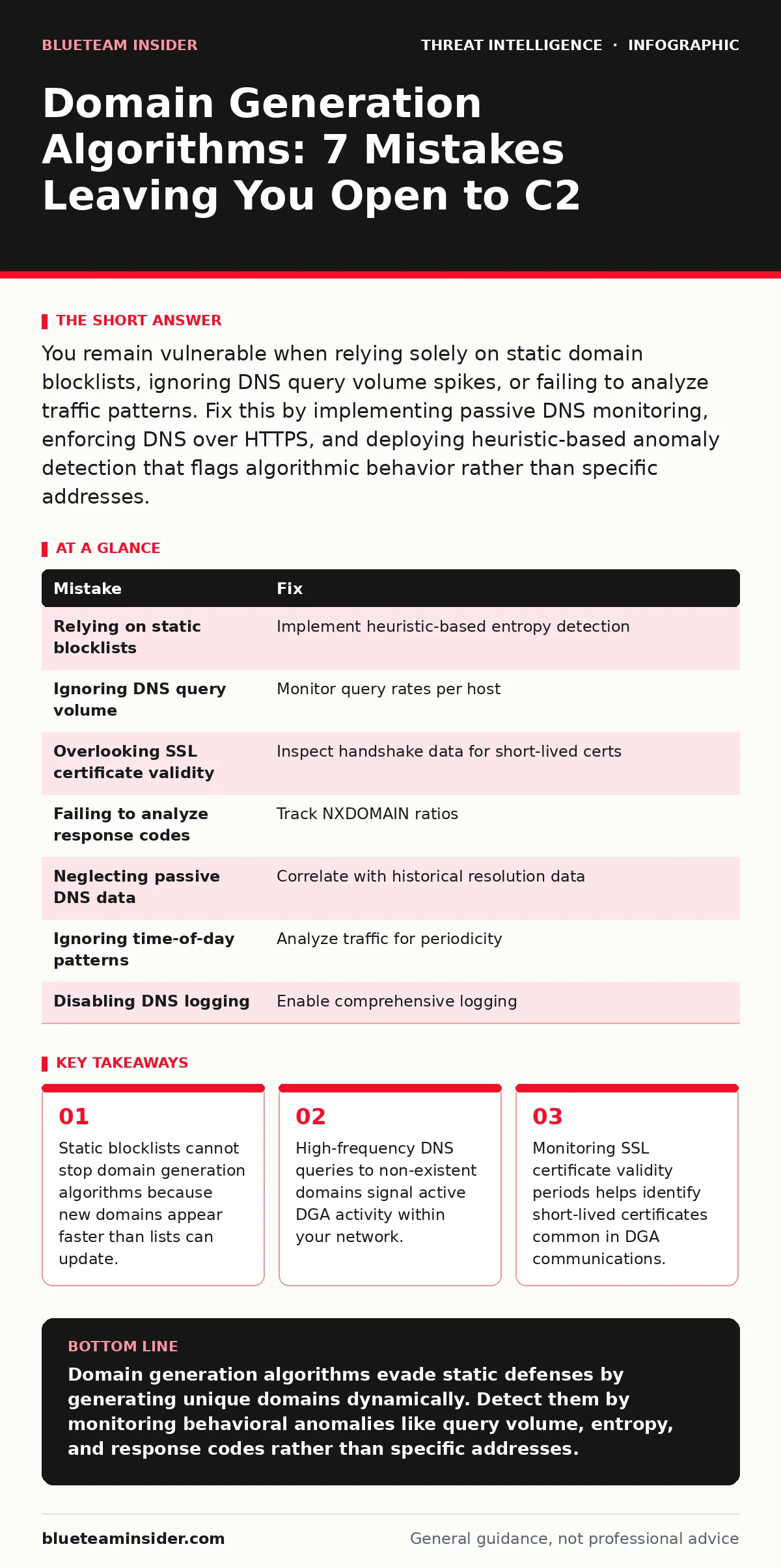
You remain vulnerable when relying solely on static domain blocklists, ignoring DNS query volume spikes, or failing to analyze traffic patterns. Fix this by implementing passive DNS monitoring, enforcing DNS over HTTPS, and deploying heuristic-based anomaly detection that flags algorithmic behavior rather than specific addresses.
Mistake 1: Relying Exclusively on Static Domain Blocklists
Static blocklists provide a false sense of security against domain generation algorithms. These algorithms produce thousands of unique domain names daily, often using randomization seeds that change with each execution cycle. By the time a specific malicious domain is added to a blocklist, the malware has already generated a new one. This approach fails because it reacts to known indicators rather than detecting the underlying behavior. The volume of generated domains exceeds the update capacity of most static lists.
Why it hurts:
Your security tools miss the majority of command and control traffic. The malware rotates through hundreds of potential domains, only contacting the one that resolves to an active server. Static lists block the noise but allow the signal to pass through unnoticed. You waste resources updating lists that are already obsolete. This gap allows attackers to maintain persistent access without triggering alerts.
The fix:
Implement heuristic-based detection that analyzes domain name entropy and structure. High entropy indicates randomness, a hallmark of algorithmic generation. Combine this with passive DNS monitoring to track historical resolution data. This method identifies suspicious patterns before the domain is actively used for malicious communication. It shifts focus from specific addresses to behavioral anomalies.
Mistake 2: Ignoring DNS Query Volume Spikes
Domain generation algorithms typically instruct malware to attempt connections with dozens or hundreds of domains in a short timeframe. This behavior creates distinct spikes in DNS query volume that differ significantly from normal user activity. Many security operations centers overlook these spikes, treating them as network noise or legitimate high-traffic applications. This oversight misses the most obvious indicator of DGA activity. Normal users do not query hundreds of unique domains in minutes.
Why it hurts:
You fail to detect the scanning phase of the attack. The malware is probing for a working command and control server. Without monitoring query frequency, you miss the window where the malware is vulnerable to detection. The sudden surge in queries strains your DNS infrastructure and masks the malicious intent behind legitimate high-volume traffic. This allows the attacker to establish a connection before you realize an infection is present.
The fix:
Deploy network monitoring tools that track DNS query rates per host. Set thresholds for acceptable query volumes based on your environment's baseline. Alert when a single host generates queries to numerous unique domains within a short period. This method detects the behavior regardless of the specific domains used. It requires no prior knowledge of the malware's domain list.
Mistake 3: Overlooking Short-Lived SSL Certificates
Many domain generation algorithms use self-signed or short-lived SSL certificates to encrypt their command and control traffic. These certificates often have validity periods of days or hours, unlike commercial certificates that last for years. Security teams often ignore certificate validity during traffic analysis, focusing instead on domain reputation. This mistake allows encrypted DGA traffic to blend in with legitimate secure communications. The short lifespan prevents long-term tracking and attribution.
Why it hurts:
You miss a critical layer of defense. Encrypted traffic hides the payload content from standard inspection tools. Short-lived certificates indicate a throwaway infrastructure designed to evade detection. By ignoring certificate details, you allow the attacker to communicate securely with their server. This makes it difficult to analyze the command and control protocol or extract useful indicators of compromise.
The fix:
Inspect SSL/TLS handshake data for certificate validity periods and issuer information. Flag connections using self-signed certificates or those with unusually short expiration dates. Combine this with certificate transparency log monitoring to detect newly issued certificates for suspicious domains. This adds a layer of verification that complements domain analysis. It helps identify infrastructure that lacks legitimate trust anchors.
Mistake 4: Failing to Analyze DNS Response Codes
Domain generation algorithms generate many domains that do not exist. This results in a high rate of DNS NXDOMAIN responses. Most security tools focus on successful resolutions, ignoring the failures. This is a critical blind spot. A high ratio of failed DNS queries to successful ones is a strong indicator of DGA activity. Legitimate applications rarely generate such a high volume of non-existent domain queries. Ignoring these responses leaves you blind to the scanning behavior.
Why it hurts:
You miss the statistical anomaly that defines DGA traffic. The malware is casting a wide net, and most attempts fail. By filtering out failed queries, you remove the evidence of the scanning process. This makes it nearly impossible to distinguish between a compromised host and normal network noise. The attacker exploits this blind spot to maintain communication without raising suspicion.
The fix:
Monitor and analyze DNS response codes, specifically NXDOMAIN rates. Calculate the ratio of failed to successful queries for each host. Alert when this ratio exceeds your established baseline. This method detects DGA activity even if the malware successfully connects to a command and control server only once. It provides a behavioral signature that is difficult to mimic with legitimate traffic.
Mistake 5: Neglecting Passive DNS Data Correlation
Passive DNS data records historical DNS resolutions across multiple networks. This data helps identify domains that are newly registered or rarely queried. Domain generation algorithms often use domains that have never been resolved before. Without correlating internal DNS logs with passive DNS data, you cannot distinguish between a new legitimate service and a malicious DGA domain. This lack of context reduces the effectiveness of your detection rules.
Why it hurts:
You treat all new domains equally, creating alert fatigue. Legitimate software updates and new services generate new domains constantly. Without historical context, you cannot prioritize threats effectively. This leads to missed detections or ignored alerts. The attacker benefits from this noise, hiding their activity among legitimate new domain registrations. You lose the ability to identify the novelty of the threat.
The fix:
Integrate passive DNS data into your security information and event management system. Correlate internal DNS logs with historical resolution data. Flag domains that have no prior resolution history or were registered very recently. This context helps prioritize investigations and reduces false positives. It allows you to focus on domains that are statistically unlikely to be legitimate.
See also: Sysmon Misunderstandings: Fix These 6 Configuration Errors Now · Remote Desktop Abuse: Early Warning Signs and Response Steps
Mistake 6: Ignoring Time-of-Day Patterns
Some domain generation algorithms use time-based seeds, meaning the domains they generate change based on the current time. This creates predictable patterns in domain generation cycles. Security teams often assume DGA traffic is random and continuous. This assumption leads to missed detections during off-peak hours or specific time windows. The malware may be more active during business hours to blend in with legitimate traffic. Ignoring temporal patterns reduces your detection accuracy.
Why it hurts:
You miss the rhythmic nature of certain DGA implementations. The malware may generate domains in bursts or at specific intervals. Without analyzing time-based patterns, you fail to identify these cycles. This allows the malware to operate undetected during predictable windows. The attacker exploits this regularity to maintain persistent access while minimizing exposure.
The fix:
Analyze DNS traffic for time-based patterns and periodicity. Look for recurring spikes in DNS activity at specific intervals. Combine this with entropy analysis to identify algorithmic generation. This method helps identify time-seeded DGA implementations. It allows you to predict future domain generations and proactively block them.
Mistake 7: Disabling DNS Logging on Critical Systems
Domain generation algorithms rely on DNS to resolve command and control servers. If DNS logging is disabled on critical systems, you lose visibility into this activity. Many administrators disable logging to save disk space or improve performance. This mistake creates a permanent blind spot. Without logs, you cannot reconstruct the attack path or identify the initial compromise. You are forced to rely on endpoint detection, which may be bypassed.
Why it hurts:
You lack the forensic data needed to investigate incidents. DNS logs are often the only record of command and control communication. Without them, you cannot determine the scope of the infection. This makes remediation difficult and increases the risk of persistence. The attacker benefits from this lack of visibility, operating freely within your network.
The fix:
Enable comprehensive DNS logging on all critical systems and network devices. Ensure logs are stored securely and retained for an adequate period. Use centralized log management to correlate DNS data with other security events. This ensures you have the necessary data for investigation and analysis. It provides a complete picture of network activity.
| Mistake | Fix |
|---|---|
| Relying on static blocklists | Implement heuristic-based entropy detection |
| Ignoring DNS query volume | Monitor query rates per host |
| Overlooking SSL certificate validity | Inspect handshake data for short-lived certs |
| Failing to analyze response codes | Track NXDOMAIN ratios |
| Neglecting passive DNS data | Correlate with historical resolution data |
| Ignoring time-of-day patterns | Analyze traffic for periodicity |
| Disabling DNS logging | Enable comprehensive logging |
Key takeaways
- Static blocklists cannot stop domain generation algorithms because new domains appear faster than lists can update.
- High-frequency DNS queries to non-existent domains signal active DGA activity within your network.
- Monitoring SSL certificate validity periods helps identify short-lived certificates common in DGA communications.
Domain generation algorithms evade static defenses by generating unique domains dynamically. Detect them by monitoring behavioral anomalies like query volume, entropy, and response codes rather than specific addresses.
Frequently asked questions
How do I distinguish DGA traffic from legitimate software updates?
Legitimate updates rarely generate high entropy domain names or produce massive spikes in NXDOMAIN responses. DGA traffic shows statistical anomalies in query frequency and domain structure that normal software does not exhibit.
Can I block DGA traffic at the firewall level?
Firewalls can block specific IPs, but DGA traffic uses dynamic domains that resolve to different IPs. You must block at the DNS level or use heuristic detection to identify and block the querying hosts before they resolve the domains.
Does DNS over HTTPS prevent DGA detection?
DNS over HTTPS encrypts queries, hiding them from network inspection. However, it does not change the behavior. You must monitor endpoint DNS activity or use proxy-based inspection to detect anomalies in the query patterns.
How often should I update my detection rules?
Detection rules for DGA should be based on behavior, not specific domains. Update your behavioral baselines regularly to account for changes in network usage patterns, but the core logic for entropy and volume remains constant.
How this guide was produced: written by the BlueTeam Insider editorial team with AI assistance, checked against the public references listed below, and reviewed when the facts change. See our editorial policy or report an error.