IOC Enrichment Errors: Fix 7 Common Analyst Mistakes
Enriching indicators without context creates false positives that drown your security team in noise and hide real threats.

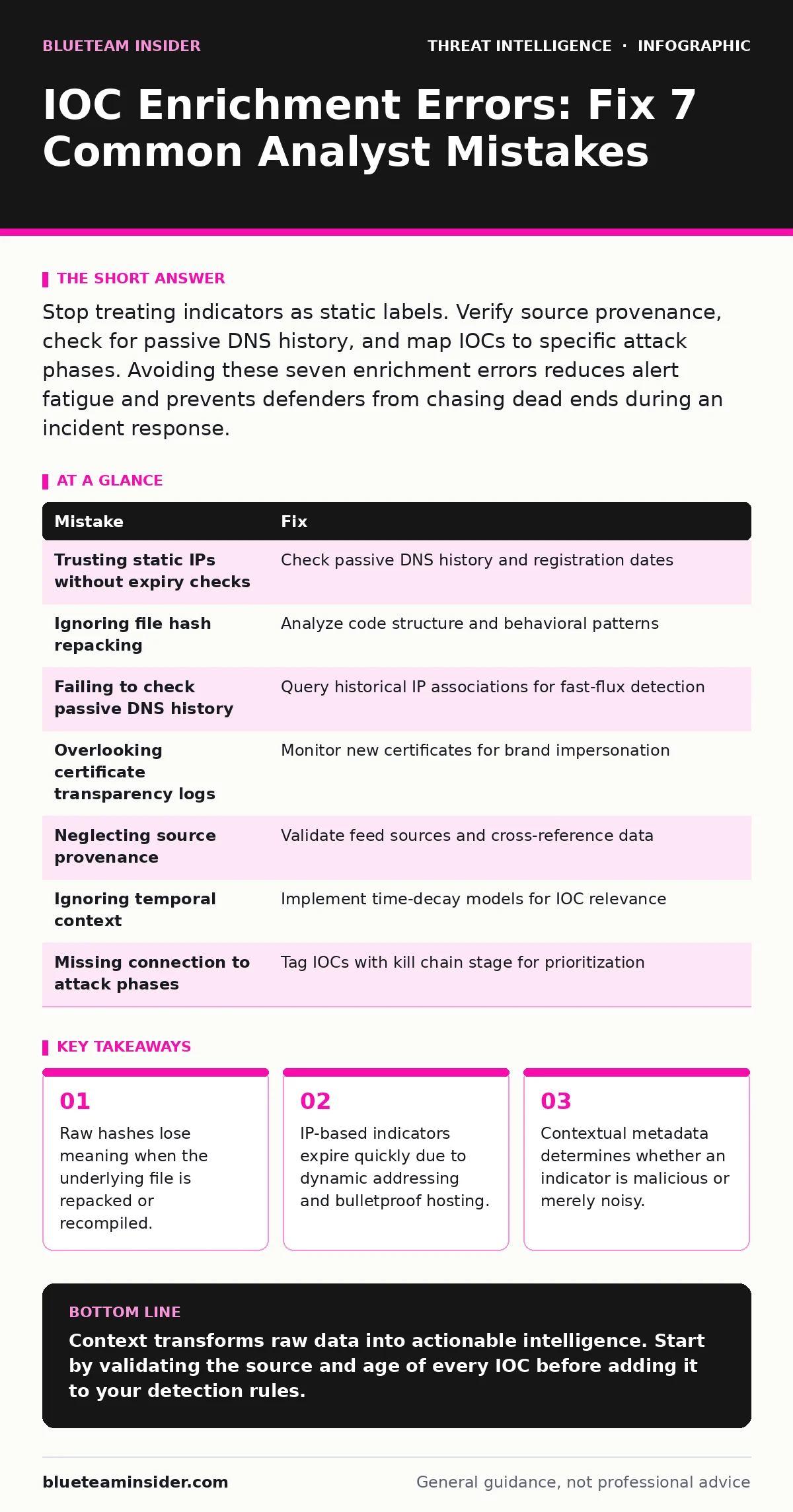
Stop treating indicators as static labels. Verify source provenance, check for passive DNS history, and map IOCs to specific attack phases. Avoiding these seven enrichment errors reduces alert fatigue and prevents defenders from chasing dead ends during an incident response.
Indicator of Compromise (IOC) enrichment is the process of adding context to raw data points like IP addresses, domains, or file hashes. This context helps you decide if a signal is noise or a threat. Many teams enrich data mechanically, feeding raw lists into tools without understanding the mechanics of the data. This approach creates hidden costs that degrade your detection capabilities over time.
Mistake 1: Trusting Static IP Indicators Without Expiry Checks
You often see IP addresses flagged as malicious and block them immediately. This works only if the IP is static and tied to a long-running command and control server. Most modern infrastructure uses dynamic IP allocation or short-lived containers. An IP flagged today may belong to a benign user tomorrow.
Why it hurts: Blocking an IP that has been reassigned causes false positives. You may inadvertently block legitimate business traffic or your own cloud services. This breaks trust in your security tools and wastes analyst time investigating benign connections.
The fix: Always check the registration date and historical reputation of an IP. Use passive DNS data to see if the IP has hosted multiple unrelated domains over time. If the history is sparse or recent, treat the IP with suspicion rather than immediate blocking. Refer to our guide on bulletproof hosting to understand how threat actors rotate infrastructure rapidly.
Mistake 2: Ignoring File Hash Repacking
You rely on SHA-256 hashes to identify malicious files. This method assumes the file content never changes. Threat actors know this. They often repack malware, changing the file structure slightly while keeping the malicious payload intact. This generates a new hash.
Why it hurts: Your static hash list becomes obsolete within hours. You miss the new variant because your system only looks for the original hash. This gap allows the malware to execute and establish persistence before you detect it.
The fix: Look for structural similarities rather than exact matches. Use techniques that analyze code sections or behavioral patterns. For deeper understanding, review our guide on defense evasion, which covers how attackers modify code to bypass signature-based detection.
Mistake 3: Failing to Check Passive DNS History
You encounter a new domain and check if it resolves to a known bad IP. This is a shallow check. Sophisticated actors use fast-flux DNS networks that change IP addresses rapidly. A single snapshot in time may show a clean IP, masking the malicious nature of the domain.
Why it hurts: You miss the connection to known malicious infrastructure. The domain appears benign because the IP it resolves to right now is clean. You fail to block the domain, allowing data exfiltration or command retrieval to continue.
The fix: Query passive DNS databases to see the full history of IP associations for the domain. If a domain has resolved to dozens of different IPs in a short period, it is likely part of a fast-flux network. Mark the domain as high-risk regardless of the current IP reputation.
Mistake 4: Overlooking Certificate Transparency Logs
You focus on domains and IPs but ignore the TLS certificates used by the infrastructure. Threat actors often generate cheap or free certificates to make their phishing pages look legitimate. They do this to bypass browser warnings.
Why it hurts: You miss early signs of brand impersonation. The domain name might be slightly different, but the certificate details can reveal the same operator. Without checking certificates, you rely solely on domain reputation, which can be manipulated.
The fix: Monitor Certificate Transparency logs for new certificates issued to domains similar to your organization’s name. Look for certificates issued to domains that have no web presence but exist only to harvest credentials. This ties into our discussion on phishing infrastructure and how attackers mimic trusted entities.
Mistake 5: Neglecting Source Provenance
You ingest IOCs from multiple feeds without verifying the source. Some feeds aggregate data from unverified community reports. Others may have low-quality detection logic. Mixing high-quality and low-quality data creates a polluted dataset.
Why it hurts: Your detection rules trigger on low-confidence data. Analysts spend hours investigating false positives from unreliable sources. This leads to alert fatigue and desensitization to real threats.
The fix: Validate the source of every IOC feed. Prefer feeds that provide transparency about their collection methods. Discard sources that do not provide context or confidence scores. Always cross-reference new IOCs with at least two independent, high-quality sources before acting.
See also: Threat Actor Profiling: Answering 8 Key Questions · Detect Phishing Infrastructure: Signals, Blind Spots and Tools
Mistake 6: Ignoring Temporal Context
You treat an IOC as equally relevant today as it was six months ago. Threat actors abandon infrastructure when they suspect detection. An IP address used in a campaign last year may now be clean.
Why it hurts: Your security controls become overly restrictive. You block traffic that is no longer malicious, impacting business operations. You also waste resources maintaining rules for dead infrastructure.
The fix: Implement a time-decay model for your IOCs. Automatically reduce the confidence score of an IOC as it ages. Remove IOCs that have not been seen in active campaigns for a defined period. This keeps your detection logic focused on current threats.
Mistake 7: Missing the Connection to Attack Phases
You enrich IOCs in isolation, without mapping them to specific stages of the kill chain. An IOC found in the initial access phase is different from one found in the exfiltration phase. Treating them the same leads to poor prioritization.
Why it hurts: You prioritize blocking initial access indicators over stopping active data theft. This misalignment wastes resources on early-stage noise while late-stage threats continue unchecked.
The fix: Tag IOCs with their associated attack phase. Prioritize enrichment and response for IOCs linked to lateral movement or data exfiltration. Use this contextual tagging to improve your SOC playbooks and ensure analysts respond with the right urgency.
| Mistake | Fix |
|---|---|
| Trusting static IPs without expiry checks | Check passive DNS history and registration dates |
| Ignoring file hash repacking | Analyze code structure and behavioral patterns |
| Failing to check passive DNS history | Query historical IP associations for fast-flux detection |
| Overlooking certificate transparency logs | Monitor new certificates for brand impersonation |
| Neglecting source provenance | Validate feed sources and cross-reference data |
| Ignoring temporal context | Implement time-decay models for IOC relevance |
| Missing connection to attack phases | Tag IOCs with kill chain stage for prioritization |
Key takeaways
- Raw hashes lose meaning when the underlying file is repacked or recompiled.
- IP-based indicators expire quickly due to dynamic addressing and bulletproof hosting.
- Contextual metadata determines whether an indicator is malicious or merely noisy.
Context transforms raw data into actionable intelligence. Start by validating the source and age of every IOC before adding it to your detection rules.
Frequently asked questions
How do I prioritize IOC enrichment tasks?
Focus on IOCs linked to active campaigns and high-value assets. Use kill chain phase tagging to identify which indicators require immediate attention.
What is the best way to handle false positives in IOC feeds?
Maintain a blocklist of known benign IOCs specific to your environment. Regularly update this list to prevent recurring false alarms.
Can I automate IOC enrichment safely?
Yes, but only for enrichment, not for immediate blocking. Use automation to gather context and confidence scores, but require human approval for enforcement actions.
How often should I review my IOC feeds?
Review feed quality and relevance monthly. Remove sources that consistently produce low-confidence or outdated data.
How this guide was produced: written by the BlueTeam Insider editorial team with AI assistance, checked against the public references listed below, and reviewed when the facts change. See our editorial policy or report an error.