Island Hopping Attacks: How Attackers Move Laterally Without Detection
Attackers often bypass perimeter defenses by targeting low-security edge devices to pivot into high-value internal networks undetected.

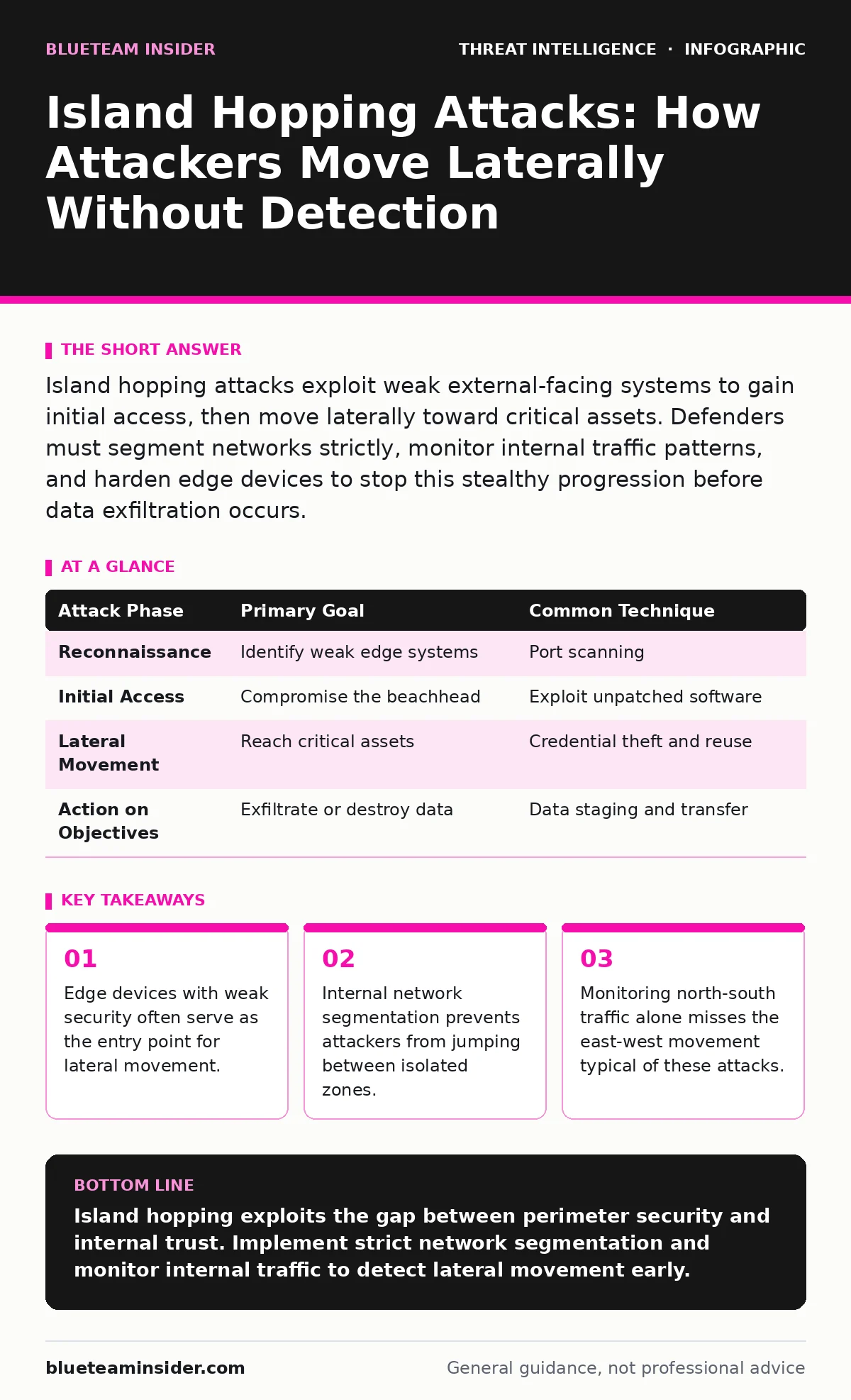
Island hopping attacks exploit weak external-facing systems to gain initial access, then move laterally toward critical assets. Defenders must segment networks strictly, monitor internal traffic patterns, and harden edge devices to stop this stealthy progression before data exfiltration occurs.
What defines an island hopping attack strategy?
An island hopping attack is a lateral movement technique where an adversary targets a less-secured peripheral system to gain access to a more secure, central network. The attacker treats the weak system as a "beachhead" or a stepping stone. Once inside, they pivot toward high-value targets while avoiding direct confrontation with primary defenses. This method exploits the assumption that securing the main data center is sufficient.
Why do attackers choose weak edge systems first?
Attackers select edge systems because they often have weaker security controls and less rigorous monitoring than core infrastructure. These systems might include branch office servers, internet-facing applications, or third-party vendor portals. The goal is to find the path of least resistance. By compromising a low-priority asset, the attacker avoids triggering alerts associated with direct attacks on critical servers.
How does network segmentation stop this progression?
Network segmentation divides a single large network into smaller, isolated zones with strict access controls. If an attacker compromises one segment, they cannot easily move to another without bypassing additional security gates. This limits the blast radius of any single breach. Without segmentation, an attacker can roam freely once they gain initial foothold access.
What role does lateral movement play in these attacks?
Lateral movement is the process of moving from one computer or user account to another within the same network. After gaining initial access, the attacker seeks higher privileges or access to sensitive data repositories. They often use stolen credentials or exploit trust relationships between systems. This phase is critical because it allows the attacker to reach their final objective without re-entering the network from the outside.
| Attack Phase | Primary Goal | Common Technique |
|---|---|---|
| Reconnaissance | Identify weak edge systems | Port scanning |
| Initial Access | Compromise the beachhead | Exploit unpatched software |
| Lateral Movement | Reach critical assets | Credential theft and reuse |
| Action on Objectives | Exfiltrate or destroy data | Data staging and transfer |
Can you detect island hopping with standard firewalls?
Standard perimeter firewalls are often ineffective because they focus on traffic entering and leaving the network boundary. They typically do not inspect or restrict traffic moving between internal servers. This creates a blind spot for east-west traffic, which is exactly how island hopping progresses. You need internal monitoring tools to see connections between internal hosts.
See also: Point-of-Sale Malware Prevention Checklist for Secure Transactions · Network Segmentation: How to Partition and Protect Your Data
How do attackers maintain persistence during the hop?
Attackers often install backdoors or create new user accounts to ensure they can return even if the initial entry point is closed. They may also modify system configurations to hide their presence. Persistence mechanisms allow the attacker to survive reboots or security scans. This makes removal difficult because the compromise is no longer just an active session but a modified system state.
What is the hidden cost of trusting internal traffic?
The hidden cost is the assumption that internal traffic is inherently safe. Many security policies implicitly trust any device already inside the network perimeter. Attackers exploit this trust by using legitimate protocols and credentials to move laterally. This means a compromised internal device can act as a trusted actor, bypassing many security checks. You must verify every connection, regardless of its origin.
How does credential theft enable this tactic?
Credential theft allows attackers to impersonate legitimate users or services. Techniques such as LSASS credential theft extract memory-resident credentials from running processes. Once obtained, these credentials can be used to authenticate to other systems. This bypasses the need to exploit new vulnerabilities on each hop, making the movement faster and quieter.
What monitoring strategies reveal the pattern?
You must monitor for unusual internal connections, especially those originating from low-privilege systems. Look for a single host connecting to many different internal servers in a short time. Anomalies in login times or locations can also signal compromise. Integrating logs from endpoints, network devices, and identity providers creates a complete picture. This holistic view helps distinguish between normal administrative activity and malicious hopping.
How do you prioritize remediation efforts?
Start by identifying and hardening all internet-facing assets that lack strong authentication. Then, review internal network segmentation to ensure critical assets are isolated. Regularly audit user and service account privileges to remove unnecessary access. Finally, ensure your monitoring covers internal traffic patterns. Prioritizing these steps reduces the attack surface and limits the ability to pivot.
Key takeaways
- Edge devices with weak security often serve as the entry point for lateral movement.
- Internal network segmentation prevents attackers from jumping between isolated zones.
- Monitoring north-south traffic alone misses the east-west movement typical of these attacks.
Island hopping exploits the gap between perimeter security and internal trust. Implement strict network segmentation and monitor internal traffic to detect lateral movement early.
Frequently asked questions
Is island hopping the same as a worm attack?
No, island hopping is a deliberate, targeted strategy by an attacker, while a worm is self-replicating malware that spreads automatically. Island hopping relies on human-like lateral movement.
How does this relate to threat actor profiling?
Understanding threat actor profiling helps you predict which edge systems an adversary might target based on their known tactics and the value of your assets.
Can remote desktop abuse facilitate island hopping?
Yes, if remote desktop is enabled and poorly secured, attackers can use it to jump from one machine to another within the network.
What is the connection to phishing infrastructure?
Phishing infrastructure is often used to deliver the initial payload that compromises the first "island," allowing the attacker to begin the hopping process.
How this guide was produced: written by the BlueTeam Insider editorial team with AI assistance, checked against the public references listed below, and reviewed when the facts change. See our editorial policy or report an error.