Microsoft Exchange Vulnerabilities: 6 Myths That Put Your Data at Risk
Exchange security failures often stem from internal trust issues and delayed patching rather than external hacking tools or complex zero-day exploits targeting the software itself.

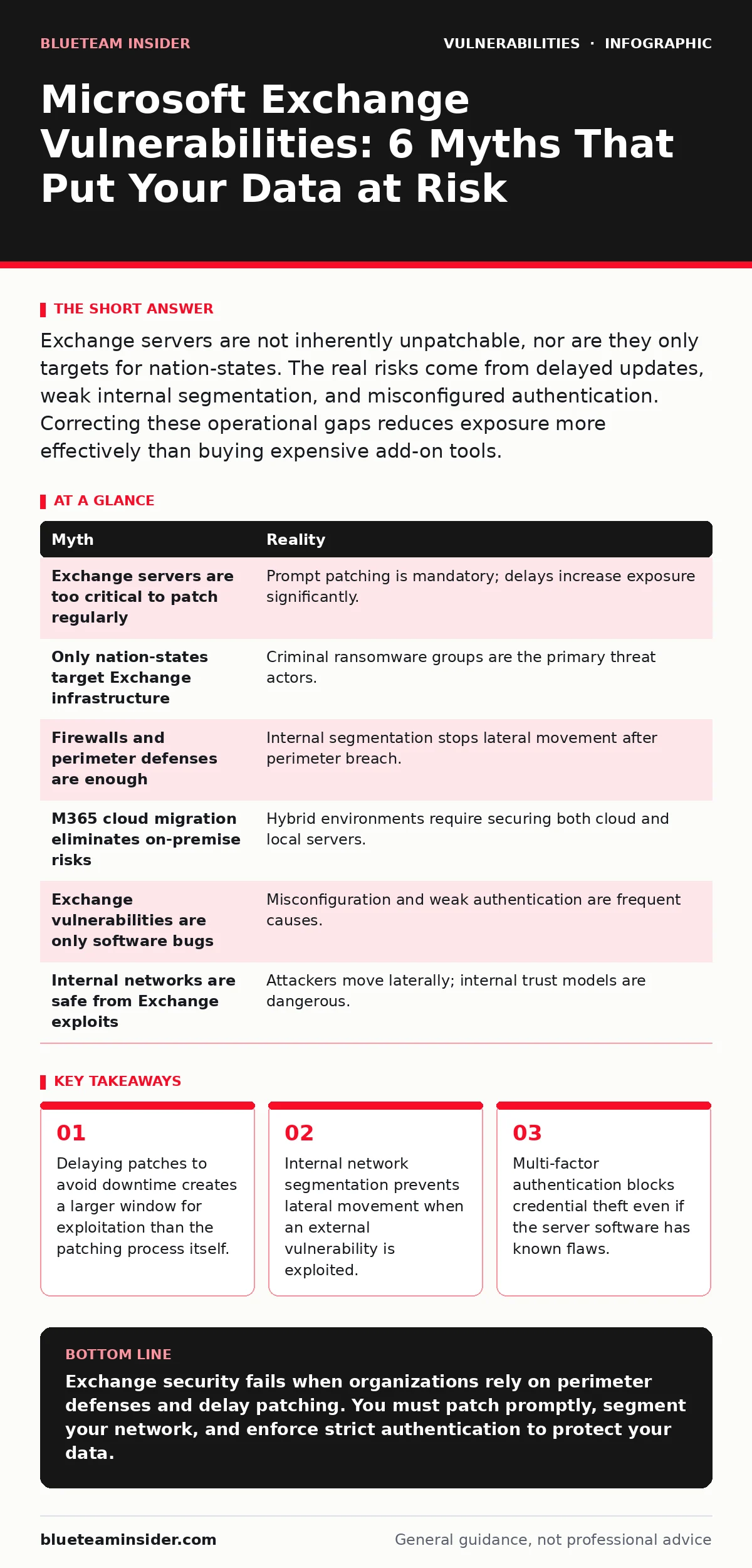
Exchange servers are not inherently unpatchable, nor are they only targets for nation-states. The real risks come from delayed updates, weak internal segmentation, and misconfigured authentication. Correcting these operational gaps reduces exposure more effectively than buying expensive add-on tools.
Myth: Exchange servers are too critical to patch regularly
Reality: Treating Exchange as a "do not touch" asset invites compromise. Every day an unpatched server remains online, it exposes the organization to known exploits. The fear of downtime often outweighs the actual risk of applying a vendor patch. Modern deployment strategies allow for rapid updates with minimal service interruption.
Organizations often hoard vulnerabilities by postponing updates until the next major maintenance window. This practice is outdated. Microsoft releases cumulative updates that address multiple issues at once. Applying these updates promptly closes the door to attackers who scan for known CVEs. The cost of an outage from patching is usually lower than the cost of a breach.
Myth: Only nation-states target Exchange infrastructure
Reality: Criminal groups targeting ransomware and data theft are the primary threat actors for Exchange. They use automated tools to scan for unpatched servers across the internet. These groups do not need state-level resources or custom zero-day exploits. They rely on publicly available information about known weaknesses.
The assumption that only sophisticated actors care about email servers is dangerous. Ransomware operators view Exchange as a high-value target because it contains sensitive communications and credentials. They use brute-force techniques and known exploits to gain initial access. Once inside, they move laterally to encrypt data. Defending against these common actors requires basic hygiene, not advanced threat hunting.
Myth: Firewalls and perimeter defenses are enough
Reality: Perimeter controls fail when attackers exploit vulnerabilities directly on the server. A firewall can block unauthorized IP addresses, but it cannot stop an exploit triggered by a legitimate request. Attackers often use compromised accounts or proxy servers to mimic trusted traffic. Internal segmentation is the true barrier.
Imagine a firewall that blocks all external traffic except port 443. An attacker sends a malicious request through that port. If the Exchange server has a vulnerability, the request executes code on the server. The firewall sees this as normal web traffic. The damage occurs inside the network. You must assume the perimeter is breached and limit the blast radius.
Myth: M365 cloud migration eliminates on-premise risks
Reality: Hybrid environments create a larger attack surface. Many organizations run on-premise Exchange servers alongside cloud services. Attackers target the on-premise component to steal credentials or reset cloud passwords. The cloud is only as secure as the weakest link in the hybrid chain. Leaving old servers unpatched undermines the entire security posture.
Organizations often believe that moving mailboxes to the cloud removes the need to secure the local server. This is incorrect. The local server often handles authentication and directory services. If an attacker compromises the local Exchange server, they can manipulate authentication flows to access cloud resources. You must secure both environments with equal rigor.
Myth: Exchange vulnerabilities are only software bugs
Reality: Misconfiguration and weak authentication are more common causes of breaches than code defects. Attackers exploit default settings, unused protocols, and weak passwords. A server can be fully patched but still vulnerable if it allows anonymous access or lacks multi-factor authentication. Security is as much about configuration as it is about code.
Imagine an administrator who patches the server but leaves remote management ports open to the internet. An attacker scans for these ports and gains access. The vulnerability was not in the code but in the exposure. Reviewing configuration settings regularly is as important as applying patches. You must disable unnecessary features and enforce strong authentication policies.
See also: How Out-of-Band Patches Work: Mechanisms, Risks, and Application · Vulnerability Scanning Best Practices for Accurate Risk Data
Myth: Internal networks are safe from Exchange exploits
Reality: Lateral movement is a primary tactic after initial compromise. Attackers who exploit an Exchange server often move to domain controllers and file servers. Internal trust models allow this movement. Without strict access controls and monitoring, an attacker can escalate privileges within hours. The internal network is not a safe haven.
Once an attacker has a foothold on the Exchange server, they use stolen credentials to access other systems. They map the network and identify high-value targets. Segmentation and least-privilege access slow this progress. You must treat every internal connection as potentially hostile. Monitoring for unusual lateral movement helps detect breaches early.
| Myth | Reality |
|---|---|
| Exchange servers are too critical to patch regularly | Prompt patching is mandatory; delays increase exposure significantly. |
| Only nation-states target Exchange infrastructure | Criminal ransomware groups are the primary threat actors. |
| Firewalls and perimeter defenses are enough | Internal segmentation stops lateral movement after perimeter breach. |
| M365 cloud migration eliminates on-premise risks | Hybrid environments require securing both cloud and local servers. |
| Exchange vulnerabilities are only software bugs | Misconfiguration and weak authentication are frequent causes. |
| Internal networks are safe from Exchange exploits | Attackers move laterally; internal trust models are dangerous. |
Understanding these realities helps you prioritize your security efforts. Patching is not optional. Configuration matters as much as code. Internal segmentation protects your broader network. You must treat Exchange as a high-value target that requires continuous attention.
Key takeaways
- Delaying patches to avoid downtime creates a larger window for exploitation than the patching process itself.
- Internal network segmentation prevents lateral movement when an external vulnerability is exploited.
- Multi-factor authentication blocks credential theft even if the server software has known flaws.
Exchange security fails when organizations rely on perimeter defenses and delay patching. You must patch promptly, segment your network, and enforce strict authentication to protect your data.
Frequently asked questions
How long should I wait to patch Exchange after a vulnerability is disclosed?
Patch immediately. The window between disclosure and widespread exploitation is often measured in days. Waiting for a service pack or a convenient maintenance window leaves you exposed to automated scanning tools that exploit known vulnerabilities within hours of their public release.
Does moving to Microsoft 365 remove the need to patch on-premise Exchange?
No. In hybrid deployments, the on-premise server often handles authentication and directory synchronization. Attackers target these local components to steal credentials or reset cloud passwords. You must maintain rigorous patching and configuration standards for any on-premise Exchange server that interacts with your cloud environment.
Can a firewall prevent exploitation of an Exchange vulnerability?
A firewall can block unauthorized access attempts, but it cannot stop an exploit triggered by a legitimate request from a trusted source. Attackers often use compromised accounts or proxy servers to bypass perimeter controls. Internal segmentation and application-layer filtering are required to mitigate the risk of successful exploitation.
What is the biggest misconception about Exchange security?
The biggest misconception is that patching alone solves the problem. While patching is critical, misconfigurations, weak authentication, and lack of internal segmentation often lead to breaches. You must combine timely updates with strong identity protection and network isolation to effectively secure your Exchange environment.
How this guide was produced: written by the BlueTeam Insider editorial team with AI assistance, checked against the public references listed below, and reviewed when the facts change. See our editorial policy or report an error.