How Defense Evasion Works: The Step-by-Step Breakdown
Attackers succeed by mimicking normal system noise, turning legitimate maintenance tasks into invisible pathways that bypass standard detection rules.

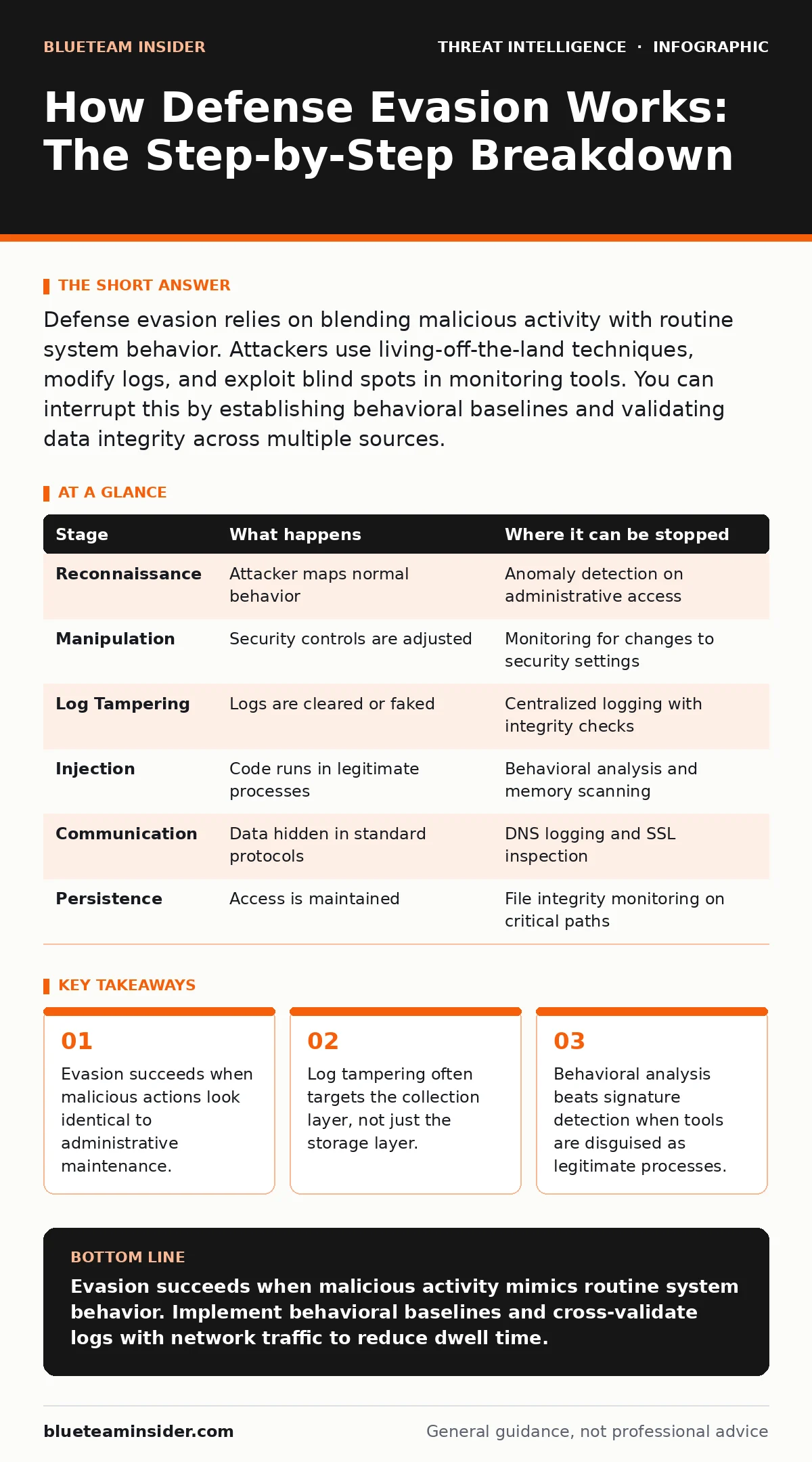
Defense evasion relies on blending malicious activity with routine system behavior. Attackers use living-off-the-land techniques, modify logs, and exploit blind spots in monitoring tools. You can interrupt this by establishing behavioral baselines and validating data integrity across multiple sources.
The Illusion of Normalcy
Defense evasion is not about breaking into a system; it is about hiding once inside. Most security tools rely on known signatures or obvious anomalies. An attacker understands that standing out guarantees detection. The goal is to become part of the background noise. This requires a deep understanding of how the target environment behaves under normal conditions.
Imagine a server that restarts every Tuesday at 02:00 AM for patching. An attacker schedules their data exfiltration for that same window. To a monitoring tool, the traffic spike looks like a routine update. This is the core mechanism of evasion: context manipulation. The attacker does not change their action; they change the context in which the action occurs.
Stage 1: Reconnaissance and Baseline Mapping
Before hiding, the attacker must know what "normal" looks like. This stage involves passive observation. The adversary monitors network traffic, process execution, and log generation rates. They are looking for patterns that can be mimicked. This is distinct from active scanning, which triggers alarms.
The attacker identifies blind spots. These are processes that run with high privileges but generate little to no detailed logging. They also identify time windows where alert fatigue is highest. By mapping the baseline, the attacker creates a template for camouflage. This preparation phase is silent but determines the success of all subsequent steps.
Stage 2: Environment Manipulation
With the baseline established, the attacker begins to alter the environment to suit their needs. This often involves removing or modifying security controls. However, direct deletion of antivirus software is risky. Instead, the attacker may disable specific real-time protection modules or adjust exclusion lists.
This stage relies on legitimate administrative interfaces. Attackers use built-in commands to change settings. This is known as living-off-the-land. Because the commands are signed by the operating vendor, they rarely trigger security alerts. The attacker creates a safe harbor within the system.
Stage 3: Log Tampering and Data Hiding
Security teams rely on logs for detection and investigation. Attackers know this. They target the logging infrastructure itself. This can involve clearing event logs on a local machine or corrupting the data sent to a central server.
Some attackers go further by injecting false data into logs. This creates noise that distracts from the actual malicious activity. It is a form of deception designed to waste analyst time. The goal is to make the signal indistinguishable from the noise. This technique is particularly effective in environments with high log volume.
Stage 4: Process Injection and Masquerading
Once hidden in the logs, the attacker needs to execute code without detection. Process injection allows an attacker to run malicious code within the memory space of a legitimate process. This makes the malicious activity appear as part of the legitimate program.
The attacker may also masquerade their tools. They rename their executable to match a system service. For instance, a hacker might name their tool svchost.exe. However, this is a crude method. More sophisticated attackers inject code into actual system processes like explorer.exe or svchost.exe. This makes process monitoring useless unless deep behavioral analysis is employed.
Stage 5: Obfuscated Communication
Data exfiltration and command-and-control communication must also be hidden. Attackers often use legitimate protocols like DNS or HTTPS. By encoding their data within standard protocol fields, they bypass deep packet inspection tools that only look for known malicious signatures.
This stage relies on the complexity of modern protocols. DNS queries can carry small amounts of data in the domain name. HTTPS traffic is encrypted, hiding the payload from network monitors. The attacker blends their traffic with the massive volume of legitimate internet requests. Detecting this requires analyzing traffic patterns, not just content.
Stage 6: Persistence and Maintenance
The final stage is maintaining access. The attacker establishes persistence mechanisms that survive reboots and updates. They may create scheduled tasks or modify registry keys. However, they do this in a way that aligns with the baseline established in Stage 1.
If the attacker changes too much, they risk detection. They must maintain a delicate balance. They need to keep their tools updated and functional without triggering behavioral alerts. This is an ongoing process. The attacker must continuously adapt to changes in the environment.
Interrupting the Cycle
Defense evasion is a continuous cycle. You can interrupt it at any stage, but some points are more effective than others. Early detection in the reconnaissance phase is ideal but difficult. Most interruptions happen during execution or communication.
| Stage | What happens | Where it can be stopped |
|---|---|---|
| Reconnaissance | Attacker maps normal behavior | Anomaly detection on administrative access |
| Manipulation | Security controls are adjusted | Monitoring for changes to security settings |
| Log Tampering | Logs are cleared or faked | Centralized logging with integrity checks |
| Injection | Code runs in legitimate processes | Behavioral analysis and memory scanning |
| Communication | Data hidden in standard protocols | DNS logging and SSL inspection |
| Persistence | Access is maintained | File integrity monitoring on critical paths |
Related techniques like LSASS credential theft often follow evasion. Once hidden, the attacker steals credentials to move laterally. Similarly, NTLM relay attacks may be used to escalate privileges without triggering password alerts. Understanding these connections helps you build a defense in depth.
The Hidden Cost of Evasion
The cost of defense evasion is not just the initial breach. It is the time the attacker remains undetected. This dwell time allows them to steal more data and establish deeper footholds. The longer they hide, the more they learn about your environment.
This creates a feedback loop. The more you monitor, the more the attacker adapts. This arms race requires constant refinement of your detection rules. You must accept that some evasion will succeed. The goal is to reduce the dwell time to a point where the damage is manageable.
Building Resilience Against Evasion
Resilience comes from diversity in monitoring. If you only look at logs, you will miss process injection. If you only look at network traffic, you will miss local log tampering. You need multiple sources of truth.
Implementing packet capture analysis can reveal obfuscated communication that log analysis misses. Using IOC enrichment helps you identify known malicious indicators, but it will not catch new evasion techniques. Behavioral baselines are your best defense against the unknown.
The Role of Human Analysis
Automated tools are essential, but they cannot interpret context. A human analyst can see that a process running at 02:00 AM is unusual for that specific server, even if it is normal for others. This contextual understanding is critical.
Threat actor profiling helps you understand the likely tactics of your adversaries. If you know they prefer living-off-the-land techniques, you can tune your monitoring to catch those specific behaviors. This proactive approach shifts the burden from the defender to the attacker.
Related topics like remote desktop abuse and port scanning are often precursors to evasion. If you stop the initial access, you stop the need for evasion. This is why layered security is vital. Each layer increases the cost and complexity for the attacker.
Final Thoughts on Detection
Defense evasion is a battle of visibility. The attacker wants to be invisible. You want to see everything. This is a contradiction that cannot be fully resolved. You must choose what to prioritize.
Focus on high-value assets and critical processes. Monitor for changes in behavior, not just known bad indicators. Accept that some noise is inevitable, but ensure that the signal is clear. This balance is the key to effective defense.
Key takeaways
- Evasion succeeds when malicious actions look identical to administrative maintenance.
- Log tampering often targets the collection layer, not just the storage layer.
- Behavioral analysis beats signature detection when tools are disguised as legitimate processes.
Evasion succeeds when malicious activity mimics routine system behavior. Implement behavioral baselines and cross-validate logs with network traffic to reduce dwell time.
Frequently asked questions
How do I detect process injection without slowing down the system?
Use memory-aware endpoint detection that analyzes process behavior rather than scanning every file on disk. Focus on high-privilege processes.
Can I prevent log tampering entirely?
No, but you can make it detectable by sending logs to a centralized, write-only server immediately. This ensures a copy exists even if
How this guide was produced: written by the BlueTeam Insider editorial team with AI assistance, checked against the public references listed below, and reviewed when the facts change. See our editorial policy or report an error.