Process Injection Mistakes That Leave Your Systems Open
Misconfigured memory permissions and weak process privileges allow attackers to hide their code inside trusted system processes without triggering standard alerts.

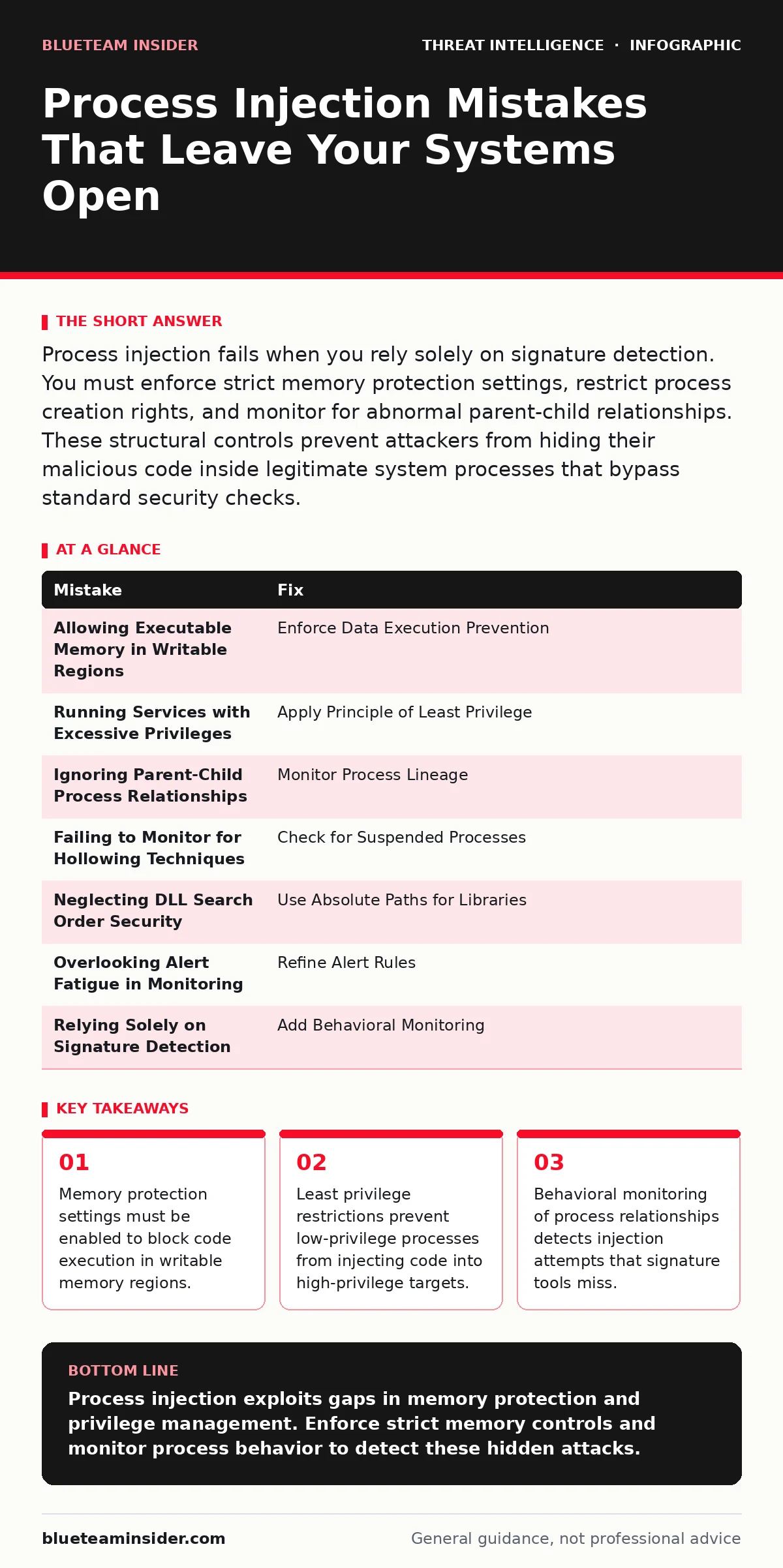
Process injection fails when you rely solely on signature detection. You must enforce strict memory protection settings, restrict process creation rights, and monitor for abnormal parent-child relationships. These structural controls prevent attackers from hiding their malicious code inside legitimate system processes that bypass standard security checks.
Mistake 1: Allowing Executable Memory in Writable Regions
Process injection relies on the ability to write data to memory and then execute that data. When an application allows memory pages to be both writable and executable, an attacker can place shellcode into that space and jump to it. This violates the principle of separation between data storage and instruction execution. Many legacy applications or poorly configured services leave this gap open by default.
Why it hurts:
Attackers use this configuration to bypass application control policies. They do not need to create a new executable file on disk. They write their payload directly into the memory of a running process. This makes the malicious code invisible to file-based scanners. The attacker gains immediate code execution within a trusted context.
The fix:
Enforce Data Execution Prevention on all critical systems. This hardware and software feature marks memory pages as non-executable unless they are explicitly designated for code. Configure your operating system to block legacy compatibility modes that disable this protection. Verify that application virtual memory allocations follow the principle of least privilege for memory access rights.
Mistake 2: Running Services with Excessive Privileges
Administrative accounts often run background services or scheduled tasks. When a service runs with high privileges, it becomes a prime target for process injection. An attacker who compromises a low-privilege user account may still inject code into a high-privilege process if the process handles untrusted input. This privilege escalation path is common in environments where service accounts are over-provisioned.
Why it hurts:
The injected code inherits the high privileges of the host process. An attacker can access restricted files, modify system configurations, or install persistent backdoors. Standard user-level restrictions do not apply to the injected code. The attacker effectively bypasses user account control prompts and security boundaries. This leads to full system compromise from a minor initial foothold.
The fix:
Apply the principle of least privilege to all service accounts. Run services under dedicated accounts with only the permissions required for their specific function. Avoid using local or domain administrator accounts for routine tasks. Regularly audit service configurations to identify and reduce excessive permission grants. This limits the blast radius of any successful injection attempt.
Mistake 3: Ignoring Parent-Child Process Relationships
Security tools often focus on the behavior of individual processes. They miss the context of how a process was created. Legitimate processes like system utilities should not spawn unexpected child processes. For example, a web browser launching a command prompt is highly suspicious. Monitoring only the child process ignores the anomaly in its origin. This blind spot allows attackers to blend in with normal system activity.
Why it hurts:
Attackers use legitimate tools to launch their injected payloads. They inject code into a benign process that then creates a new process. The new process appears legitimate because it uses a trusted binary. Detection systems that do not track process lineage fail to flag this activity. The attacker maintains persistence and executes commands without raising immediate alarms.
The fix:
Implement process creation logging that captures the parent process identifier. Analyze these logs to establish a baseline of expected parent-child relationships. Alert on deviations from this baseline, such as a web browser spawning a system utility. This behavioral analysis reveals injection techniques that signature-based tools miss. Refer to our guide on defense evasion for more on hiding techniques.
Mistake 4: Failing to Monitor for Hollowing Techniques
Process hollowing involves creating a suspended process, unloading its original code, and replacing it with malicious code. This technique is harder to detect because the process name remains legitimate. The process ID stays the same. Standard monitoring that checks process names and paths will not see any change. The attacker effectively hijacks a trusted process identity to run their payload.
Why it hurts:
The injected code runs under the guise of a trusted application. Security policies that whitelist specific executables will allow this malicious activity. The attacker avoids detection by application control systems that rely on file paths. This method also helps bypass endpoint detection tools that do not monitor memory modifications. The compromise remains hidden for extended periods.
The fix:
Monitor for processes that start in a suspended state and then resume execution. Look for rapid memory modifications immediately after process creation. Implement integrity checks that verify the code running in memory matches the file on disk. These checks detect the swap between legitimate and malicious code. This approach complements traditional signature-based detection methods.
Mistake 5: Neglecting DLL Search Order Security
Dynamic Link Libraries are shared code modules that applications load at runtime. Attackers exploit the order in which systems search for these libraries. They place a malicious library in a directory that the system checks first. The legitimate application loads the malicious code instead of the intended library. This technique, known as DLL side-loading, achieves code execution without injecting into an existing process.
Why it hurts:
The malicious code runs with the privileges of the application that loaded it. If the application runs with high privileges, the attacker gains those same rights. The malicious library often mimics the name of a legitimate system library. This confusion bypasses file-based detection that looks for known malicious filenames. The attacker achieves persistence through the application's regular startup routine.
The fix:
Configure applications to use absolute paths for library loading. Disable the search for libraries in the current working directory. Use application whitelisting to restrict which libraries can be loaded by specific programs. Regularly scan directories for unexpected library files. This reduces the attack surface for side-loading and injection techniques.
Mistake 6: Overlooking Alert Fatigue in Monitoring
Security teams receive thousands of alerts daily. Many of these are false positives or low-priority events. When teams ignore high volumes of noise, they miss subtle indicators of process injection. Injection attempts often generate fewer alerts than brute-force attacks. This quiet nature allows them to slip past overwhelmed analysts. The lack of immediate attention lets the attacker establish a foothold.
Why it hurts:
Critical injection indicators are buried in irrelevant noise. Analysts may tune out alerts related to memory access or process creation. This desensitization leads to delayed response times. Attackers exploit this delay to expand their access and steal data. The organization suffers from prolonged undetected intrusion. See our guide on alert fatigue for strategies to reduce noise.
The fix:
Refine alert rules to focus on high-fidelity indicators. Use behavioral analytics to reduce false positives. Prioritize alerts that show unusual process relationships or memory modifications. Ensure that critical injection indicators trigger immediate investigation. This targeted approach ensures that security teams can respond to real threats quickly.
Mistake 7: Relying Solely on Signature Detection
Signatures identify known malicious code patterns. They are ineffective against new or customized injection techniques. Attackers frequently modify their payloads to avoid signature matches. This constant evolution renders static detection methods obsolete. Relying only on signatures leaves a large gap in your defense. Attackers exploit this gap by using novel injection methods.
Why it hurts:
Zero-day injection techniques bypass signature-based tools entirely. Custom malware written for a specific target will not match known patterns. The attacker achieves full compromise without triggering any alerts. The organization remains unaware of the breach until significant damage occurs. This reactive approach fails to prevent modern, adaptive attacks.
The fix:
Combine signature detection with behavioral monitoring. Use heuristics to identify suspicious activities regardless of the specific code. Implement machine learning models that detect anomalies in process behavior. Regularly update your detection rules to include new indicators of compromise. This layered approach provides deeper visibility into injection attempts.
| Mistake | Fix |
|---|---|
| Allowing Executable Memory in Writable Regions | Enforce Data Execution Prevention |
| Running Services with Excessive Privileges | Apply Principle of Least Privilege |
| Ignoring Parent-Child Process Relationships | Monitor Process Lineage |
| Failing to Monitor for Hollowing Techniques | Check for Suspended Processes |
| Neglecting DLL Search Order Security | Use Absolute Paths for Libraries |
| Overlooking Alert Fatigue in Monitoring | Refine Alert Rules |
| Relying Solely on Signature Detection | Add Behavioral Monitoring |
Key takeaways
- Memory protection settings must be enabled to block code execution in writable memory regions.
- Least privilege restrictions prevent low-privilege processes from injecting code into high-privilege targets.
- Behavioral monitoring of process relationships detects injection attempts that signature tools miss.
Process injection exploits gaps in memory protection and privilege management. Enforce strict memory controls and monitor process behavior to detect these hidden attacks.
Frequently asked questions
How do I detect process injection on a Windows system?
Monitor for processes with unusual parent-child relationships and check for memory pages that are both writable and executable.
Can antivirus software stop process injection?
Traditional antivirus often misses injection because it focuses on files. You need endpoint detection and response tools that monitor memory and behavior.
What is the difference between process injection and DLL side-loading?
Injection places code into an existing process. Side-loading tricks an application into loading a malicious library from a local directory.
How do I prevent DLL search order hijacking?
Configure applications to use absolute paths for libraries and disable searching in the current working directory.
How this guide was produced: written by the BlueTeam Insider editorial team with AI assistance, checked against the public references listed below, and reviewed when the facts change. See our editorial policy or report an error.