Bot Management Misconceptions: What Cloud Security Teams Get Wrong
Treating all automated traffic as malicious creates blind spots that allow credential stuffing and data scraping to bypass standard security controls undetected.

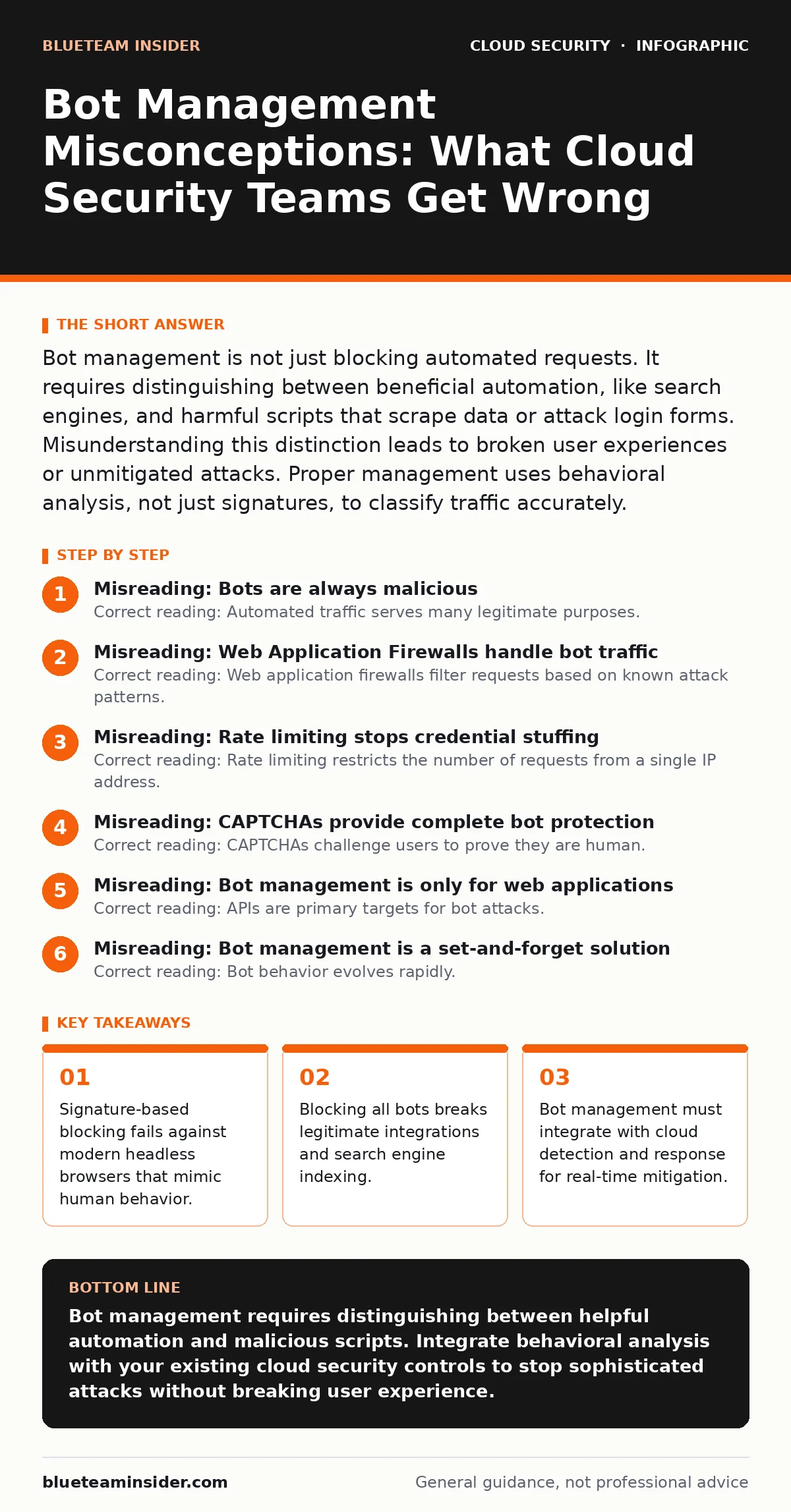
Bot management is not just blocking automated requests. It requires distinguishing between beneficial automation, like search engines, and harmful scripts that scrape data or attack login forms. Misunderstanding this distinction leads to broken user experiences or unmitigated attacks. Proper management uses behavioral analysis, not just signatures, to classify traffic accurately.
Misreading: Bots are always malicious
Correct reading: Automated traffic serves many legitimate purposes. Search engines use bots to index your content. Monitoring services use bots to check uptime. Internal tools use bots to synchronize data. Blocking all automated traffic breaks these essential functions. You must classify bots by intent, not by automation status.
A bot that crawls your site for SEO is helpful. A bot that scrapes your pricing data is harmful. The mechanism is the same. The intent differs. Your security controls must distinguish between the two. Imagine a monitoring bot that checks your API health. If you block all bots, you lose visibility into your system status. You create a blind spot while trying to close one.
Misreading: Web Application Firewalls handle bot traffic
Correct reading: Web application firewalls filter requests based on known attack patterns. They look for SQL injection or cross-site scripting payloads. They do not analyze user behavior. A bot can send perfectly valid HTTP requests that contain no malicious payloads. It can request pages at a steady, slow pace. A web application firewall sees this as normal traffic.
It allows the request through. Bot management solutions analyze behavioral signals. They look at mouse movements, typing speeds, and navigation paths. They detect anomalies that firewalls miss. You need both controls. The firewall stops code injection. The bot manager stops automated abuse. Relying only on the firewall leaves your application open to scraping and credential stuffing.
Misreading: Rate limiting stops credential stuffing
Correct reading: Rate limiting restricts the number of requests from a single IP address. Credential stuffing attacks use millions of compromised credentials. Attackers distribute these requests across many IP addresses. They use residential proxies that look like real home networks. Rate limiting per IP address does not stop this distribution. The attack stays below the threshold for each individual IP.
Your system sees normal traffic volume. The bot management system looks at account-level behavior. It detects rapid login attempts from many locations. It flags the account for review. It challenges the user with proof of humanity. Rate limiting is a blunt instrument. Bot management is a precise tool. Use rate limiting to protect against brute force from a single source. Use bot management to protect against distributed attacks.
Misreading: CAPTCHAs provide complete bot protection
Correct reading: CAPTCHAs challenge users to prove they are human. Modern bots use optical character recognition to solve simple CAPTCHAs. They use machine learning to solve image-based CAPTCHAs. They use human farms to solve complex CAPTCHAs. CAPTCHAs degrade the user experience. Legitimate users find them annoying. They abandon your site. Bots adapt to CAPTCHAs.
You play a game of cat and mouse. You raise the difficulty. Users suffer more. Bot management uses passive signals. It analyzes device fingerprints, network reputation, and behavioral biometrics. It challenges only suspicious traffic. It allows clean traffic through without friction. This approach protects your users while stopping bots. CAPTCHAs are a reactive measure. Bot management is a proactive measure.
Misreading: Bot management is only for web applications
Correct reading: APIs are primary targets for bot attacks. APIs expose data and functionality directly. They lack the visual cues that web browsers provide. Bots can interact with APIs without a browser. They can scrape data, abuse functionality, or perform credential stuffing. Many organizations deploy bot management on their web front end. They leave their APIs exposed.
This creates a security gap. Attackers bypass the web protections and hit the API directly. You must extend bot management to your API endpoints. Use API gateways to enforce policies. Analyze request patterns at the API level. Detect anomalous usage. Block malicious bots before they reach your backend services. This ensures consistent protection across all entry points.
See also: Cloud Detection and Response: 6 Misunderstandings That Leave You Exposed · Detect Orphaned Cloud Resources: Logs, Signals and Blind Spots
Misreading: Bot management is a set-and-forget solution
Correct reading: Bot behavior evolves rapidly. Attackers develop new techniques to evade detection. Your bot management rules must adapt. Static rules become obsolete. They generate false positives. They miss new threats. You must continuously monitor and update your policies. Analyze traffic patterns regularly. Tune your detection thresholds.
Integrate with cloud detection and response to correlate bot activity with other security events. This helps you identify coordinated attacks. Review blocked traffic to ensure you are not blocking legitimate users. Adjust your settings based on feedback. Bot management is an ongoing process. It requires active management and tuning. Treat it like any other security control. Review it. Update it. Improve it.
Misreading: Bot management replaces other security controls
Correct reading: Bot management is one layer of defense. It does not replace identity management, encryption, or network security. It works best when integrated with other controls. Use MFA for cloud accounts to protect against credential theft. Use bring your own key encryption to protect your data at rest. Use container image scanning to prevent vulnerable software from running.
Bot management stops automated abuse. It does not stop insider threats. It does not stop zero-day exploits. It does not replace the need for strong authentication. Layer your defenses. Combine bot management with identity, encryption, and application security. This creates a resilient security posture. No single control provides complete protection.
Misreading: All bot traffic looks the same
Correct reading: Bots vary widely in sophistication. Simple scripts use basic HTTP requests. They lack browser features. Advanced bots use headless browsers. They execute JavaScript. They mimic human behavior. They use residential proxies. They rotate user agents. Your detection methods must match the threat level. Simple signatures stop simple bots.
Behavioral analysis stops advanced bots. You must understand the bot landscape. Identify the types of bots that target your industry. Adjust your detection strategy accordingly. A news site faces different bot threats than a financial service. Customize your approach. Do not use a one-size-fits-all solution. Tailor your controls to your specific risk profile.
Key takeaways
- Signature-based blocking fails against modern headless browsers that mimic human behavior.
- Blocking all bots breaks legitimate integrations and search engine indexing.
- Bot management must integrate with cloud detection and response for real-time mitigation.
- Behavioral analysis detects anomalies in mouse movements and timing patterns.
Bot management requires distinguishing between helpful automation and malicious scripts. Integrate behavioral analysis with your existing cloud security controls to stop sophisticated attacks without breaking user experience.
Frequently asked questions
How do I distinguish between a search engine bot and a malicious scraper?
Search engines identify themselves with specific user agents and follow robots.txt rules. Malicious scrapers often hide their identity and ignore robots.txt. Check the request headers and behavior patterns.
Can bot management slow down my website performance?
Modern bot management solutions use passive analysis. They do not add significant latency. They analyze traffic in real-time without blocking legitimate requests. Poorly configured rules can cause slowdowns.
Do I need bot management if I use a CDN?
CDNs provide some basic bot protection. They block known malicious IPs. They do not analyze behavioral signals. You need dedicated bot management to stop sophisticated attacks that mimic human behavior.
How often should I update my bot management rules?
Review your rules regularly. Update them when you see new attack patterns or false positives. Integrate with cloud detection and response to automate updates based on threat intelligence.
How this guide was produced: written by the BlueTeam Insider editorial team with AI assistance, checked against the public references listed below, and reviewed when the facts change. See our editorial policy or report an error.