Why the Ransomware Payment Debate Shapes Your Security Strategy
Payment policy dictates backup architecture and incident response speed, forcing teams to choose between financial risk and operational resilience before an attack occurs.

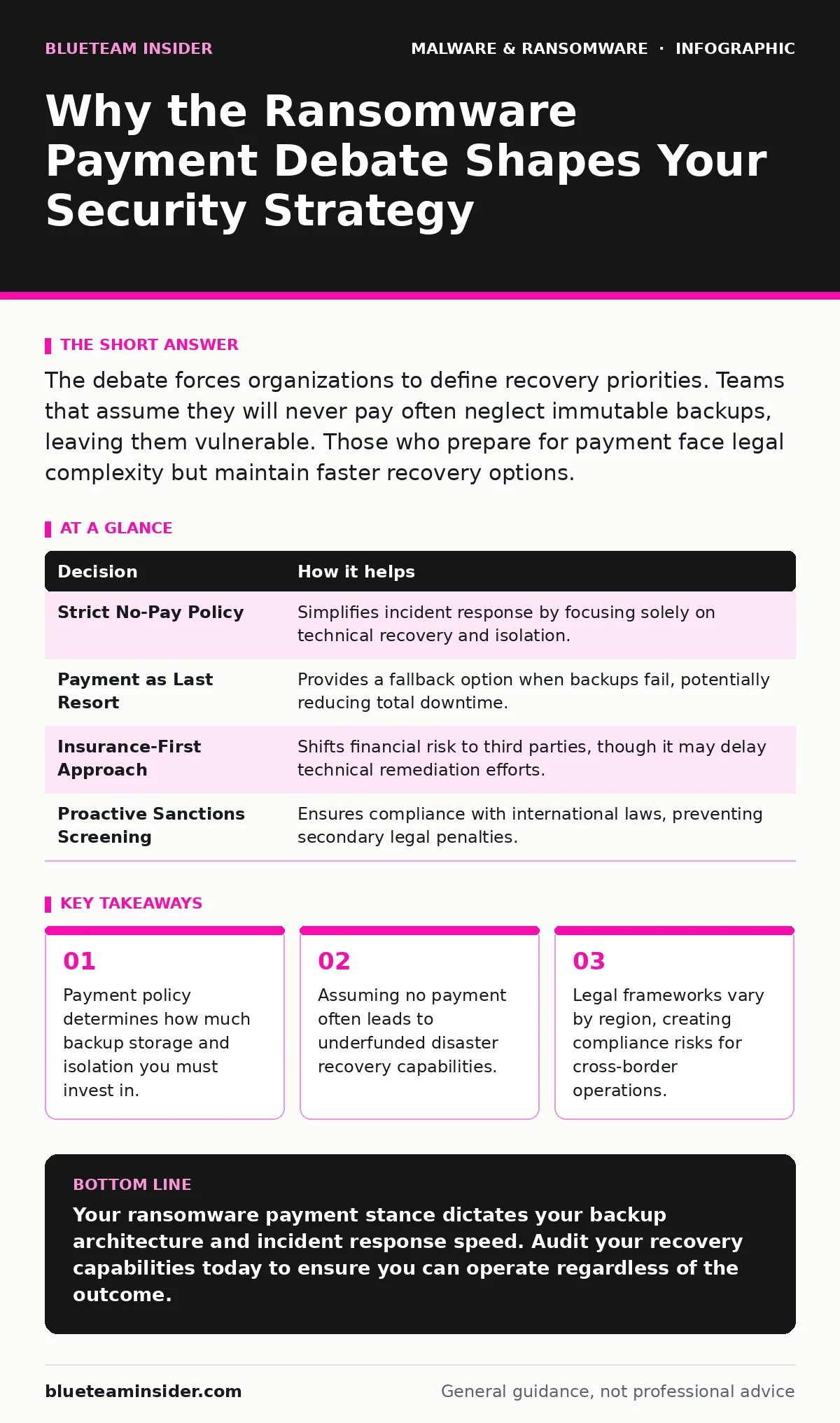
The debate forces organizations to define recovery priorities. Teams that assume they will never pay often neglect immutable backups, leaving them vulnerable. Those who prepare for payment face legal complexity but maintain faster recovery options.
The False Binary of Pay or Not Pay
The common narrative presents a simple choice: pay the ransom or restore from backups. This binary view ignores the operational reality of modern infrastructure. Most organizations cannot restore every system instantly from cold storage. Downtime costs often exceed the ransom amount within hours.
This gap between ideal recovery and actual capability drives the debate. It is not merely a moral question. It is a structural engineering problem. Your stance on payment dictates how you design your network segmentation and backup retention.
If you decide never to pay, you must assume total data loss. This requires expensive, air-gapped backups and rigorous testing. If you leave payment as an option, you must prepare for the legal and forensic complexities of transferring funds. Both paths require specific, costly preparations.
How Policy Dictates Architecture
Your decision on payment influences your technical controls. Teams that adopt a strict no-payment policy often over-invest in redundancy. They build parallel systems that mirror production environments. This ensures continuity but increases operational overhead.
Conversely, teams that consider payment viable may rely more on insurance. This can lead to complacency in daily hygiene. They might skip regular backup verification because they believe coverage exists. This creates a hidden fragility.
Imagine a team that believes insurance covers all losses. They neglect to test their restore procedures. When an attack occurs, they find their backups are corrupted or incomplete. The insurance payout does not restore their data. It only covers the financial loss. The business still stops operating.
The Legal and Compliance Maze
Payment is not just a technical transaction. It is a legal event. Many jurisdictions have sanctions against specific entities or regions. Paying a group linked to sanctioned states can violate federal laws. This exposure extends to the entire organization, not just the IT department.
Compliance frameworks often require reporting of data breaches. If you pay, you may be admitting to a breach of confidentiality. This triggers notification requirements for customers and regulators. The timeline for these notifications is strict. Missing a deadline incurs additional fines.
Some regions have laws explicitly prohibiting ransomware payments. In other areas, it is a gray area. Legal counsel must be involved in the pre-incident planning phase. They help define which scenarios might justify payment and which do not. This pre-approval process saves time during a crisis.
Financial Risk vs. Operational Resilience
The cost of payment is uncertain. Attackers often demand more money after initial decryption. They may threaten to release stolen data again. This dynamic creates an open-ended financial liability. You cannot cap the cost of payment.
The cost of resilience is predictable. You know the price of hardware, software, and staff training. You can budget for these expenses. Investing in resilience reduces the probability of success for attackers. It also reduces the severity of impact if they succeed.
However, resilience has limits. Advanced persistent threats can bypass even strong controls. Supply chain compromises can infect backups. No architecture is invulnerable. The debate forces you to accept residual risk. You must decide how much risk is acceptable.
Incident Response Preparation
Your payment stance changes your incident response plan. If payment is off the table, your plan focuses on isolation and restoration. You prioritize disconnecting affected systems and spinning up clean environments. Speed is the primary metric.
If payment is an option, your plan includes negotiation and forensics. You need a secure communication channel with the attackers. You need a method to verify decryption keys before paying. You need a way to track the transaction for law enforcement. These steps add complexity and time.
Teams that do not plan for this often freeze during an attack. They lack the authority to make quick decisions. They waste hours debating ethics while data is encrypted. A pre-defined policy removes this paralysis. It allows the team to execute their chosen path immediately.
| Decision | How it helps |
|---|---|
| Strict No-Pay Policy | Simplifies incident response by focusing solely on technical recovery and isolation. |
| Payment as Last Resort | Provides a fallback option when backups fail, potentially reducing total downtime. |
| Insurance-First Approach | Shifts financial risk to third parties, though it may delay technical remediation efforts. |
| Proactive Sanctions Screening | Ensures compliance with international laws, preventing secondary legal penalties. |
See also: Cloud Incident Response: 8 Practices to Contain Breaches Fast · Incident Response Plan for Ransomware Attack: Stop the Spread
The Role of Third-Party Tools
When backups fail, organizations look for alternatives. Ransomware decryption tools exist for some older strains. These tools are free and provided by security firms or governments. They work only if the attackers reuse encryption keys or make mistakes.
For modern, well-coded ransomware, decryption tools are rare. Ransomware-as-a-service models use strong, unique keys for every victim. This makes decryption impossible without the attacker’s private key. Understanding this limitation is vital for setting expectations.
Do not rely on the hope of a free decryption tool. Treat your backups as the primary recovery mechanism. Verify that your backup solution protects against ransomware specifically. Look for features like immutable storage and off-site replication.
Building a Defensible Position
The goal is not to win the debate. The goal is to prepare for any outcome. You must have the technical capability to recover without paying. This means regular, tested backups. It means network segmentation that limits lateral movement.
Simultaneously, you must have the legal and financial framework to consider payment if necessary. This includes cyber insurance and legal counsel. It includes a clear chain of command for decision-making. This dual preparation covers all bases.
The Long-Term Strategic View
The ransomware attack chain evolves constantly. Attackers improve their techniques to bypass defenses. They target backup systems directly. They use social engineering to gain access. Your strategy must adapt.
Regularly review your payment policy. Assess changes in legal regulations. Evaluate new backup technologies. Engage with industry peers to understand trends. This ongoing process ensures your organization remains resilient.
The debate matters because it forces you to confront your weaknesses. It highlights the gap between your current state and your desired state. Closing that gap is the true objective of security planning.
Key takeaways
- Payment policy determines how much backup storage and isolation you must invest in.
- Assuming no payment often leads to underfunded disaster recovery capabilities.
- Legal frameworks vary by region, creating compliance risks for cross-border operations.
Your ransomware payment stance dictates your backup architecture and incident response speed. Audit your recovery capabilities today to ensure you can operate regardless of the outcome.
Frequently asked questions
Does cyber insurance cover ransomware payments?
Coverage varies by policy. Some policies cover the ransom, while others exclude it or require prior approval. Check your specific terms.
Can I pay anonymously to avoid legal issues?
Anonymous payment methods are difficult to secure. Attackers often use cryptocurrencies that leave a trace. Legal sanctions may still apply.
How do I verify the attackers will decrypt my data?
You cannot guarantee this. Attackers may provide a partial decryption test. However, there is no absolute verification method before full payment.
What is the best backup strategy against ransomware?
Use the 3-2-1 rule. Keep three copies of data, on two different media, with one off-site and immutable. Test restores regularly.
How this guide was produced: written by the BlueTeam Insider editorial team with AI assistance, checked against the public references listed below, and reviewed when the facts change. See our editorial policy or report an error.