FortiGate Vulnerabilities: How to Detect, Patch and Lock Down Your Firewall
FortiGate security flaws often hide in firmware layers, requiring careful validation before any update to prevent service disruption or configuration loss.

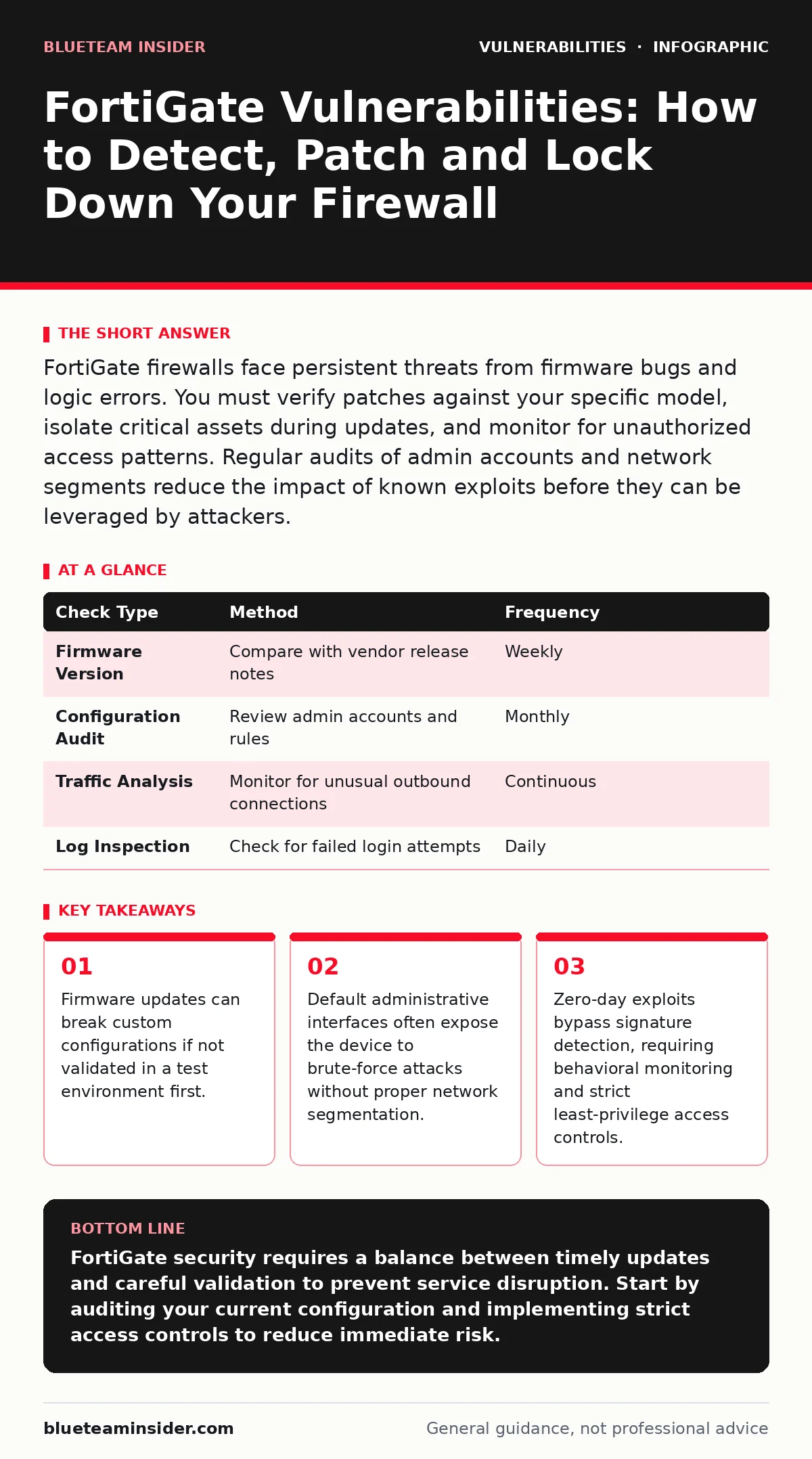
FortiGate firewalls face persistent threats from firmware bugs and logic errors. You must verify patches against your specific model, isolate critical assets during updates, and monitor for unauthorized access patterns. Regular audits of admin accounts and network segments reduce the impact of known exploits before they can be leveraged by attackers.
What are FortiGate vulnerabilities?
FortiGate vulnerabilities are weaknesses in the firewall’s firmware, web management interface, or underlying operating system that attackers exploit to gain unauthorized access. These flaws range from simple misconfigurations to complex code errors in the kernel. Attackers use these gaps to bypass security policies, steal data, or install malware directly on the network perimeter. Understanding the type of vulnerability helps you choose the right mitigation strategy, whether it is a quick patch or a deeper architectural change.
Why do FortiGate vulnerabilities persist?
FortiGate vulnerabilities persist because complex embedded systems contain millions of lines of code, some of which are difficult to audit thoroughly before release. Firmware vulnerabilities often involve low-level hardware interactions that are hard to test for edge cases. Additionally, many organizations delay updates due to fear of breaking existing network configurations. This hesitation creates a window where known exploits remain effective. The trade-off is between immediate stability and long-term security risk.
How do attackers exploit FortiGate weaknesses?
Attackers exploit FortiGate weaknesses by sending malicious packets that trigger unexpected behavior in the firewall’s processing engine. They may target the web management console with injection attacks or abuse API endpoints to escalate privileges. Some exploits rely on default credentials that were never changed during initial setup. Others exploit logic errors in how the device handles encrypted traffic, allowing data to pass through inspection filters. The goal is always to bypass the intended security controls without triggering alarms.
What is the impact of an unpatched FortiGate?
An unpatched FortiGate can lead to complete network compromise, allowing attackers to move laterally into internal systems. The impact extends beyond data theft to include service disruption, as attackers may modify firewall rules to block legitimate traffic. Unpatched software leaves the device vulnerable to known exploits that are widely available in public databases. This exposure increases the likelihood of successful attacks, especially when combined with other weaknesses like weak passwords or exposed management interfaces.
How do you identify a vulnerable FortiGate?
You identify a vulnerable FortiGate by checking the current firmware version against known security advisories and comparing it with the vendor’s release notes. Security advisory reading helps you understand the severity and scope of each flaw. Automated vulnerability scanners can detect exposed services and outdated software versions. Manual audits of configuration files reveal misconfigurations that may expose the device. Regular checks ensure you catch new vulnerabilities before they are exploited in the wild.
| Check Type | Method | Frequency |
|---|---|---|
| Firmware Version | Compare with vendor release notes | Weekly |
| Configuration Audit | Review admin accounts and rules | Monthly |
| Traffic Analysis | Monitor for unusual outbound connections | Continuous |
| Log Inspection | Check for failed login attempts | Daily |
What is the safest way to patch a FortiGate?
The safest way to patch a FortiGate is to test the update in an isolated environment before applying it to production systems. Change management for security patches ensures that you have a rollback plan if the update causes instability. Back up your configuration before starting the process. Apply patches during maintenance windows to minimize disruption. Verify that all services are functioning correctly after the update. This disciplined approach reduces the risk of downtime while maintaining security.
Can you mitigate FortiGate vulnerabilities without patching?
You can mitigate FortiGate vulnerabilities without patching by implementing strict network segmentation and disabling unnecessary services. Limit access to the management interface to specific IP addresses. Enable multi-factor authentication for all administrative accounts. Use intrusion prevention systems to block known exploit patterns. While these measures reduce risk, they do not eliminate it. They serve as temporary controls until a permanent fix is available.
How do you monitor for FortiGate exploits?
You monitor for FortiGate exploits by analyzing traffic logs for unusual patterns, such as repeated failed login attempts or unexpected data transfers. Behavioral analysis tools can detect anomalies that signature-based systems miss. Set up alerts for changes to firewall rules or user permissions. Regularly review system logs for signs of compromise. Continuous monitoring ensures you detect intrusions early, even if the exploit bypasses initial defenses.
What is the role of least privilege in FortiGate security?
Least privilege restricts user and system permissions to the minimum necessary for their function, reducing the attack surface. In FortiGate security, this means limiting administrative access to only those who need it and segregating network zones. It prevents attackers from moving laterally if they compromise a single account. Implementing least privilege requires careful planning and regular audits to ensure permissions remain appropriate. This practice significantly reduces the impact of any potential breach.
How does FortiGate compare to other firewall vulnerabilities?
FortiGate vulnerabilities differ from general firewall flaws in their specific interaction with the device’s proprietary firmware and hardware acceleration features. While SQL injection or PHP object injection may affect web applications hosted behind the firewall, FortiGate flaws often target the device itself. Understanding these distinctions helps you prioritize defenses. A guide on vulnerabilities in PyPI packages highlights how third-party components can introduce risk, similar to how firmware bugs affect FortiGate systems.
What is the long-term strategy for FortiGate security?
The long-term strategy for FortiGate security involves regular updates, continuous monitoring, and strict access controls. You must stay informed about new threats and adjust your defenses accordingly. Responsible disclosure practices ensure that vendors are aware of issues and can release fixes promptly. Integrating security into your change management processes ensures that updates are applied safely and consistently. This proactive approach maintains a strong security posture over time.
Key takeaways
- Firmware updates can break custom configurations if not validated in a test environment first.
- Default administrative interfaces often expose the device to brute-force attacks without proper network segmentation.
- Zero-day exploits bypass signature detection, requiring behavioral monitoring and strict least-privilege access controls.
FortiGate security requires a balance between timely updates and careful validation to prevent service disruption. Start by auditing your current configuration and implementing strict access controls to reduce immediate risk.
Frequently asked questions
How often should I update my FortiGate firmware?
Update your FortiGate firmware as soon as critical patches are released, but always test them in a non-production environment first.
Can a FortiGate be hacked if it is behind another firewall?
Yes, if the management interface is exposed or if default credentials are used, attackers can still compromise the device.
What should I do if I suspect a FortiGate breach?
Isolate the device from the network, preserve logs for analysis, and engage incident response procedures immediately.
Are older FortiGate models more vulnerable?
Older models may have reached end-of-life, meaning they no longer receive security updates, making them significantly more vulnerable.
How this guide was produced: written by the BlueTeam Insider editorial team with AI assistance, checked against the public references listed below, and reviewed when the facts change. See our editorial policy or report an error.