Recovery Point Objective vs Recovery Time Objective: The Real Cost of Data Loss
Your recovery point objective dictates how much work you permanently lose, while your recovery time objective dictates how long your business stays offline.

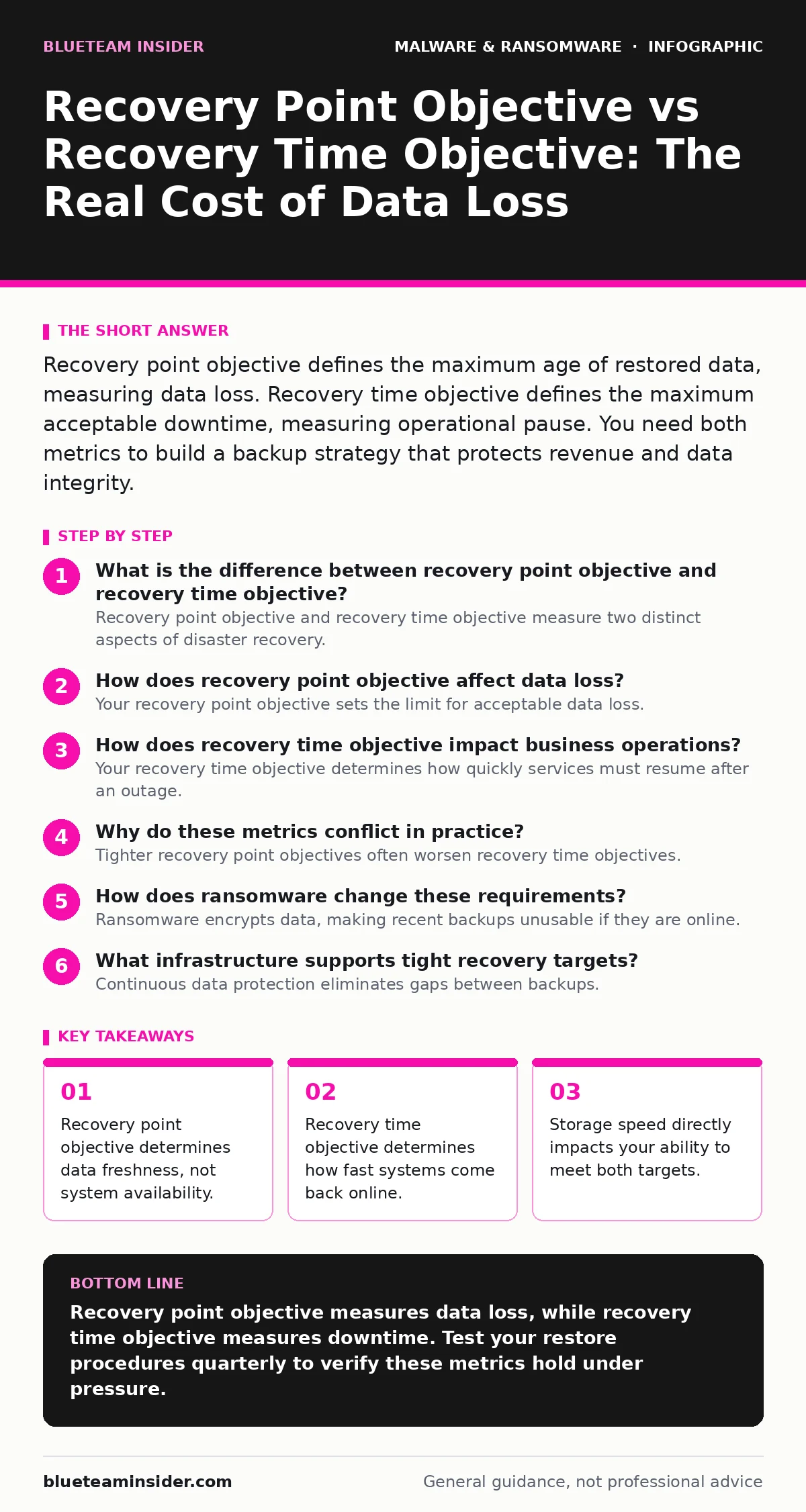
Recovery point objective defines the maximum age of restored data, measuring data loss. Recovery time objective defines the maximum acceptable downtime, measuring operational pause. You need both metrics to build a backup strategy that protects revenue and data integrity.
What is the difference between recovery point objective and recovery time objective?
Recovery point objective and recovery time objective measure two distinct aspects of disaster recovery. The recovery point objective defines how much data you can afford to lose, measured in time. The recovery time objective defines how long your systems can remain offline, measured in time. One tracks data freshness, while the other tracks system availability. You must define both to create a functional backup strategy.
How does recovery point objective affect data loss?
Your recovery point objective sets the limit for acceptable data loss. If your recovery point objective is 1 hour, you might lose up to 1 hour of new data during a crash. This metric depends on how frequently you back up your systems. Frequent backups reduce the recovery point objective but increase storage costs. You must balance data safety against infrastructure expenses.
How does recovery time objective impact business operations?
Your recovery time objective determines how quickly services must resume after an outage. A 4-hour recovery time objective means your team has 4 hours to restore systems. This metric drives your choice of recovery hardware and automation tools. Faster recovery times require more expensive, high-performance infrastructure. Slow recovery times risk customer churn and revenue loss.
| Metric | Measures | Primary Driver | Cost Factor |
|---|---|---|---|
| Recovery Point Objective | Data Loss | Backup Frequency | Storage Volume |
| Recovery Time Objective | Downtime | Restore Speed | Compute Power |
Why do these metrics conflict in practice?
Tighter recovery point objectives often worsen recovery time objectives. More frequent backups create more data to restore. Restoring terabytes of incremental changes takes significant time. You cannot simply increase backup frequency without improving restore speed. This trade-off forces you to choose between data granularity and rapid uptime. Many organizations fail to recognize this hidden cost.
How does ransomware change these requirements?
Ransomware encrypts data, making recent backups unusable if they are online. You need immutable backups that cannot be altered or deleted. This protects your recovery point objective from malicious actors. However, immutable storage may slow down restores, impacting your recovery time objective. You must isolate backup media from production networks. See our guide on ransomware decryption tools for additional context.
See also: Banking Trojans Prevention Checklist for Secure Transactions
What infrastructure supports tight recovery targets?
Continuous data protection eliminates gaps between backups. This technology captures every change, allowing near-zero recovery point objectives. It requires high-bandwidth networks and fast storage. These components ensure you can replay changes quickly. This setup meets strict recovery time objectives but demands significant investment. Traditional scheduled backups cannot achieve these speeds.
How do you validate your recovery objectives?
Paper plans do not guarantee operational success. You must run full recovery drills annually. Measure the actual time to restore critical systems. Compare this duration against your stated recovery time objective. Verify the data version restored matches your recovery point objective. Document any deviations and adjust your infrastructure. This process reveals hidden bottlenecks in your workflow.
How do external threats influence these metrics?
Attack surface reduction rules can prevent initial compromise. This reduces the likelihood of needing disaster recovery. However, when breaches occur, your recovery objectives determine resilience. Banking trojans often target financial data, requiring strict recovery point objectives. Linux malware may target servers, demanding fast recovery time objectives. Understanding the threat helps prioritize your metrics.
What is the first step to improve your posture?
Audit your current backup frequency and restore speeds. Identify which systems have the strictest requirements. Align your infrastructure investments with these critical needs. Do not apply uniform standards to all systems. Prioritize revenue-generating applications. This focused approach optimizes spending and effectiveness. Review our analysis of the ransomware payment debate for context on risk tolerance.
Key takeaways
- Recovery point objective determines data freshness, not system availability.
- Recovery time objective determines how fast systems come back online.
- Storage speed directly impacts your ability to meet both targets.
- Immutable backups prevent ransomware from corrupting your recovery points.
Recovery point objective measures data loss, while recovery time objective measures downtime. Test your restore procedures quarterly to verify these metrics hold under pressure.
Frequently asked questions
Can I have a zero recovery point objective?
Zero recovery point objective requires continuous data protection. This technology captures every change in real-time. It is expensive and complex to maintain. Most organizations accept a small window of data loss.
How often should I review my recovery time objective?
Review your recovery time objective annually or after major changes. Infrastructure upgrades can improve or degrade restore speeds. Business growth may change critical system dependencies. Regular reviews ensure your plan remains viable.
Does cloud storage improve recovery time objectives?
Cloud storage can improve recovery time objectives if bandwidth is sufficient. Downloading large datasets over standard internet connections is slow. Dedicated lines or local caching may be necessary. Cloud backups often help more with recovery point objectives.
What happens if I miss my recovery point objective?
Missing your recovery point objective means permanent data loss. Recent transactions or updates will be gone. This can cause compliance violations and customer trust issues. You must rebuild that data from other sources.
How this guide was produced: written by the BlueTeam Insider editorial team with AI assistance, checked against the public references listed below, and reviewed when the facts change. See our editorial policy or report an error.