Hybrid Cloud Security Explained: How to Lock Down Mixed Environments
Managing hybrid cloud security requires treating your on-premises data center and public cloud accounts as a single, continuous perimeter rather than two separate fortresses.

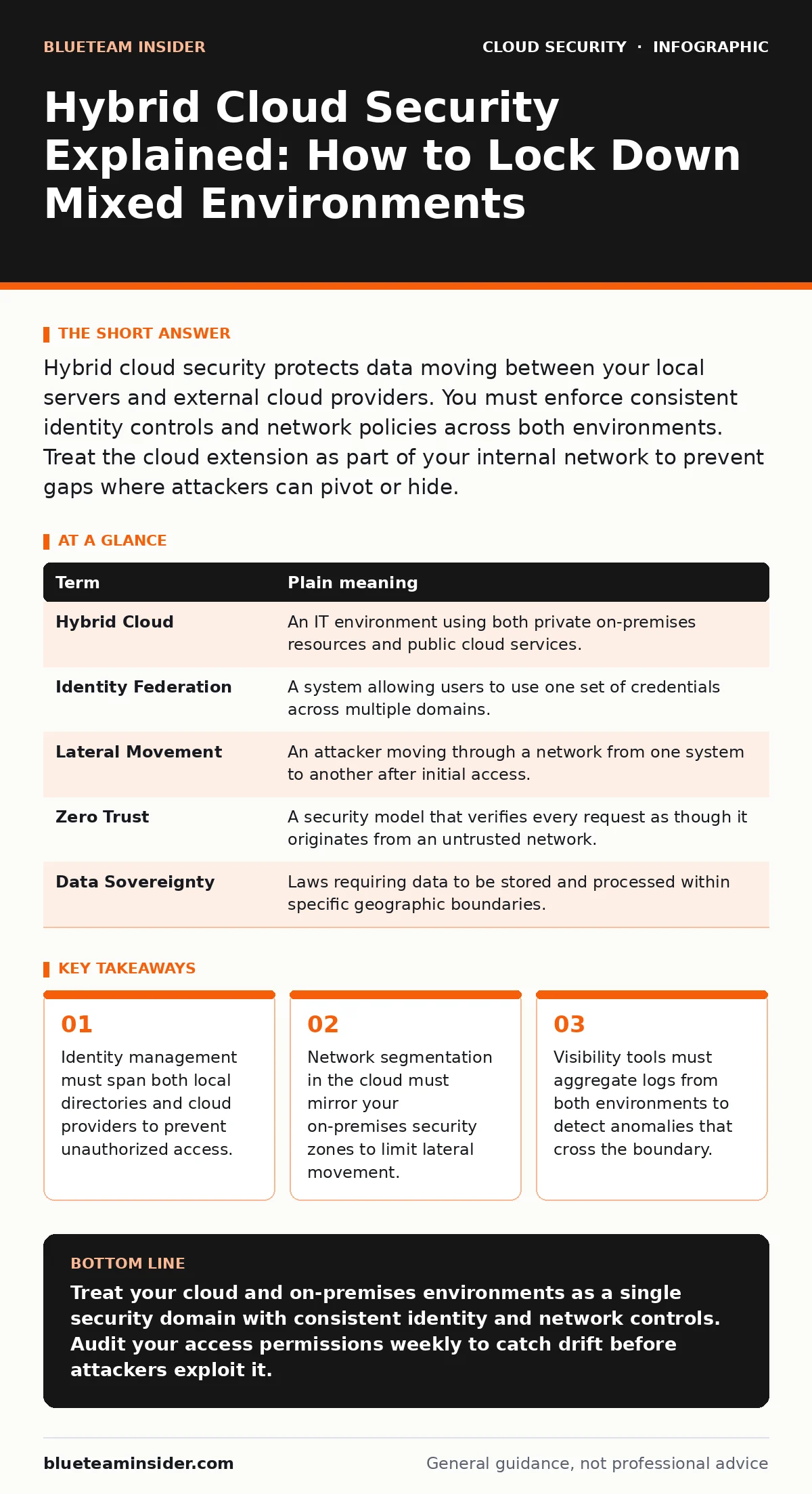
Hybrid cloud security protects data moving between your local servers and external cloud providers. You must enforce consistent identity controls and network policies across both environments. Treat the cloud extension as part of your internal network to prevent gaps where attackers can pivot or hide.
The Extended Warehouse Analogy
Imagine your organization’s data is stored in a large, secure warehouse. For years, you have controlled every lock, guard, and camera inside this building. This is your on-premises infrastructure. Now, suppose you rent storage space in a neighboring city to handle seasonal overflow. This rented space is the public cloud.
The risk is not that the neighboring city is unsafe. The risk is that you are using different keys, different rules, and different alarm systems for the two locations. If a thief steals your master key to the warehouse, they might not care that the overflow storage uses a different lock. They simply walk in. Hybrid cloud security is the practice of ensuring that security policies flow seamlessly between your warehouse and the rented storage.
Defining the Boundary
In a hybrid environment, the traditional firewall perimeter disappears. You no longer have a single gate to guard. Instead, you have data moving constantly between your local data center and cloud providers. This movement creates a "shadow boundary" that is difficult to see but easy to exploit.
You must define what "inside" means. Is a laptop connecting from home part of the warehouse? Is a cloud server processing that data part of the warehouse? If you treat them as separate entities, you create blind spots. Attackers look for these blind spots. They exploit the gap where your local security policy ends and the cloud provider’s policy begins.
The Identity Bridge
Identity is the new perimeter. In the warehouse analogy, identity is the keycard that lets employees enter. In hybrid cloud security, you must ensure that the same user credentials work consistently across both environments. This is often achieved through identity federation.
Identity federation allows a user to log in once and access resources in both the local data center and the cloud. Without this, users create separate accounts for the cloud. These cloud-only accounts often lack the strict monitoring applied to local accounts. They become weak points.
See also: MFA for cloud accounts to ensure that single sign-on does not become a single point of failure if credentials are compromised.
Mini Glossary
| Term | Plain meaning |
|---|---|
| Hybrid Cloud | An IT environment using both private on-premises resources and public cloud services. |
| Identity Federation | A system allowing users to use one set of credentials across multiple domains. |
| Lateral Movement | An attacker moving through a network from one system to another after initial access. |
| Zero Trust | A security model that verifies every request as though it originates from an untrusted network. |
| Data Sovereignty | Laws requiring data to be stored and processed within specific geographic boundaries. |
The Hidden Cost of Visibility
Many organizations assume that because they pay for cloud security tools, they are protected. This is a common mistake. Cloud providers secure the infrastructure, but you secure what you put in it. This is shared responsibility.
The hidden cost is visibility. Your local security tools cannot see into the cloud by default. If you do not integrate your monitoring systems, you are flying blind in the rented storage area. You might detect a breach in the warehouse hours after it has already spread to the cloud.
See also: Bot Management Misconceptions: What Cloud Security Teams Get Wrong · Cloud Detection and Response: 6 Misunderstandings That Leave You Exposed
Consistent Network Policies
Network segmentation divides your environment into smaller, isolated zones. If one zone is breached, the attacker cannot easily jump to others. In a hybrid setup, you must extend this segmentation into the cloud.
Suppose an attacker compromises a server in your local warehouse. If your cloud storage is connected without proper segmentation, that attacker can move laterally into the cloud. They can exfiltrate data or deploy ransomware. You must treat the cloud network as an extension of your internal network, applying the same strict access controls.
Refer to: cloud ransomware strategies to understand how attackers exploit unsegmented networks to encrypt data across hybrid environments.
Try This Now
- Map your data flow. Identify exactly which data moves from your local servers to the cloud. Classify this data by sensitivity.
- Audit your identities. List all users who have access to both local and cloud resources. Ensure they use the same authentication method.
- Check for drift. Compare your security policies in the cloud against your local policies. Identify any gaps where cloud settings are less restrictive.
Closing the Loop
Security is not a one-time setup. It is a continuous process of verification. You must regularly review who has access and where data is moving. Tools that aggregate logs from both environments help you spot anomalies.
If you see unusual traffic between your warehouse and the rented storage, investigate it immediately. Do not assume it is normal background noise. In a hybrid world, normal is relative. Your job is to define what normal looks like for your specific setup.
See also: cloud audit logs for detailed instructions on capturing and analyzing this cross-environment traffic.
Key takeaways
- Identity management must span both local directories and cloud providers to prevent unauthorized access.
- Network segmentation in the cloud must mirror your on-premises security zones to limit lateral movement.
- Visibility tools must aggregate logs from both environments to detect anomalies that cross the boundary.
Treat your cloud and on-premises environments as a single security domain with consistent identity and network controls. Audit your access permissions weekly to catch drift before attackers exploit it.
Frequently asked questions
Do I need different security tools for cloud and on-premises?
You can use different tools, but they must integrate. If they do not share data, you cannot detect threats that move between the two environments.
Is hybrid cloud more secure than just using the cloud?
It can be, if you keep sensitive data on-premises and use the cloud for less critical tasks. However, it adds complexity that can lead to misconfiguration if not managed carefully.
How do I handle compliance in a hybrid setup?
You must ensure that data in the cloud meets the same regulatory standards as data on-premises. This often requires encrypting data before it leaves your local network.
What is the biggest risk in hybrid cloud security?
Inconsistent policies. When rules differ between environments, attackers exploit the weaker side to gain access to the stronger side.
How this guide was produced: written by the BlueTeam Insider editorial team with AI assistance, checked against the public references listed below, and reviewed when the facts change. See our editorial policy or report an error.