HTTP Request Smuggling Mistakes That Leave Your Server Open
Mismatched parsers between proxies and backends allow attackers to inject hidden requests that bypass security controls and access other users' data without detection.

HTTP request smuggling occurs when your reverse proxy and backend server interpret HTTP headers differently. This mismatch lets attackers craft requests that the proxy thinks are one thing but the backend treats as another. You fix this by enforcing strict header parsing rules and disabling ambiguous methods across your entire infrastructure stack.
Mistake 1: Allowing Mixed Content-Length and Transfer-Encoding
Your infrastructure interprets HTTP headers based on specific rules. When a request contains both a Content-Length header and a Transfer-Encoding header, different servers handle this conflict differently. One server may prioritize the length header while the other prioritizes the chunked encoding. This disagreement creates a gap where an attacker can insert a second request into the stream. The proxy reads the first request and forwards it, but the backend sees extra bytes as a new, unauthorized request.
Why it hurts: The backend server processes the injected request as if it came directly from the proxy. This allows an attacker to bypass authentication checks and access resources belonging to other users. The injected request might delete data or change settings without the proxy ever seeing the malicious intent.
The fix: Configure your servers to reject any request that contains both Content-Length and Transfer-Encoding headers. Most modern web servers have a setting to enforce this strict parsing behavior. Ensure this setting is enabled on both the reverse proxy and the backend application server to maintain consistent interpretation.
Mistake 2: Ignoring Header Case Sensitivity
HTTP standards specify that header field names are case-insensitive. However, some implementations treat headers differently based on their casing. An attacker might capitalize a header name in a way that the proxy ignores it but the backend server respects it. This subtle difference allows the attacker to hide critical headers from the security layer while ensuring the application processes them. The proxy sees a clean request, but the backend sees the injected instructions.
Why it hurts: Security tools often rely on header names to filter or modify traffic. If the proxy misses a header due to case variations, it cannot apply necessary security controls. The backend might execute commands or access files based on headers that the proxy never inspected. This undermines your defense-in-depth strategy.
The fix: Normalize all header names to a standard case before processing. Your reverse proxy should convert all headers to lowercase or uppercase consistently. This ensures that both the proxy and the backend server interpret the headers identically. Consistent normalization prevents case-based evasion techniques.
Mistake 3: Failing to Validate Transfer-Encoding Chunks
Transfer-Encoding allows data to be sent in chunks without knowing the total size upfront. Each chunk has a size prefix followed by the data. If your server does not strictly validate the size of each chunk, an attacker can send more data than declared. The proxy might stop reading after the declared size, but the backend continues reading the extra bytes as part of the next request. This desynchronization is the core mechanism of request smuggling.
Why it hurts: The backend server interprets the overflow data as a new HTTP request. This new request can target sensitive endpoints that the proxy would normally block. The attacker gains unauthorized access to internal services or user data. The proxy logs show a benign request, making detection difficult.
The fix: Enforce strict chunk validation. Reject any request where the chunk size does not match the actual data provided. Ensure that the backend server validates chunk sizes independently of the proxy. This double-checking prevents desynchronization attacks.
Mistake 4: Leaving CONNECT Method Enabled
The CONNECT method is designed for proxy tunnels, typically used for HTTPS traffic. It creates a direct tunnel between the client and the target server. If your reverse proxy allows CONNECT requests to internal services, an attacker can use this method to bypass the proxy’s security checks. The tunnel bypasses the proxy’s inspection capabilities entirely. This creates a direct path for smuggling attacks or other exploits.
Why it hurts: The proxy cannot inspect the traffic flowing through the CONNECT tunnel. An attacker can send arbitrary HTTP requests directly to the backend, bypassing authentication and access controls. This is particularly dangerous if the backend service is not hardened against direct access. The tunnel effectively removes the proxy from the security equation.
The fix: Disable the CONNECT method unless it is explicitly required for external HTTPS traffic. If you must allow CONNECT, restrict it to specific, trusted targets. Ensure that internal services are not accessible via CONNECT tunnels. This limits the attack surface for tunneling-based smuggling.
Mistake 5: Using Inconsistent HTTP Versions
Different HTTP versions have different parsing rules. HTTP/1.1 and HTTP/2 handle headers and framing differently. If your infrastructure mixes versions without proper translation, an attacker can exploit these differences. The proxy might speak HTTP/1.1 to the client but HTTP/2 to the backend. This version mismatch can lead to incorrect interpretation of headers and body data, enabling smuggling techniques.
Why it hurts: The translation layer between HTTP versions might drop or modify headers incorrectly. An attacker can craft a request that looks valid in one version but exploits a parsing bug in the other. This inconsistency creates confusion between the proxy and the backend, leading to security bypasses.
The fix: Standardize on a single HTTP version for internal communication. If you must support multiple versions, ensure that the translation layer is robust and tested. Verify that headers are preserved correctly during version translation. Consistent versioning reduces the risk of parsing errors.
See also: Use-After-Free Vulnerabilities: How Memory Errors Become Hacks
Mistake 6: Neglecting Backend Server Configuration
Security often focuses on the reverse proxy, neglecting the backend server. The backend server must also enforce strict parsing rules. If the backend is lenient while the proxy is strict, an attacker can bypass the proxy’s checks by targeting the backend directly. The backend might accept malformed requests that the proxy would reject. This creates a weak link in your security chain.
Why it hurts: The backend server becomes the entry point for smuggling attacks. Even if the proxy blocks most attacks, a misconfigured backend can still be exploited. This undermines the security provided by the proxy. Attackers target the weakest link in the infrastructure.
The fix: Harden the backend server configuration. Enable strict parsing modes and disable unnecessary features. Ensure that the backend rejects ambiguous requests. Regularly audit backend settings to ensure they align with security best practices.
Mistake 7: Overlooking Third-Party Libraries
Your application might use third-party libraries for HTTP parsing. These libraries might have vulnerabilities or lenient parsing defaults. If you do not update these libraries or configure them securely, they become a source of weakness. An attacker can exploit a bug in a library to smuggle requests. This is similar to the risks associated with unpatched software, but specific to parsing logic.
Why it hurts: Vulnerabilities in third-party libraries are often unknown until exploited. A bug in a parsing library can allow request smuggling without any configuration error on your part. This makes detection and remediation difficult. You rely on the library maintainer for fixes.
The fix: Keep all third-party libraries up to date. Monitor security advisories for the libraries you use. Configure libraries to use strict parsing modes where possible. Consider using memory-safe programming languages for new components to reduce the risk of parsing bugs.
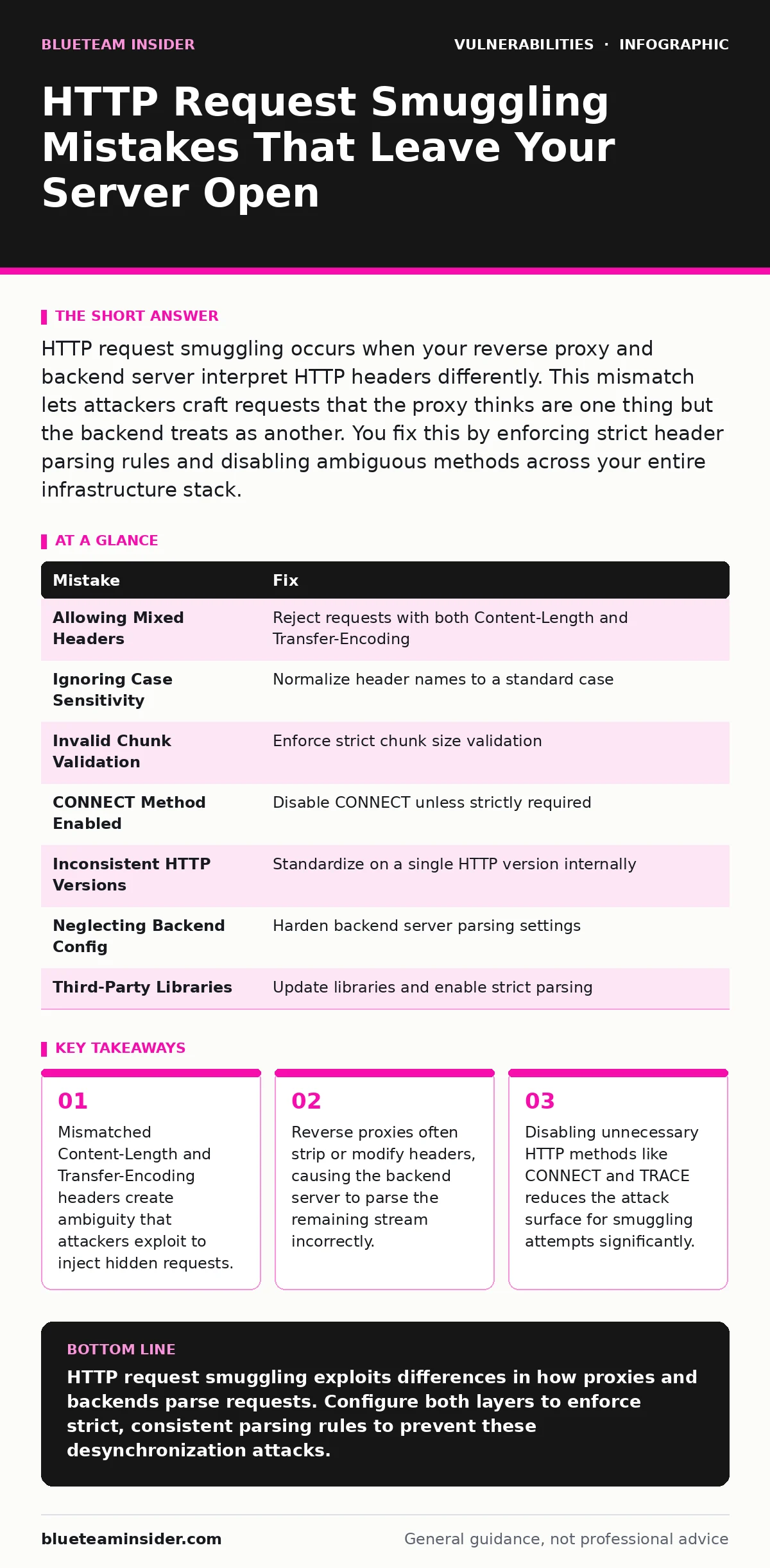
| Mistake | Fix |
|---|---|
| Allowing Mixed Headers | Reject requests with both Content-Length and Transfer-Encoding |
| Ignoring Case Sensitivity | Normalize header names to a standard case |
| Invalid Chunk Validation | Enforce strict chunk size validation |
| CONNECT Method Enabled | Disable CONNECT unless strictly required |
| Inconsistent HTTP Versions | Standardize on a single HTTP version internally |
| Neglecting Backend Config | Harden backend server parsing settings |
| Third-Party Libraries | Update libraries and enable strict parsing |
Key takeaways
- Mismatched Content-Length and Transfer-Encoding headers create ambiguity that attackers exploit to inject hidden requests.
- Reverse proxies often strip or modify headers, causing the backend server to parse the remaining stream incorrectly.
- Disabling unnecessary HTTP methods like CONNECT and TRACE reduces the attack surface for smuggling attempts significantly.
HTTP request smuggling exploits differences in how proxies and backends parse requests. Configure both layers to enforce strict, consistent parsing rules to prevent these desynchronization attacks.
Frequently asked questions
Does HTTPS prevent HTTP request smuggling?
No, HTTPS encrypts the traffic but does not change how the servers parse the HTTP headers. Smuggling happens at the application layer, which is decrypted before parsing.
How do I detect HTTP request smuggling?
Look for anomalies in request logs, such as unexpected response codes or timing differences. Specialized tools can simulate smuggling attacks to test your defenses.
Is HTTP/2 immune to request smuggling?
HTTP/2 uses a different framing mechanism, but it is not immune. New smuggling techniques have emerged for HTTP/2, often involving header compression or frame manipulation.
Can a Web Application Firewall stop this?
A WAF can help if configured correctly to detect malformed requests. However, if the WAF and backend parse differently, smuggling may still occur. Consistent parsing is key.
How this guide was produced: written by the BlueTeam Insider editorial team with AI assistance, checked against the public references listed below, and reviewed when the facts change. See our editorial policy or report an error.