Broken Object Level Authorization Warning Signs and Fixes
Broken object level authorization allows users to access data they should not see by changing simple identifiers in API requests.
Look for accessible data when you change user IDs in URLs or API payloads. If your application serves records based on predictable identifiers without checking ownership, you have a broken object level authorization flaw. Verify server-side ownership checks for every request.
Recognizing Immediate Indicators of Access Control Failures
Broken object level authorization, often called BOLA, occurs when an application fails to verify that a user is authorized to access a specific object. You notice this flaw first when changing a numeric ID in a URL or API payload reveals another user’s data. This happens because the server trusts the client to provide the correct identifier. The application retrieves the record matching that ID without confirming the requester owns it.
Imagine you change a customer ID from 101 to 102 in a support portal request. If the system returns the profile for customer 102, the authorization logic is broken. This pattern appears frequently in RESTful APIs where resources are identified by predictable sequences. The server assumes the session token grants access to any resource the user requests. This assumption creates a direct path for data exfiltration.
Subtle Signs That Escalate Over Time
Some BOLA indicators are harder to spot because they involve non-numeric identifiers or indirect access patterns. You might see successful requests for resources using UUIDs that do not belong to the current user. The application processes the request because it lacks a specific ownership check for that unique identifier. This flaw persists even when the IDs appear random and unpredictable.
Another subtle sign is inconsistent behavior between different endpoints. One API endpoint might correctly enforce access controls while a similar endpoint does not. Developers often copy code snippets without replicating the security checks. This inconsistency allows attackers to pivot from a secure endpoint to a vulnerable one. The lack of uniform authorization logic across the application increases the attack surface significantly.
Understanding the Mechanics of Object Access
The core mechanism behind BOLA is the separation of authentication and authorization. Authentication confirms who you are. Authorization confirms what you can do. Many applications handle authentication well but skip authorization for specific objects. The server receives a request with a valid session token and a resource ID. It retrieves the resource without verifying the token’s owner matches the resource’s owner.
This gap exists because developers often assume the UI prevents unauthorized access. They believe users cannot see the IDs of other objects. However, API clients and network tools bypass the UI entirely. The server must enforce these rules independently. Relying on the interface for security is a fundamental error. The server is the only place where access decisions should be final.
Practical Steps When You Detect a Flaw
When you identify a potential BOLA issue, you must verify it does not cause harm. Do not access sensitive data belonging to others. Document the specific request and response that demonstrates the flaw. Record the parameters you changed and the resulting data exposure. This evidence helps developers understand the scope of the vulnerability.
Report the finding through responsible disclosure channels. Provide the exact steps to reproduce the issue. Explain how the missing authorization check allows unauthorized access. Developers need clear instructions to fix the logic. They must add server-side checks that compare the user’s identity with the object’s ownership record before returning any data.
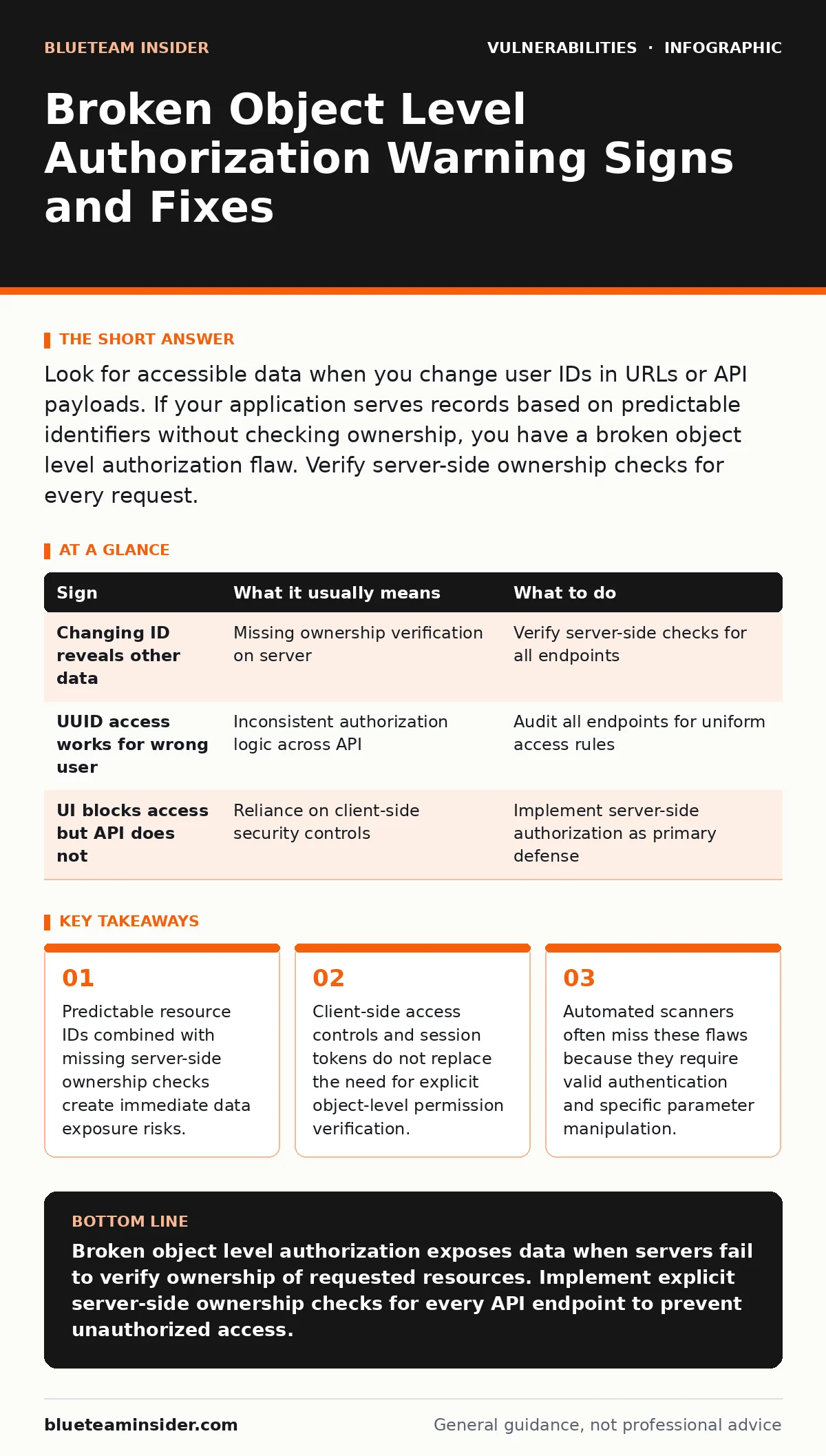
| Sign | What it usually means | What to do |
|---|---|---|
| Changing ID reveals other data | Missing ownership verification on server | Verify server-side checks for all endpoints |
| UUID access works for wrong user | Inconsistent authorization logic across API | Audit all endpoints for uniform access rules |
| UI blocks access but API does not | Reliance on client-side security controls | Implement server-side authorization as primary defense |
Mitigating the Risk Through Code Changes
Fixing BOLA requires explicit authorization checks in every function that accesses data. You must verify the user’s identity against the object’s ownership metadata. This check happens before the database query executes. If the user does not own the object, the server returns an access denied error. This prevents the data from ever being retrieved.
Do not rely on filtering results after they are fetched. Returning all records and filtering on the server side is inefficient and risky. The query should only fetch records owned by the authenticated user. This approach reduces database load and eliminates the possibility of accidental leakage. It also simplifies the security logic by making ownership a primary filter.
See also: User Access Provisioning: Definition, Purpose, and Security Risks · PHP Object Injection: How Serialized Data Compromises Web Apps
Integrating Security into Development Practices
Preventing BOLA requires integrating security checks early in the development lifecycle. Developers should treat authorization as a mandatory step in every API design. Code reviews must focus on access control logic. Automated testing should include scenarios where users attempt to access resources they do not own. These tests catch regressions when code changes introduce new vulnerabilities.
Consider how API vulnerabilities often stem from these same authorization gaps. A comprehensive security strategy addresses both the structure of the API and the permissions within it. Regular audits of access control logic help maintain security over time. As applications grow, new endpoints are added. Each new endpoint must inherit the same strict authorization requirements.
Long-Term Maintenance and Monitoring
Maintaining secure authorization requires continuous monitoring and updates. You must review access control logic whenever the data model changes. New fields or relationships can introduce new access paths. Developers must ensure these paths are protected by the same authorization checks. This ongoing maintenance prevents new BOLA flaws from emerging.
Security teams should monitor logs for unusual access patterns. Sudden spikes in access to specific resources might indicate exploitation. Automated alerts can help detect these anomalies early. This proactive approach allows you to respond before significant data exposure occurs. Regular security training for developers also reinforces the importance of proper authorization.
Key takeaways
- Predictable resource IDs combined with missing server-side ownership checks create immediate data exposure risks.
- Client-side access controls and session tokens do not replace the need for explicit object-level permission verification.
- Automated scanners often miss these flaws because they require valid authentication and specific parameter manipulation.
Broken object level authorization exposes data when servers fail to verify ownership of requested resources. Implement explicit server-side ownership checks for every API endpoint to prevent unauthorized access.
Frequently asked questions
How does BOLA differ from broken function level authorization?
BOLA allows access to specific data objects like user profiles or orders. Broken function level authorization allows access to entire functions or administrative features. Both fail to verify permissions but at different scopes.
Can random IDs prevent BOLA?
Random IDs like UUIDs make guessing harder but do not prevent BOLA. Attackers can still discover valid IDs through other means. Server-side ownership checks are required regardless of ID format.
Do role-based access controls fix BOLA?
Role-based access controls define what roles can do but not which specific objects. BOLA requires checking if a user owns a specific object. Role checks must be combined with object-level ownership verification.
How do I test for BOLA in my application?
Use authenticated accounts to modify resource identifiers in API requests. Check if the server returns data belonging to other users. Automated tools can help but manual testing is often necessary for complex logic.
How this guide was produced: written by the BlueTeam Insider editorial team with AI assistance, checked against the public references listed below, and reviewed when the facts change. See our editorial policy or report an error.