API Security Myths: Why Common Beliefs Fail to Protect Data
Standard web defenses do not automatically secure APIs, and rate limiting often fails to stop sophisticated data extraction attacks that mimic human behavior.

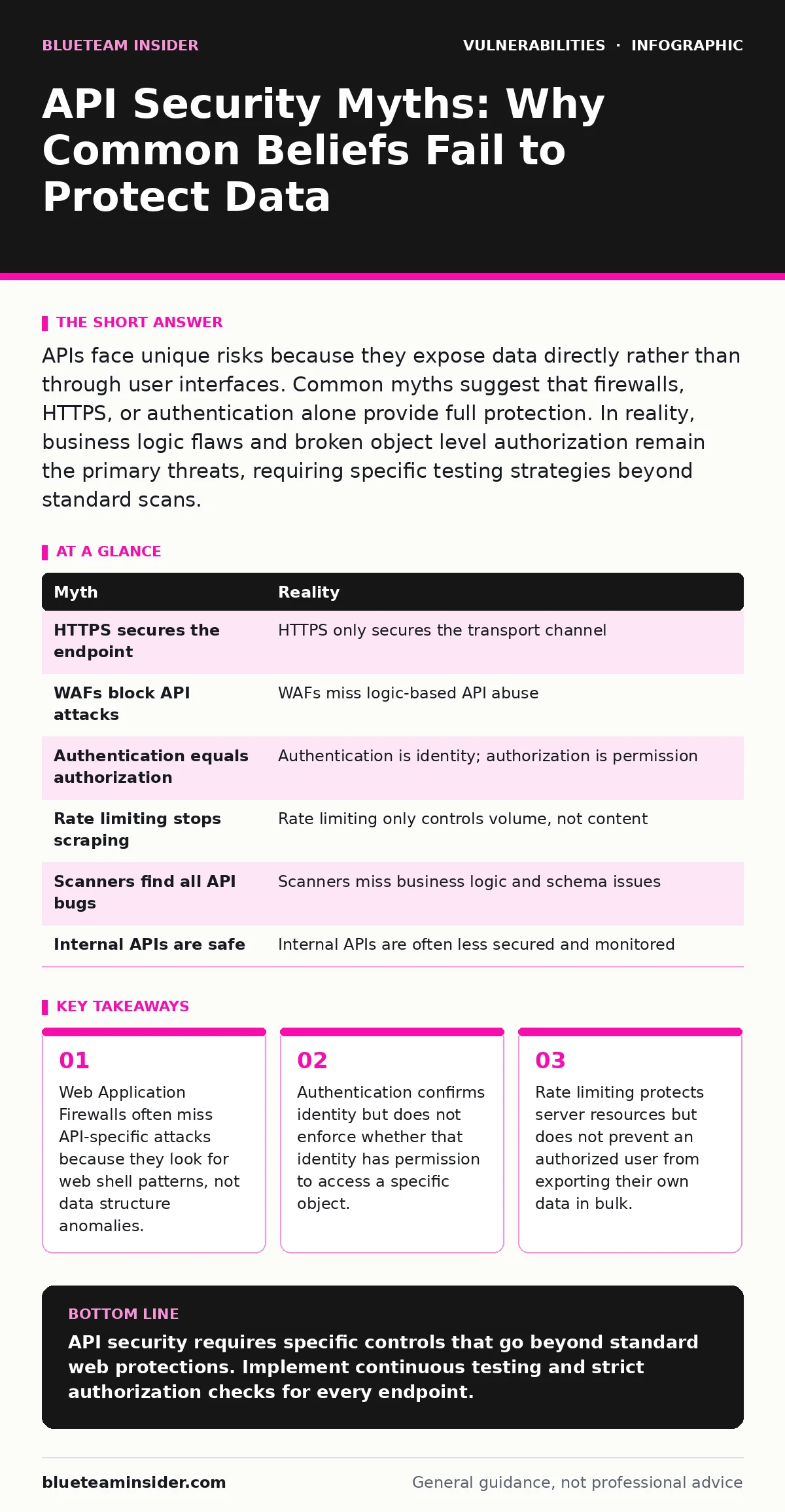
APIs face unique risks because they expose data directly rather than through user interfaces. Common myths suggest that firewalls, HTTPS, or authentication alone provide full protection. In reality, business logic flaws and broken object level authorization remain the primary threats, requiring specific testing strategies beyond standard scans.
Myth: HTTPS Encrypts All API Traffic
Reality: Transport Layer Security encrypts data while it moves between the client and the server, but it does nothing to protect the data once it arrives. Many teams assume that because the connection is secure, the endpoint is safe. This is a category error.
Imagine a bank sending a signed letter in a sealed envelope. The seal prevents tampering during transit, but it does not verify if the recipient is allowed to open the account inside. An attacker who intercepts the traffic sees only noise, but an attacker who sends a request to the API sees the plaintext response.
Encryption hides the content, not the intent. It prevents eavesdropping, but it does not stop an attacker from crafting malicious requests. You must validate every request regardless of whether the channel is encrypted.
Myth: Web Application Firewalls Block API Attacks
Reality: Web Application Firewalls are designed to filter traffic based on known attack signatures, such as SQL injection or cross-site scripting. These tools struggle with APIs because API attacks often use valid HTTP methods and standard JSON payloads.
A WAF looks for malicious strings in parameters. API abuse often involves using correct syntax to request data you should not see. For example, changing an ID number in a URL to access another user’s profile uses perfectly valid HTTP methods. The firewall sees a clean GET request and lets it pass.
This gap exists because WAFs operate at the network or transport layer, while API vulnerabilities often reside in the application logic. You need application-level security controls that understand the schema and the state of your data.
Myth: Authentication Is Enough for Authorization
Reality: Authentication proves who you are. Authorization determines what you can do. Confusing these two concepts is one of the most common causes of data breaches.
Suppose a user logs in with valid credentials. The system confirms their identity. It does not automatically mean they have the right to view administrative settings or other users' records. Broken Object Level Authorization occurs when the application trusts the client to specify which resource to access without verifying ownership.
An attacker who has one valid account can often access thousands of other records by iterating through IDs. This is not a failure of password strength. It is a failure of permission checks. Every endpoint must verify that the authenticated user has the right to perform the specific action on the specific object.
Myth: Rate Limiting Stops Data Scraping
Reality: Rate limiting controls how many requests a client can make in a given time. It protects server availability, not data confidentiality.
Imagine a thief who enters a library with a valid pass. They can only check out one book per minute. This limit prevents them from emptying the shelves in an hour, but it does not stop them from reading every book over a week. API scrapers often use slow, steady requests that fall below the threshold.
They mimic human behavior to avoid detection. Since the requests are authorized and within limits, the system considers them legitimate. Rate limiting is a DoS control, not an access control. To prevent scraping, you need anomaly detection that looks for patterns in the data being accessed, not just the volume of requests.
Myth: Standard Vulnerability Scanners Find API Bugs
Reality: Traditional vulnerability scanners are built for web applications with HTML forms and DOM structures. They often fail to parse JSON, XML, or GraphQL payloads correctly.
A scanner might see an API endpoint as a static file rather than a dynamic service. It sends generic payloads to test for common flaws. It rarely tests for business logic errors, such as state transition violations or parameter manipulation.
If your API uses complex authentication flows or requires specific headers, the scanner may not even reach the protected endpoints. You need specialized API security testing that understands your schema and can simulate real user workflows. See our guide on vulnerability scanning for more on tool limitations.
Myth: Open APIs Are Inherently More Secure
Reality: Public APIs often undergo more scrutiny, leading to better documentation and security practices. However, this perception creates a false sense of security for internal APIs.
Internal APIs are often treated as trusted zones. They may lack the same rigorous authentication and logging as public-facing services. Attackers who breach the perimeter often pivot to internal APIs to move laterally.
Because these APIs are not exposed to the internet, they may not be included in external security assessments. This leaves them unpatched and unmonitored. Treat internal APIs with the same rigor as external ones. Assume the network perimeter is already breached.
Myth: API Security Is a One-Time Configuration
Reality: APIs evolve rapidly. New endpoints are added, parameters change, and logic is updated. A security configuration that works today may fail tomorrow.
Developers often bypass security controls to meet deadlines. This leads to shadow APIs that are undocumented and unsecured. Without continuous monitoring, these endpoints become blind spots.
Security must be integrated into the development lifecycle. Automated checks should run with every code commit. Regular reviews ensure that changes do not introduce new vulnerabilities. This is similar to managing unpatched software, where delay creates risk.
| Myth | Reality |
|---|---|
| HTTPS secures the endpoint | HTTPS only secures the transport channel |
| WAFs block API attacks | WAFs miss logic-based API abuse |
| Authentication equals authorization | Authentication is identity; authorization is permission |
| Rate limiting stops scraping | Rate limiting only controls volume, not content |
| Scanners find all API bugs | Scanners miss business logic and schema issues |
| Internal APIs are safe | Internal APIs are often less secured and monitored |
Key takeaways
- Web Application Firewalls often miss API-specific attacks because they look for web shell patterns, not data structure anomalies.
- Authentication confirms identity but does not enforce whether that identity has permission to access a specific object.
- Rate limiting protects server resources but does not prevent an authorized user from exporting their own data in bulk.
API security requires specific controls that go beyond standard web protections. Implement continuous testing and strict authorization checks for every endpoint.
Frequently asked questions
Do I need a separate WAF for my APIs?
You do not necessarily need a separate appliance, but you need WAF rules tuned specifically for API traffic patterns and JSON payloads.
How do I prevent Broken Object Level Authorization?
Implement server-side checks that verify the user owns the object or has explicit permission before returning any data.
Is GraphQL more secure than REST?
Neither is inherently more secure. GraphQL introduces new risks like query depth and introspection, which require specific mitigation strategies.
Should I rate limit based on IP or user?
Rate limiting by user is more accurate, as it accounts for shared IPs and prevents legitimate users from being blocked by others.
How this guide was produced: written by the BlueTeam Insider editorial team with AI assistance, checked against the public references listed below, and reviewed when the facts change. See our editorial policy or report an error.