Next Gen Antivirus: How Behavior Detection Stops Modern Threats
Next gen antivirus stops zero-day attacks by watching how programs behave, not just by matching known virus signatures.

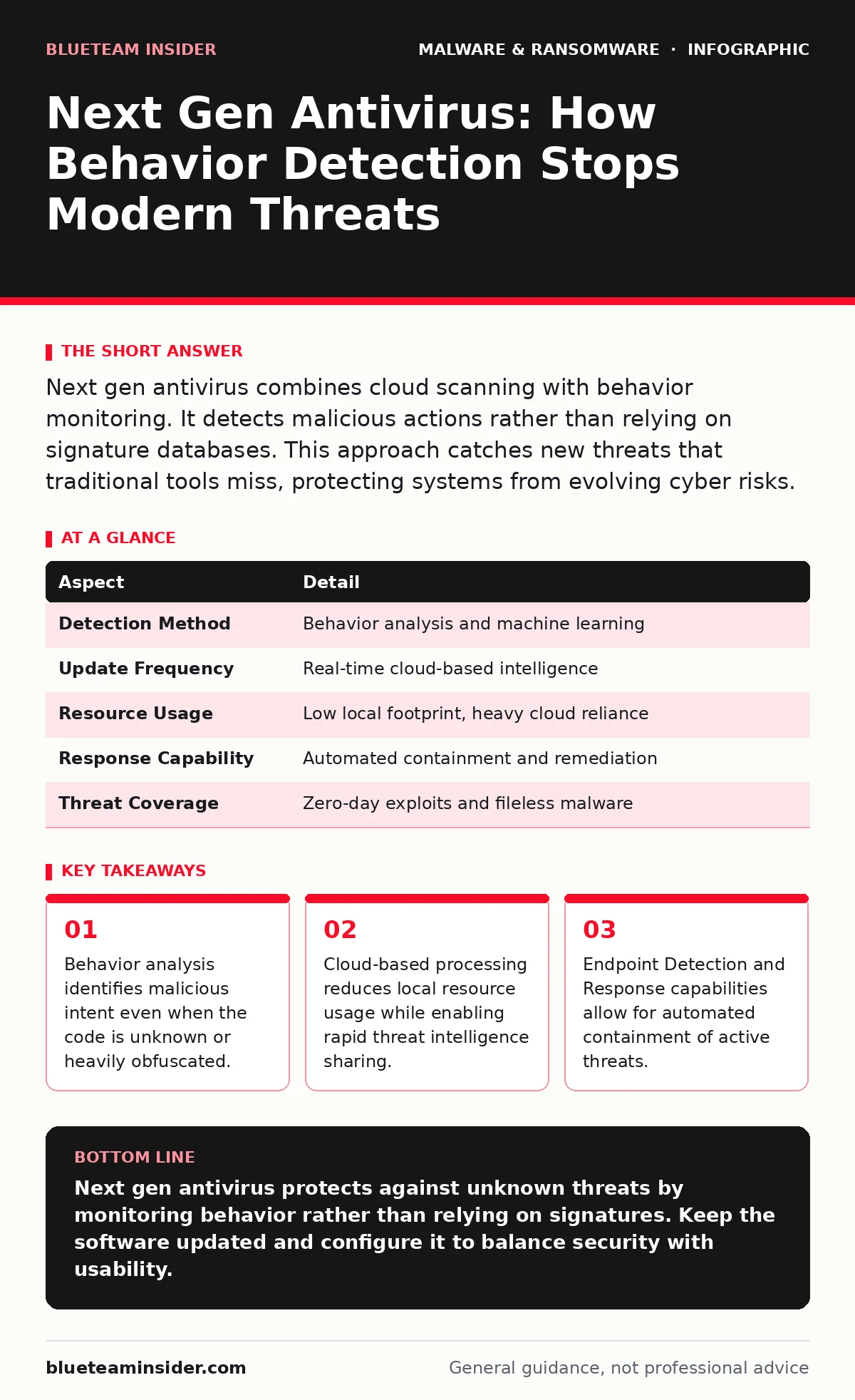
Next gen antivirus combines cloud scanning with behavior monitoring. It detects malicious actions rather than relying on signature databases. This approach catches new threats that traditional tools miss, protecting systems from evolving cyber risks.
Everyday Analogy: The Bouncer vs The Watchdog
Imagine a nightclub with a strict dress code. A traditional security guard checks every guest against a list of banned individuals. If someone is not on the list, they enter. This method fails when a banned person changes their appearance or when a new threat emerges. Next gen antivirus operates like a bouncer who watches behavior. If a guest starts fighting, stealing, or causing chaos, the bouncer ejects them regardless of their name or attire. This shift from identity verification to action monitoring defines the modern approach to endpoint security.
What Is Next Gen Antivirus
Next gen antivirus is a security solution that uses multiple detection methods to identify and block threats. It moves beyond simple signature matching to include machine learning, heuristic analysis, and sandboxing. These tools examine the behavior of files and processes in real time. The system looks for indicators of compromise that suggest malicious intent, such as unauthorized registry changes or unusual network connections. This multi-layered approach addresses the limitations of legacy security products that struggle with novel attacks.
| Aspect | Detail |
|---|---|
| Detection Method | Behavior analysis and machine learning |
| Update Frequency | Real-time cloud-based intelligence |
| Resource Usage | Low local footprint, heavy cloud reliance |
| Response Capability | Automated containment and remediation |
| Threat Coverage | Zero-day exploits and fileless malware |
How Next Gen Antivirus Works
The core mechanism of next gen antivirus involves continuous monitoring of system activities. When a program executes, the security engine observes its actions. It compares these actions against a baseline of normal behavior for that specific application type. If a text editor tries to connect to a remote server or modify system files, the engine flags this as anomalous.
The system then consults a cloud database for recent threat indicators. This allows the tool to detect fileless malware, which operates in memory without writing files to the disk. The integration of Endpoint Detection and Response ensures that the system can isolate the affected device automatically.
Who It Affects
This technology impacts organizations and individuals who face sophisticated cyber threats. Traditional signatures fail against polymorphic malware, which changes its code structure with each infection to evade detection. Next gen antivirus protects users who download files from untrusted sources or open email attachments. It is particularly relevant for environments where ransomware attack chain tactics are common. Attackers often use living-off-the-land binaries, which are legitimate system tools abused for malicious purposes. Behavior monitoring detects these abuses because the context of use is wrong, even if the tool itself is trusted.
The Hidden Costs of Advanced Protection
Implementing next gen antivirus introduces trade-offs that many users overlook. The reliance on cloud processing means that constant internet connectivity is required for optimal performance. If the connection drops, the local agent may revert to less effective signature-based protection. Additionally, the deep inspection of system processes can interfere with specialized software.
Engineering tools, virtualization platforms, and certain database applications may trigger alerts due to their complex interactions with the operating system. This requires careful tuning of the security policy to avoid disrupting legitimate workflows. The cost is not just financial but also operational, as security teams must manage exceptions and investigate alerts.
What People Usually Get Wrong
Users often believe that next gen antivirus eliminates the need for other security practices. This is a dangerous misconception. While behavior detection catches many threats, it cannot prevent initial access vectors like phishing emails. Users must still exercise caution when clicking links or downloading attachments. Another common error is assuming that cloud-based solutions protect all data.
If a device is offline, the cloud intelligence is unavailable. Furthermore, some users disable real-time scanning to improve system performance, leaving gaps in protection. This undermines the continuous monitoring that makes next gen antivirus effective. Understanding these limitations is key to maintaining a secure environment.
Integration with Broader Security Strategies
Next gen antivirus does not operate in isolation. It works best when integrated with other security layers. For instance, it complements email filtering by catching threats that bypass initial screens. It also supports incident response by providing detailed logs of malicious activity. When combined with user training, it reduces the impact of social engineering attacks. Organizations should also consider the risks of malware in pirated software, which often bypasses standard security checks. By ensuring all software is from legitimate sources, users reduce the attack surface. This holistic approach ensures that next gen antivirus is one part of a resilient defense strategy.
Managing False Positives and Exceptions
One of the biggest challenges with next gen antivirus is managing false positives. Because the system looks for suspicious behavior, legitimate software can sometimes trigger alerts. This happens when applications perform actions that resemble malware, such as injecting code into other processes for debugging. Security administrators must review these alerts carefully. Blocking legitimate software can cause operational disruptions. Creating allowlists for trusted applications is necessary, but it must be done cautiously. Overly broad allowlists can create security gaps. Regular review of exception lists ensures that only necessary applications are exempt from strict monitoring.
The Role of Machine Learning
Machine learning algorithms are central to next gen antivirus. These algorithms analyze vast amounts of data to identify patterns associated with malicious activity. They learn from new threats and update their models continuously. This allows the system to adapt to evolving attack techniques without manual updates. Machine learning helps distinguish between benign anomalies and genuine threats. For example, it can recognize that a sudden spike in network traffic from a specific application is likely an exfiltration attempt. This capability reduces the reliance on human analysts for initial detection. It also speeds up the response time, allowing for faster containment of threats.
Comparing With Legacy Solutions
Legacy antivirus solutions rely heavily on signature databases. These databases contain known patterns of malware. If a new variant of a virus appears, it must be added to the database before the antivirus can detect it. This creates a window of vulnerability. Next gen antivirus closes this window by detecting unknown threats based on behavior. It does not need to know the specific signature of a threat to block it. This makes it more effective against zero-day attacks. However, legacy solutions are often simpler to configure and manage. They may be sufficient for low-risk environments with minimal exposure to advanced threats.
Addressing Specific Threat Vectors
Next gen antivirus is particularly effective against computer worms that spread rapidly across networks. By detecting the replication behavior of these worms, the system can stop them before they infect multiple devices. It also helps mitigate the impact of banking trojans, which monitor user activity to steal credentials. These trojans often use legitimate tools to avoid detection, but their behavior remains suspicious. By focusing on intent rather than identity, next gen antivirus provides a stronger defense. It also aids in the detection of Linux malware, which is becoming more common as servers and cloud infrastructure grow.
Maintaining Effective Protection
To maintain effective protection, users must keep their systems updated. Outdated operating systems and applications contain vulnerabilities that attackers exploit. Next gen antivirus can detect exploitation attempts, but it cannot fix the underlying vulnerability. Regular patching is essential. Users should also enable automatic updates for the antivirus software itself. This ensures that the detection engines and threat intelligence are current. Additionally, users should review security settings periodically. Adjusting sensitivity levels can help reduce false positives without compromising security. Engaging with security updates and advisories helps users stay ahead of emerging threats.
The Future of Endpoint Security
The landscape of endpoint security continues to evolve. Next gen antivirus is shifting towards more autonomous response capabilities. Artificial intelligence will play a larger role in threat detection and remediation. Integration with identity management systems will allow for more precise access control. This means that security decisions will be based not just on device behavior but also on user context. As attacks become more sophisticated, the need for adaptive security solutions grows. Next gen antivirus provides the foundation for these advanced capabilities. It ensures that systems remain protected against both known and unknown threats.
Practical Steps for Users
Users can take several steps to enhance their protection. First, ensure that next gen antivirus is installed and running on all devices. Second, configure the software to use cloud-based intelligence for real-time updates. Third, review and adjust detection settings to minimize false positives. Fourth, educate users about the risks of downloading untrusted software. Fifth, integrate the antivirus with other security tools for a layered defense. These steps create a robust security environment. They help users stay protected against the latest cyber threats. Regular maintenance and awareness are key to long-term security.
Key takeaways
- Behavior analysis identifies malicious intent even when the code is unknown or heavily obfuscated.
- Cloud-based processing reduces local resource usage while enabling rapid threat intelligence sharing.
- Endpoint Detection and Response capabilities allow for automated containment of active threats.
Next gen antivirus protects against unknown threats by monitoring behavior rather than relying on signatures. Keep the software updated and configure it to balance security with usability.
Frequently asked questions
Does next gen antivirus replace the need for firewalls?
No, next gen antivirus focuses on endpoint behavior, while firewalls control network traffic. Both are necessary for a layered defense strategy.
Can next gen antivirus detect ransomware before encryption starts?
Yes, by monitoring for suspicious file access patterns and system modifications, it can detect and block ransomware before data is encrypted.
Is next gen antivirus suitable for small businesses?
Yes, it is suitable for businesses of all sizes. Cloud-based solutions make it accessible and manageable for small teams without dedicated security staff.
How does next gen antivirus handle offline threats?
Offline protection relies on local behavior analysis and cached threat intelligence. It may be less effective than cloud-connected modes but still provides significant protection.
How this guide was produced: written by the BlueTeam Insider editorial team with AI assistance, checked against the public references listed below, and reviewed when the facts change. See our editorial policy or report an error.