How iOS Zero-Click Exploits Work: The Silent Chain
Zero-click attacks bypass user interaction by chaining multiple memory corruption flaws to execute code within system processes before the user notices any activity.

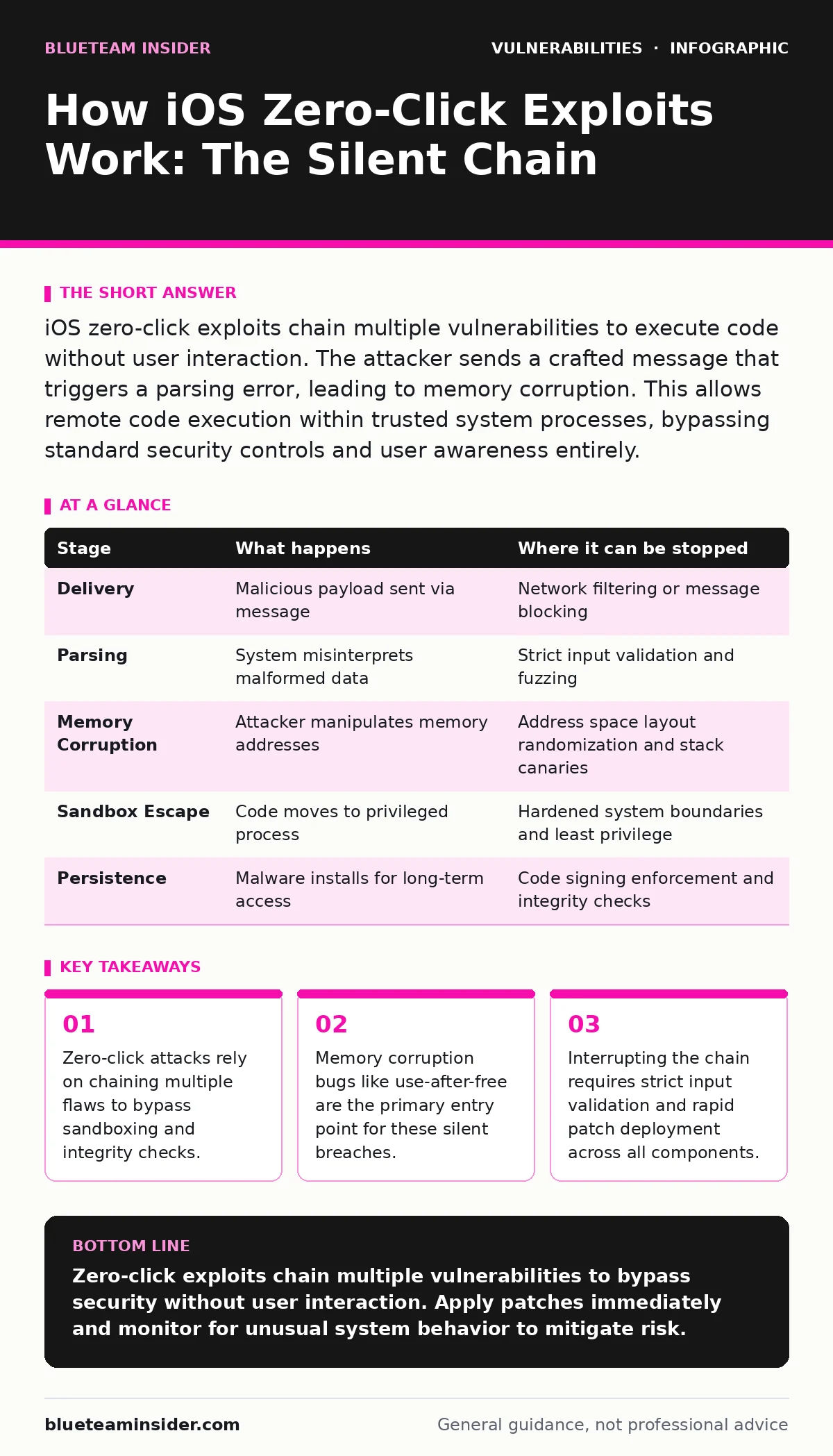
iOS zero-click exploits chain multiple vulnerabilities to execute code without user interaction. The attacker sends a crafted message that triggers a parsing error, leading to memory corruption. This allows remote code execution within trusted system processes, bypassing standard security controls and user awareness entirely.
The Anatomy of a Silent Breach
Zero-click vulnerabilities represent the highest level of sophistication in mobile malware. These attacks require no interaction from the target. The device executes the malicious payload automatically upon receiving a specially crafted data packet. This silence is what makes these threats particularly dangerous for high-value targets. The attacker gains access before the user realizes anything is wrong. Understanding the mechanics helps you appreciate why defense is so difficult. The attack is not a single bug but a chain of failures. Each link in the chain must hold for the exploit to succeed. Breaking any single link prevents the compromise.
Stage 1: The Delivery Vector
The attack begins with a seemingly innocuous message. This message travels through standard communication channels like iMessage, SMS, or even image metadata. The attacker crafts the payload to look like normal data to the receiving device. The goal is to trigger a specific parsing routine within the operating system. This routine processes the incoming data without asking for user confirmation.
The system assumes the data is safe because it arrives via a trusted channel. This trust is the first vulnerability the attacker exploits. The payload is hidden within the structure of the message itself. It does not require the user to open an attachment or click a link. The mere receipt of the message is enough to start the process.
Stage 2: Parsing and Validation Failure
Once received, the iOS operating system begins to parse the message. Parsing involves breaking down the data stream into understandable components. The system checks headers, lengths, and types against expected formats. A zero-click exploit relies on a flaw in this validation logic. The attacker sends data that violates the expected structure in a subtle way.
The parser fails to reject this malformed data. Instead, it continues processing, leading to unexpected behavior. This is often where the first vulnerability in the chain resides. The system might allocate memory incorrectly or misinterpret data types. This confusion creates an unstable state within the application. The instability is the foothold the attacker needs for the next stage.
Stage 3: Memory Corruption
The unstable state from the parsing error leads to memory corruption. This is the core of most zero-click exploits. The attacker manipulates memory addresses to point to malicious code. This often involves use-after-free vulnerabilities, where the system accesses memory that has already been released. The attacker controls what data sits in that freed memory.
When the system reads from that address, it executes the attacker's instructions. This step requires precise timing and knowledge of the system's memory layout. The attacker must predict where their code will land in memory. Any deviation in memory layout can cause the exploit to fail. This precision is why these attacks are so rare and valuable.
Stage 4: Escaping the Sandbox
iOS applications run in a sandbox, which restricts their access to other parts of the system. The initial code execution happens within the sandboxed application. To be truly dangerous, the attacker must escape this confinement. This requires a second vulnerability, often in a system service. The attacker exploits a flaw in a privileged process that interacts with the sandboxed app.
This second bug allows the malicious code to move into a higher-privilege context. The sandbox is designed to contain damage, but a logic error can create a backdoor. The attacker jumps from the restricted environment to a more powerful one. This escalation is critical for installing persistent malware. Without this step, the device can simply kill the app to stop the attack.
Stage 5: Privilege Escalation and Persistence
Now operating with higher privileges, the attacker seeks to maintain access. The goal is to install a persistent agent that survives reboots and updates. This requires exploiting another vulnerability, often in the kernel or a core system daemon. The attacker modifies system files or registers new services. This stage bypasses code signing checks that normally prevent unauthorized software from running.
The device believes the new code is part of the operating system. The attacker achieves root-level access, granting control over all hardware and software. This level of access allows for keylogging, microphone access, and data exfiltration. The user has no indication that their device has been compromised. The attack is now fully established and hidden.
| Stage | What happens | Where it can be stopped |
|---|---|---|
| Delivery | Malicious payload sent via message | Network filtering or message blocking |
| Parsing | System misinterprets malformed data | Strict input validation and fuzzing |
| Memory Corruption | Attacker manipulates memory addresses | Address space layout randomization and stack canaries |
| Sandbox Escape | Code moves to privileged process | Hardened system boundaries and least privilege |
| Persistence | Malware installs for long-term access | Code signing enforcement and integrity checks |
The Hidden Costs of Defense
Defending against zero-click attacks is resource-intensive. The primary cost is the speed of patch development. Vendors must analyze complex chains of vulnerabilities to create effective fixes. This process takes time, leaving devices vulnerable in the interim. Another hidden cost is the trade-off between security and performance. Strict memory safety features can slow down device operation.
Users may resist enabling features that impact battery life or speed. This resistance creates gaps in protection. Organizations must also invest in advanced threat detection systems. These systems monitor for unusual behavior rather than known signatures. Such monitoring requires significant computational resources and expertise. The cost of defense often exceeds the cost of the attack for the adversary.
Interrupting the Attack Chain
You can interrupt the attack chain at several points. The most effective method is rapid patching. When a vulnerability is disclosed, apply the fix immediately. Delaying updates leaves the device exposed to known exploits. Another method is to reduce the attack surface. Disable unnecessary services and features that could be used as entry points.
This limits the opportunities for an attacker to find a foothold. Implementing strict input validation on all data inputs is also critical. This prevents malformed data from reaching the parsing stage. While not foolproof, it raises the bar for attackers. Finally, use security frameworks that enforce memory safety. These frameworks can detect and prevent memory corruption before it leads to code execution.
The Role of Secure Design
Preventing zero-click vulnerabilities starts with secure design principles. Developers must assume that all input is malicious. This mindset drives the implementation of strict validation and sanitization. Code should be written to handle errors gracefully without crashing. Crashes can be exploited to gain information or control. Using languages with built-in memory safety reduces the risk of use-after-free bugs.
These languages prevent direct memory manipulation, eliminating a whole class of vulnerabilities. Secure design also involves threat modeling. This process identifies potential attack vectors and assesses their impact. By anticipating how an attacker might chain vulnerabilities, developers can build stronger defenses. Proactive design is more effective than reactive patching.
Monitoring for Silent Compromise
Detecting a zero-click attack after it occurs is difficult. The malware is designed to hide its activity. However, certain indicators can suggest a compromise. Unusual network traffic, such as connections to unknown servers, is a red flag. High battery consumption or unexpected device heating may indicate background processes. These signs are not definitive proof but warrant investigation.
Security tools that monitor system calls can detect anomalous behavior. Look for processes accessing sensitive data without authorization. Regular system audits can help identify unauthorized changes. While detection is challenging, continuous monitoring increases the chance of catching the attacker. Early detection limits the damage and allows for faster response.
The Future of Mobile Security
The arms race between attackers and defenders continues. As defenses improve, attackers develop more sophisticated techniques. Zero-click exploits are likely to become more prevalent. They offer the highest reward for the least risk to the attacker. Defenders must adapt by adopting new security models. Memory-safe languages and automated testing will become standard. The focus will shift from preventing every bug to limiting the damage when one is found. This approach accepts that vulnerabilities will exist but ensures they cannot be chained easily. Resilience becomes more important than perfection. The goal is to make exploitation so difficult that attackers move on to easier targets.
Integrating Security Practices
To protect against these advanced threats, integrate security into your daily practices. Regularly update your devices to the latest software versions. This ensures you have the latest patches for known vulnerabilities. Use security tools that monitor for unusual activity. These tools can provide early warnings of a potential breach. Educate yourself on the signs of compromise.
Knowing what to look for helps you respond quickly. Consider the principles of threat modeling when evaluating new technologies. Understanding the potential risks allows you to implement appropriate controls. Security is an ongoing process, not a one-time fix. Continuous vigilance and adaptation are necessary to stay ahead of evolving threats.
Key takeaways
- Zero-click attacks rely on chaining multiple flaws to bypass sandboxing and integrity checks.
- Memory corruption bugs like use-after-free are the primary entry point for these silent breaches.
- Interrupting the chain requires strict input validation and rapid patch deployment across all components.
Zero-click exploits chain multiple vulnerabilities to bypass security without user interaction. Apply patches immediately and monitor for unusual system behavior to mitigate risk.
Frequently asked questions
Can antivirus software detect zero-click exploits?
Traditional antivirus relies on known signatures, which zero-click exploits avoid. Advanced behavior-based detection may identify suspicious activity, but it is not guaranteed to catch every attempt.
Do jailbroken devices have better protection against zero-click attacks?
Jailbreaking removes security restrictions, making devices more vulnerable. It disables sandboxing and code signing, allowing easier exploitation and persistence for attackers.
How long does it take to patch a zero-click vulnerability?
Patching times vary depending on complexity. Vendors may take weeks or months to analyze and fix the underlying issues, leaving users exposed during this window.
Is turning off iMessage a complete solution?
Disabling iMessage reduces the attack surface but does not eliminate risk. Attackers can use other vectors like SMS or image metadata. A layered defense is more effective.
How this guide was produced: written by the BlueTeam Insider editorial team with AI assistance, checked against the public references listed below, and reviewed when the facts change. See our editorial policy or report an error.