Cloud Compliance FAQ: Answers to 8 Common Questions
Compliance frameworks measure your process maturity, not your actual security posture, creating a gap where you pass audits while remaining vulnerable to modern threats.
Cloud compliance requires mapping technical controls to regulatory requirements. It is not a one-time setup. You must maintain continuous evidence of control effectiveness. Misconfigurations remain the primary cause of failure, not a lack of policy.
What is the difference between cloud security and cloud compliance?
Security is the practice of protecting your data and systems from unauthorized access. Compliance is the verification that your security practices meet specific regulatory or industry standards. You can be secure without being compliant if you lack documentation. You can be compliant without being secure if your controls are poorly implemented but well-documented.
Security focuses on threat mitigation and risk reduction. Compliance focuses on adherence to a defined set of rules. A strong security posture often satisfies compliance requirements, but compliance checklists do not always cover emerging threats. You must treat compliance as a subset of your broader security strategy, not a replacement for it.
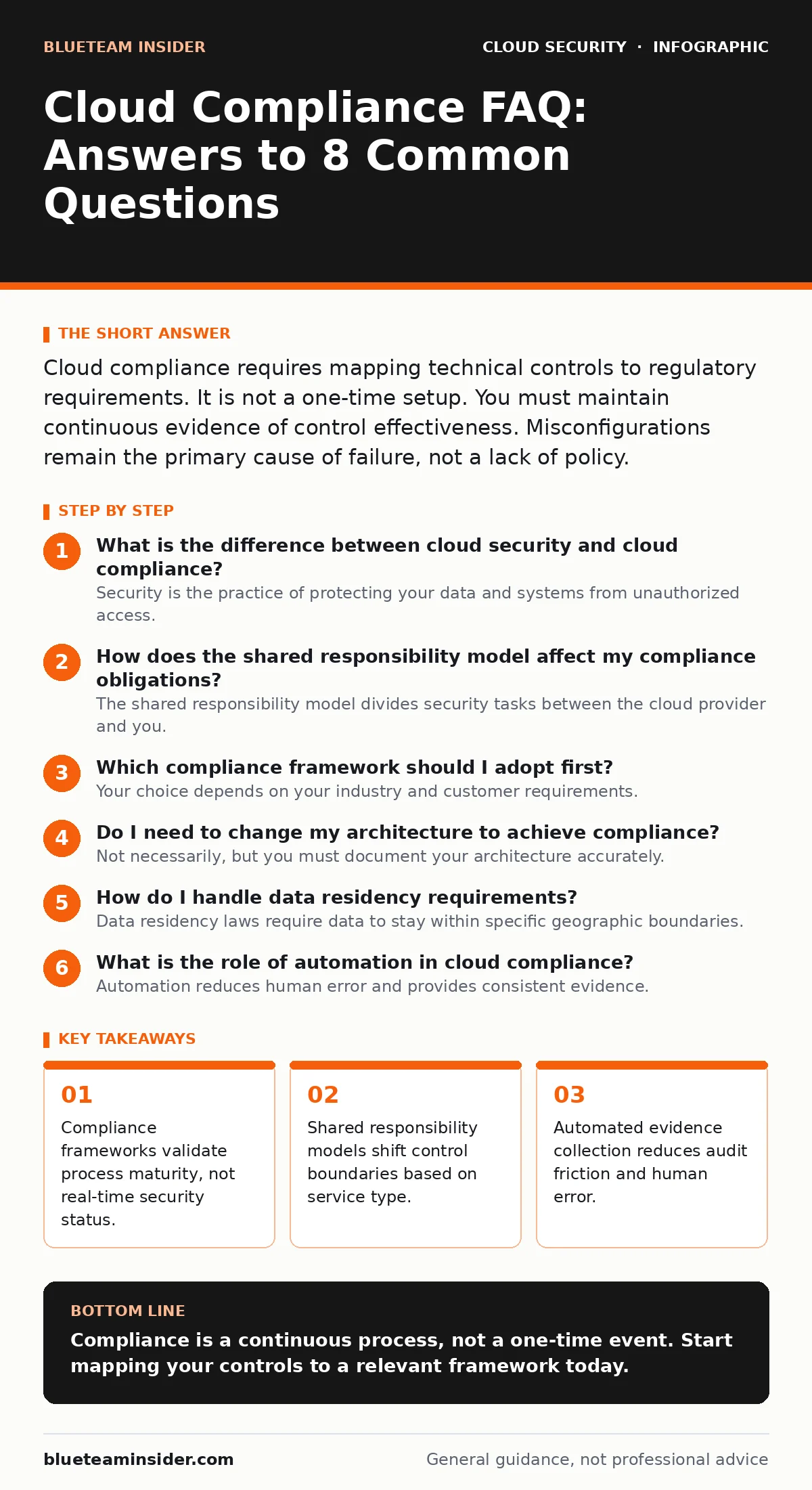
How does the shared responsibility model affect my compliance obligations?
The shared responsibility model divides security tasks between the cloud provider and you. The provider secures the infrastructure, including hardware, software, and networking. You secure what you put in the cloud, including data, identity management, and configuration settings. Your compliance obligations depend entirely on your role in this division.
If you use Infrastructure as a Service, you manage the operating system and applications. You are responsible for patching and access controls. If you use Platform as a Service or Software as a Service, the provider manages more layers. Your responsibility shifts to data classification and user identity. Misunderstanding this boundary leads to gaps in your audit evidence. Refer to our guide on cloud landing zones to define these boundaries clearly in your architecture.
Which compliance framework should I adopt first?
Your choice depends on your industry and customer requirements. Healthcare organizations typically prioritize HIPAA for patient data protection. Financial institutions often require PCI DSS for payment card processing. General data privacy concerns may drive adoption of GDPR or CCPA. There is no single best framework for every organization.
Start with the framework mandated by your primary customers or regulators. Map your existing controls to that framework’s requirements. Identify gaps where your current practices do not meet the standard. Addressing one framework often creates controls that satisfy others. This approach reduces redundant effort and focuses your resources on high-impact areas.
Do I need to change my architecture to achieve compliance?
Not necessarily, but you must document your architecture accurately. Compliance auditors need to see how data flows through your environment. They verify that sensitive data is encrypted at rest and in transit. They check that access controls limit user permissions to the minimum required.
If your architecture lacks encryption or proper logging, you must change it. If it already has these controls, you only need to prove they work. Poor documentation is a common failure point. Ensure your network diagrams and data flow maps are current. Auditors rely on these artifacts to verify your control design.
How do I handle data residency requirements?
Data residency laws require data to stay within specific geographic boundaries. You must configure your cloud services to store data in regions that meet these laws. This often means disabling cross-region replication for sensitive datasets. You must also verify where backups and logs are stored.
Some services automatically replicate data for redundancy. You must explicitly disable this feature for regulated data. Failure to do so can violate residency laws even if your primary storage is compliant. Review your storage class settings and backup policies. Ensure they align with legal jurisdiction requirements.
What is the role of automation in cloud compliance?
Automation reduces human error and provides consistent evidence. Manual checks are prone to oversight and fatigue. Automated tools can continuously monitor your environment for misconfigurations. They generate reports that auditors accept as proof of control effectiveness.
You can use policy-as-code tools to enforce standards. These tools prevent non-compliant resources from being deployed. They also remediate drift when configurations change unexpectedly. This continuous monitoring is far more effective than periodic manual audits. See our guide on cloud audit logs for details on configuring these monitoring tools.
How do I manage third-party vendor compliance?
You are responsible for your vendors’ access to your environment. You must verify that they follow your security standards. This includes reviewing their security certifications and audit reports. You must also limit their access to only what they need.
Use identity federation to manage vendor access. This allows you to enforce multi-factor authentication and conditional access policies. Do not create long-term shared accounts for vendors. This practice creates audit trails that are difficult to trace. Refer to MFA for cloud accounts for best practices on securing external access.
What are the hidden costs of cloud compliance?
Compliance requires ongoing maintenance, not just initial setup. You must continuously monitor for configuration drift. You must update documentation as your environment changes. You must train staff on new requirements and processes.
The cost of failed audits can exceed the cost of compliance. Fines and reputational damage are significant risks. Additionally, manual compliance efforts consume engineering time. This time could be spent on innovation or security improvements. Automation reduces this hidden cost by streamlining evidence collection.
| Control Area | Manual Effort | Automated Effort | Primary Risk |
|---|---|---|---|
| Access Reviews | High | Low | Stale permissions |
| Encryption Checks | Medium | Low | Data exposure |
| Logging Configuration | High | Medium | Audit gaps |
| Patch Management | High | Low | Vulnerability exploitation |
How do I prepare for a cloud compliance audit?
Preparation begins long before the audit date. Maintain continuous evidence of control effectiveness. Keep your documentation updated and accessible. Ensure your team understands the audit process.
Auditors will request samples of configurations and logs. They will verify that your controls are working as documented. They may also interview staff to test knowledge. Be ready to explain your security decisions. Refer to cloud security assessments for a deeper dive into pre-audit readiness checks.
What happens if I fail a cloud compliance audit?
Failure results in a list of non-conformities. You must create a remediation plan to address each issue. This plan includes timelines and responsible parties. You must implement changes and provide evidence of remediation.
Repeated failures can lead to loss of certification. This can impact your ability to do business. It can also result in legal penalties. Treat non-conformities as critical security issues. Address them with the same urgency as a security incident. See cloud incident response for guidance on managing high-priority remediation efforts.
Key takeaways
- Compliance frameworks validate process maturity, not real-time security status.
- Shared responsibility models shift control boundaries based on service type.
- Automated evidence collection reduces audit friction and human error.
Compliance is a continuous process, not a one-time event. Start mapping your controls to a relevant framework today.
Frequently asked questions
Can I use the same compliance controls for multiple clouds?
Yes, many controls are technology-agnostic. Focus on standard practices like encryption and access management.
How often should I review my compliance status?
Continuous monitoring is best. At minimum, review quarterly to catch configuration drift.
Does compliance protect me from ransomware?
No, compliance validates process maturity. You need specific security controls to prevent ransomware. See **cloud ransomware** for defense strategies.
Who is responsible for compliance in a hybrid environment?
You are responsible for the entire data lifecycle. Ensure consistent controls across on-premises and cloud environments.
How this guide was produced: written by the BlueTeam Insider editorial team with AI assistance, checked against the public references listed below, and reviewed when the facts change. See our editorial policy or report an error.